
D-Day Beaches Normandy Travel Guide & Memorial Visit Tips
Standing on the windswept sands of Omaha Beach, it’s difficult to imagine the chaos and heroism that unfolded here in June 1944. The peaceful waves now lap gently against the shore where thousands of Allied forces once stormed ashore during Operation Overlord, the largest amphibious invasion in history. Today, these hallowed D-Day landing beaches in Normandy, France, serve as both memorials to those who sacrificed everything for freedom and accessible destinations for travelers seeking to understand one of World War II’s most pivotal moments.
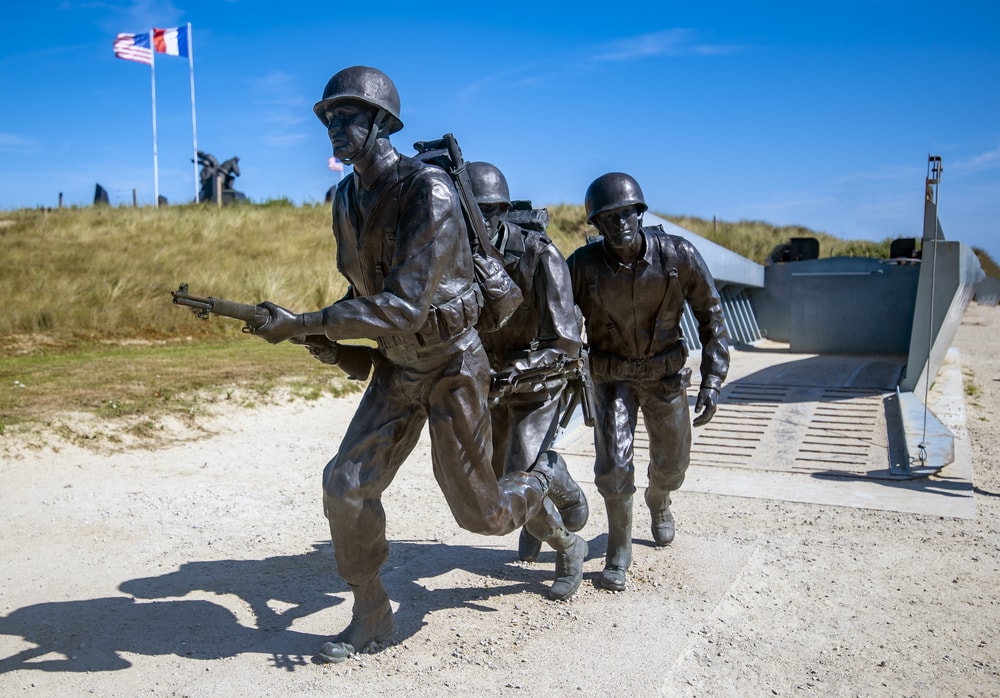
The Normandy beaches stretch along 80 kilometres of coastline, from Utah Beach in the west to Sword Beach in the east. Each of these D-Day beaches offers a unique perspective on the events of June 6, 1944, when over 156,000 Allied troops landed on French soil in countless landing craft, marking the beginning of the end for Nazi forces in the ongoing conflict between France and Germany.
Gen. Dwight D. Eisenhower (Supreme Allied Commander): “The eyes of the world are upon you. The hopes and prayers of liberty-loving people everywhere march with you.” (From his Order of the Day, June 5, 1944.)
- D-Day Beaches Normandy Travel Guide & Memorial Visit Tips
- Planning Your Visit to Normandy
- Map of D-Day Beaches
- The Five D-Day Landing Beaches
- Sword & Gold Beaches (British Sectors)
- Juno Beach: The Canadian Contribution
- Canadian Memorial Sites:
- Beyond the Beaches: Essential Normandy WWII Sites
- War Cemeteries: Honouring All Who Fell
- 2025/26 Updates: New Memorials & Events
- Practical Travel Tips
- Guided Tours vs. Independent Travel
- Making Your Visit Meaningful
- The Lasting Impact
Planning Your Visit to Normandy
Getting to Normandy from Paris
The most convenient way to reach Normandy from Paris is by train. Direct services run from Paris Saint-Lazare to Bayeux (2 hours) and Caen (2 hours), both excellent base towns for exploring the D-Day sites. Car rental is recommended for maximum flexibility when visiting multiple beaches and memorials.

Transportation Options:
Train: Direct services from Paris Saint-Lazare to Bayeux or Caen (many visitors also arrive via New York to Paris flights before continuing by rail)
Car: 2.5-3 hours drive from Paris Charles de Gaulle Airport
Ferry: Portsmouth to Caen (6 hours) or Portsmouth to Le Havre (5.5 hours)
Guided Tours: Full-day D-Day battle site tours available from Paris
Normandy D-Day Beaches and American Cemetery Day Trip from Paris click for more
Normandy American D-Day Beaches Full Day Tour from Bayeux click for more
Best Time to Visit
While the D-Day landing beaches can be visited year-round, the most meaningful time is around the June 6th anniversary. However, this is also the busiest period. For a more contemplative experience with fewer crowds, consider visiting in late spring (April-May) or early autumn (September-October).
2025 Commemorations: The 81st anniversary of the D-Day battle will feature ceremonies at American, British, and Canadian cemeteries, with events that were planned throughout early June 1944’s anniversary period. In 2026 more events will be planned for the 82nd anniversary.
Map of D-Day Beaches

The Five D-Day Landing Beaches
Utah Beach: The Westernmost Landing
Utah Beach, stretching from Sainte-Marie-du-Mont to Quinéville, was added to the original invasion plan by General Eisenhower to ensure the capture of Cherbourg port. Despite initial navigation difficulties caused by strong currents that scattered landing craft, the 4th U.S. Infantry Division achieved their objectives with relatively light casualties—fewer than 300 out of 23,000 troops landed. The successful Utah and Omaha operations demonstrated the effectiveness of Allied coordination between ground forces and air force support.
Brig. Gen. Theodore Roosevelt Jr. (4th Infantry Division): “We’ll start the war from right here.” (His famous words after realizing the landing had drifted off-course—he led troops inland despite heavy fire.)
Pvt. Robert Sales (82nd Airborne, dropped near Utah): “The fields were flooded, and Germans were waiting. But Utah was luckier than Omaha. By dawn, we knew we had a chance.”

What to See:
Utah Beach Museum (Musée du Débarquement): Located in an original German bunker, this museum tells the story of the American landings with authentic artifacts and immersive displays.
Kilometre 0 Marker: The symbolic starting point of the Liberty Road

German Fortifications: Remnants of the Atlantic Wall defences
Visiting Information:
Address: Utah Beach Museum – Plage de la Madeleine, 50480 Sainte-Marie-du-Mont
Hours: Daily 9:30 AM – 7 PM (summer), 10 AM – 5 PM (winter)
Admission: Adults €8, Students €6, Children under 10 free
Sainte-Mère-Église: The Paratroopers’ Town
Just inland from Utah Beach lies Sainte-Mère-Église, where American paratroopers from the 82nd and 101st Airborne Divisions landed in the early hours of June 1944. The town’s church steeple still displays a replica parachute commemorating Private John Steele, whose parachute caught on the steeple during the invasion. The Allied forces’ successful airborne operations here were crucial to the overall D-Day battle strategy.

Key Attractions:
Airborne Museum: Three buildings dedicated to the American paratroopers, featuring a life-sized D-Day glider and immersive exhibits
Church of Sainte-Mère-Église: Stained glass windows honour the paratroopers
Historic Town Center: Well-preserved Norman architecture with wartime significance
Omaha Beach – “Bloody Omaha”
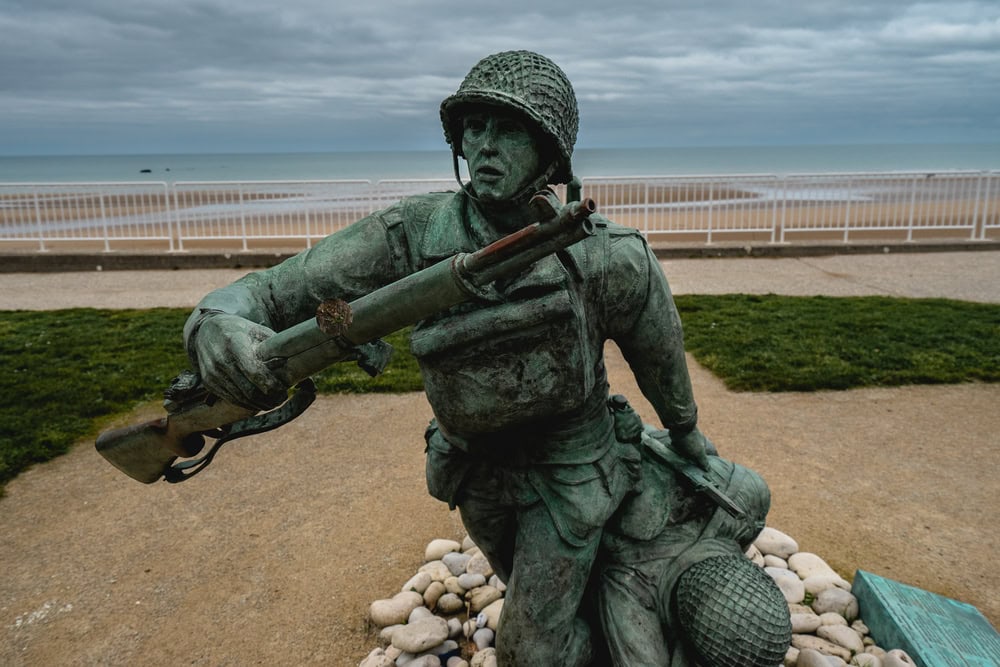
Of all the D-Day beaches, Omaha remains the most emotionally challenging to visit. The 1st and 29th U.S. Infantry Divisions faced the fiercest German resistance here, with landing craft struggling against rough seas and enemy fire. The D-Day battle at Omaha resulted in approximately 2,400 American casualties on June 6, 1944 alone. The beach’s natural geography—high bluffs, limited exits, and strong defensive positions—made it a formidable obstacle that tested the resolve of Allied forces.
Sgt. John Ellery (1st Infantry Division): “The first wave on Omaha Beach was chaos. The sea was red with blood. I saw men cut down before they even reached the sand. We just kept moving forward because there was no going back.”
Pvt. David Silva (29th Infantry Division): “The bluffs looked impossible. Machine guns pinned us down. But somehow, a few brave men started climbing—and the rest of us followed. That’s how Omaha was won.”
Memorial Sites:
Normandy American Cemetery: Overlooking Omaha Beach, this cemetery contains 9,388 grave markers and honours 1,557 missing soldiers on the Walls of the Missing.

Overlord Museum: Extensive collection of D-Day artifacts, vehicles, and equipment. Tickets adult from 16 up 9.50€
Omaha Beach Memorial Museum: Chronicles the German occupation through the American liberation. Tickets – Adults 7.80 €

Visiting the American Cemetery:
Address: 14710 Colleville-sur-Mer
Hours: Daily 9 AM – 5 PM (April-September), 9 AM – 5 PM (October-March)
Admission: Free
Guided tours available in multiple languages
Standing among the perfectly aligned white crosses and Stars of David, visitors often describe an overwhelming sense of gratitude and solemnity. The visitor center provides excellent context through films, interactive displays, and personal stories of the fallen.
Sword & Gold Beaches (British Sectors)
Gold Beach was assigned to the British 50th Infantry Division, who successfully linked up with Canadian forces from Juno Beach by day’s end. The sector included the strategic port town of Arromanches-les-Bains, where the Allies constructed one of two artificial Mulberry harbours. The coordinated air force and naval bombardment preceding the landings helped Allied forces secure this vital section of the Normandy beaches.
Maj. Nigel Taylor (British 3rd Infantry Division, Sword Beach): “The French commandos with us were fearless. They stormed those defences like it was personal—and for them, it was.”
Sapper Bill Millin (Piper for Lord Lovat, Sword Beach):”I played ‘Highland Laddie’ as we waded ashore. The Germans must’ve thought we were mad—but it kept our lads moving.”

Must-Visit Sites:
Arromanches 360° Cinema: Immersive film experience using archival footage projected on nine screens
D-Day Landing Museum (The Musée du Débarquement (Landing Museum): Detailed exhibits about the artificial harbor construction. Tickets for the museum and Cinema are €6..
Mulberry Harbor Remains: Concrete caissons still visible at low tide
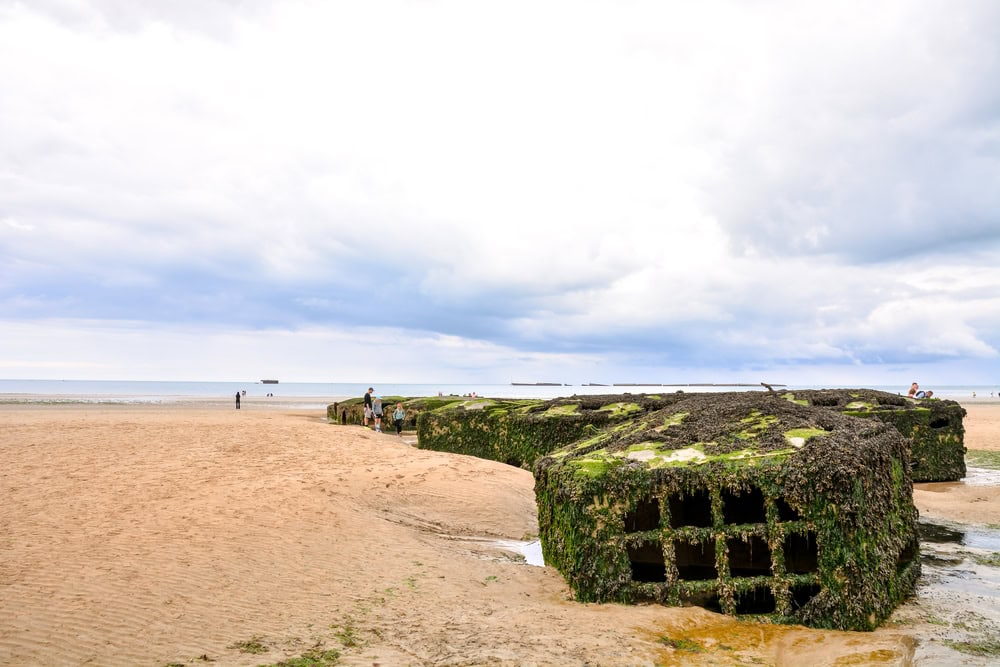
The remains of the Mulberry harbor provide a tangible connection to the massive logistical undertaking required to sustain the invasion. These prefabricated concrete structures, towed across the English Channel by specialized vessels, enabled the Allied forces to land 500,000 men, 77,000 vehicles, and 230,000 tons of supplies in the first 100 days after the June 1944 landings. The engineering feat rivalled the construction projects undertaken by major companies like Ford during wartime production.
Sword Beach: The Eastern Flank
The easternmost landing beach, Sword was assaulted by the British 3rd Infantry Division, along with French and British commandos who had crossed the channel in specialized landing craft. The beach’s proximity to Caen made it strategically crucial for securing the invasion’s eastern flank during the critical first days of the June 1944 campaign. Air force reconnaissance had identified this as a key position for preventing German reinforcements from reaching the other D-Day landing beaches.
Historic Sites:
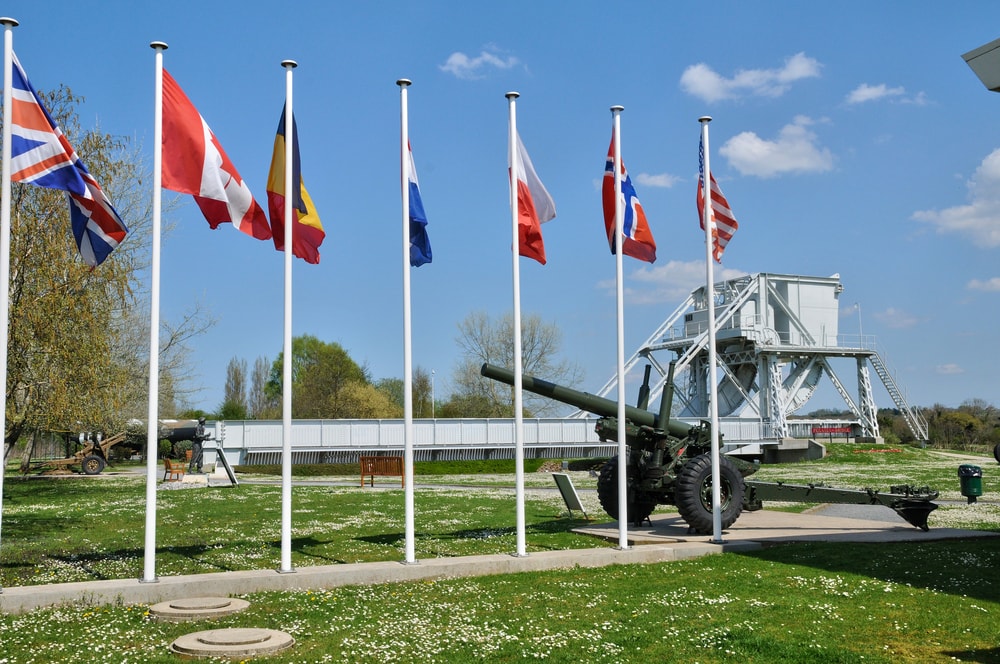
Pegasus Bridge Memorial: Commemorates the first Allied victory on D-Day, captured by British airborne gliders. Tickets Adults €9.50.
Merville Gun Battery: Fortress captured by British paratroopers in a daring pre-dawn assault

Pegasus Memorial Museum: Local museum detailing the British and French commando operations
Juno Beach: The Canadian Contribution
Juno Beach witnessed the landing of the 3rd Canadian Infantry Division and 2nd Canadian Armoured Brigade. Despite facing choppy seas that affected landing craft operations and strong German defences, Canadian forces pushed farther inland than any other Allied division during the D-Day battle, though at significant cost—1,074 Canadian casualties, including 359 killed. The success at Juno demonstrated the crucial contribution of Commonwealth forces to the liberation of France from Germany.
Cpl. Leo Gariepy (1st Canadian Parachute Battalion): “Juno was a slaughterhouse at first. But by noon, we’d pushed farther inland than anyone expected. That’s the Canadian spirit.”
Nurse Mary Owen (Field Hospital near Juno): “The wounded kept coming. All day, all night. We ran out of bandages but never out of tears.”
Canadian Memorial Sites:
Juno Beach Centre: The only Canadian museum on the D-Day beaches, telling the story of Canadian military and civilian contributions to the war effort

Bény-sur-Mer Canadian War Cemetery: Final resting place of 2,049 Commonwealth servicemen, maintained by local volunteers who still tend the graves with remarkable dedication

Visiting Information:
Juno Beach Centre: 9 AM – 7 PM (April-September), 10 AM – 5 PM (October-March). Tickets – Adults €7.50, Students €6, Children under 6 free, Museum is staffed with young Canadians who volunteer to work here for experience.
Beyond the Beaches: Essential Normandy WWII Sites
The Caen Memorial Museum
Known as the “Museum for Peace,” the Caen Memorial provides comprehensive context for the D-Day landing beaches within the broader scope of World War II. The museum’s extensive exhibits trace the path from 1918 to 1989, helping visitors understand the global implications of the June 1944 Normandy invasion and the subsequent liberation of France from Germany. Interactive displays show how the coordination between Allied forces, air force units, and naval operations made the D-Day battle possible.

Highlights:
Interactive D-Day exhibits with original artifacts – Adult ticket 20,80 €
Immersive film presentations

Beautiful peace gardens
General Richter’s command bunker
Pointe du Hoc
Between Utah and Omaha beaches, this cliff top position was assaulted by U.S. Army Rangers in one of the D-Day battle’s most daring operations. The preserved battlefield, complete with bomb craters and German fortifications, provides a visceral understanding of the Rangers’ heroic assault that was crucial to securing the western flank of the D-Day landing beaches. The successful scaling of these cliffs under enemy fire demonstrated the exceptional training and courage of Allied forces.

What Makes It Special:
Original German casemates and observation posts
Preserved battlefield landscape
Ranger monument overlooking the sea
War Cemeteries: Honouring All Who Fell
The Normandy region contains numerous military cemeteries honouring soldiers from all nations:
Allied Cemeteries:
Normandy American Cemetery: 9,388 American graves
Bayeux War Cemetery: 4,648 British Commonwealth graves

Bény-sur-Mer: 2,049 Canadian graves

German Cemetery:
La Cambe: 21,222 German graves, maintained as a reminder that war affects all nations.

Visiting these cemeteries provides perspective on the human cost of war. The German cemetery at La Cambe, with its dark stone markers and sombre atmosphere, serves as a poignant reminder that young men from all nations paid the ultimate price.
2025/26 Updates: New Memorials & Events
Plan your visit with these latest additions and commemorations:
New Memorials & Exhibits
Omaha Beach Education Center Expansion (2025): A new interactive wing at the Normandy American Cemetery Visitor Center, featuring augmented reality exhibits that bring personal stories of fallen soldiers to life.
Canadian Heroes of Juno Beach Statue (2024): A bronze monument honouring the 3rd Canadian Infantry Division, unveiled at Juno Beach Centre on June 6, 2024.

Updated Pegasus Bridge Museum: Renovated exhibits with newly declassified archival footage of the British airborne operations.
Traveller Tips for 2025/26
- Advance Booking Required: Due to high demand for the 81st anniversary, reserve guided tours and hotels early.
- New Shuttle Service: A free hop-on/hop-off bus now connects all five D-Day beaches (May–September).
- Digital Pass: Download the Normandy Remembers app for self-guided audio tours and event schedules.
For real-time updates, check Normandie Tourisme or follow #DDay82 on social media.
Practical Travel Tips
Bayeux (Best base for American sectors):
- Historic town with excellent restaurants
- 20 minutes to Omaha Beach
- Home to the famous Bayeux Tapestry
Caen (Best for British/Canadian sectors):
- Larger city with more amenities
- Good transport connections
- Close to Sword Beach and Pegasus Bridge
Dining in Normandy
Normandy’s culinary traditions complement a historical visit perfectly:
Calvados: Apple brandy, perfect for evening reflection
Camembert and Pont-l’Évêque: Local cheeses

Fresh seafood: Oysters, mussels, and fish from the same waters that carried the invasion fleet – best place is in Cancale, Brittany.

Norman cider: Traditional accompaniment to regional dishes
Guided Tours vs. Independent Travel
Guided Tours Advantages:
Expert historical commentary
Transportation included
Access to local insights
Efficient itinerary planning
Independent Travel Benefits:
- Personal pace for reflection
- Flexibility to revisit meaningful sites
- Opportunity for spontaneous discoveries
- More intimate experience
Making Your Visit Meaningful
Before You Go
Reading first-hand accounts enhances the experience significantly. Recommended books include:
D-Day: June 6, 1944 – by Stephen Ambrose
The Longest Day – by Cornelius Ryan
Band of Brothers – by Stephen Ambrose

During Your Visit
Allow full days for each major sector
Bring comfortable walking shoes for beach and cemetery visits
Consider the weather—Normandy can be windy and changeable
Respect the solemnity of memorial sites
Engage with local guides who often have family connections to the events

Photography and Remembrance
While photography is generally permitted at most sites, maintain respectful behaviour, especially in cemeteries. Many visitors leave flowers or small flags at graves, continuing a tradition of remembrance that connects past and present.

The Lasting Impact
Living in France for three years offers countless opportunities to connect with the countries layered past, but few experiences are as profound as spending three days exploring Bayeux and the D-Day beaches. Wandering the medieval streets of Bayeux—home to the famed tapestry and a gateway to Normandy’s wartime history—you’re reminded that this region has witnessed centuries of turning points.

Yet nothing compares to standing on Omaha Beach at dawn, tracing the bunkers at Pointe du Hoc, or walking among the silent rows of white crosses at the American Cemetery. The memorials that rise from the bluffs and beaches are not relics of a distant past, but living guardians of memory, ensuring that the courage of those who fought here remains as vivid as the tides.

To walk these paths is to step into a story larger than yourself: one of loss, resilience, and the fragile peace they bought. Whether you come to trace a grandfather’s footsteps, to grasp the scale of history, or simply to pay quiet tribute, Normandy’s beaches will etch themselves into your soul. Long after you leave, the weight of what happened here lingers—not as a shadow, but as a reminder of what was won, and what we must never take for granted.
Planning Resources
- Official Normandy Tourism Website: www.normandie-tourisme.fr
- D-Day Museum Websites: Individual museums maintain current hours and pricing
- Transportation: SNCF Connect for train bookings
- Accommodation: Book early for June visits, especially anniversary years
Sources and Further Reading:
Ambrose, Stephen E. “D-Day June 6, 1944: The Climactic Battle of World War II.” Simon & Schuster, 2013.
Keegan, John. “Six Armies in Normandy: From D-Day to the Liberation of Paris.” Penguin Books, 2004.
National World War II Museum, New Orleans. “D-Day: The Allied Invasion of Normandy.”
Commonwealth War Graves Commission. “Normandy Cemeteries and Memorials.”
American Battle Monuments Commission. “Normandy American Cemetery and Memorial.”