
Schengen Area rules explained ETIAS, visas, EU and UK travel
This guide explains the Schengen Area, how it differs from the European Union and the United Kingdom, and how Europe’s visa policy works for non-European travelers. It is written for country nationals from North America, the UK, and other non-European countries who want clear, reliable travel guidance, with links to authoritative sources.
Schengen Area Rules
What the Schengen Area Is
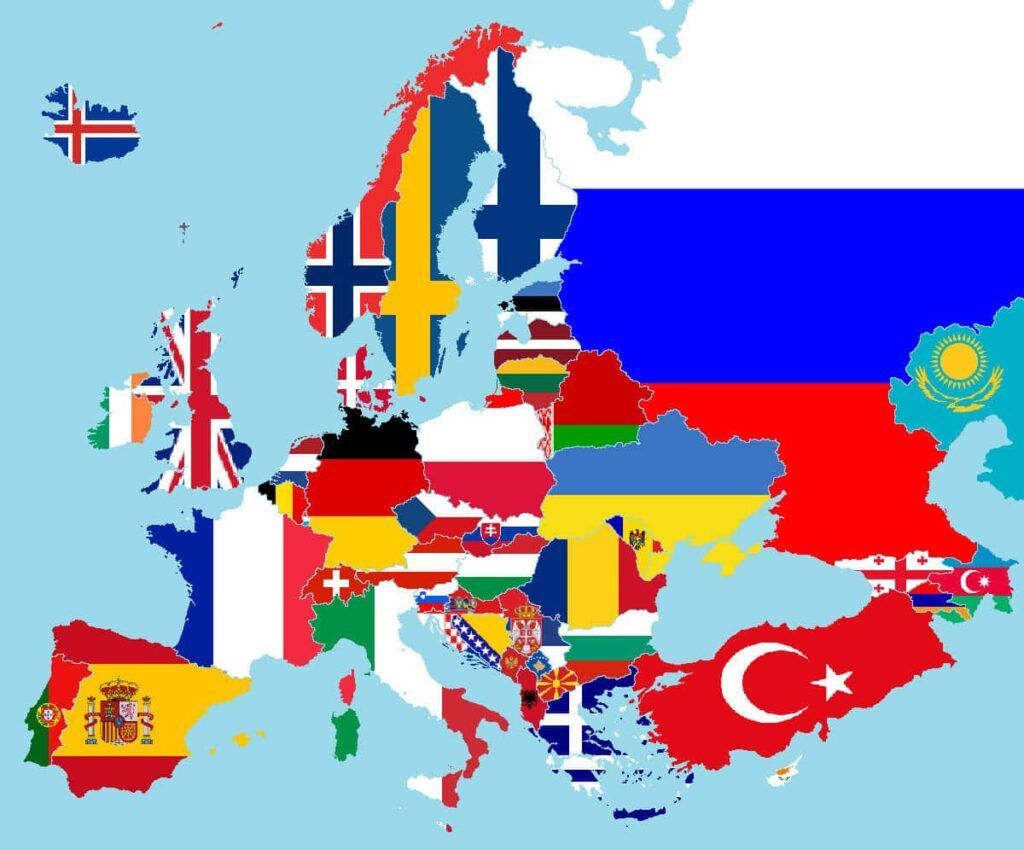
The Schengen Area (often called the Schengen zone) is a group of European countries that have abolished routine passport controls at their internal borders. This system is based on an international agreement that allows free movement once a traveler has legally crossed a Schengen external border (see the European Commission’s overview of the Schengen Area).
Although internal borders are open, Schengen relies on strict, shared controls at its external borders, ensuring security across all participating member states. Understanding the visa rules is step one. If you’re thinking further ahead than a 90-day stay, the Living Abroad Guide picks up from there.

- Schengen Area rules explained ETIAS, visas, EU and UK travel
- Schengen Area Rules
- The 90/180 Day Period Rule Explained
- Schengen Visa and European Visa Policy
- Cost of Schengen Visas and for What Countries
- How to Apply for a Schengen Visa
- ETIAS and the External Border
- Schengen, the European Union, and the Council
- The United Kingdom and the Common Travel Area
- Non-Schengen European Countries
- Tailored Guidance for U.S., Canadian, and UK Nationals
- Final Takeaway
Schengen Countries
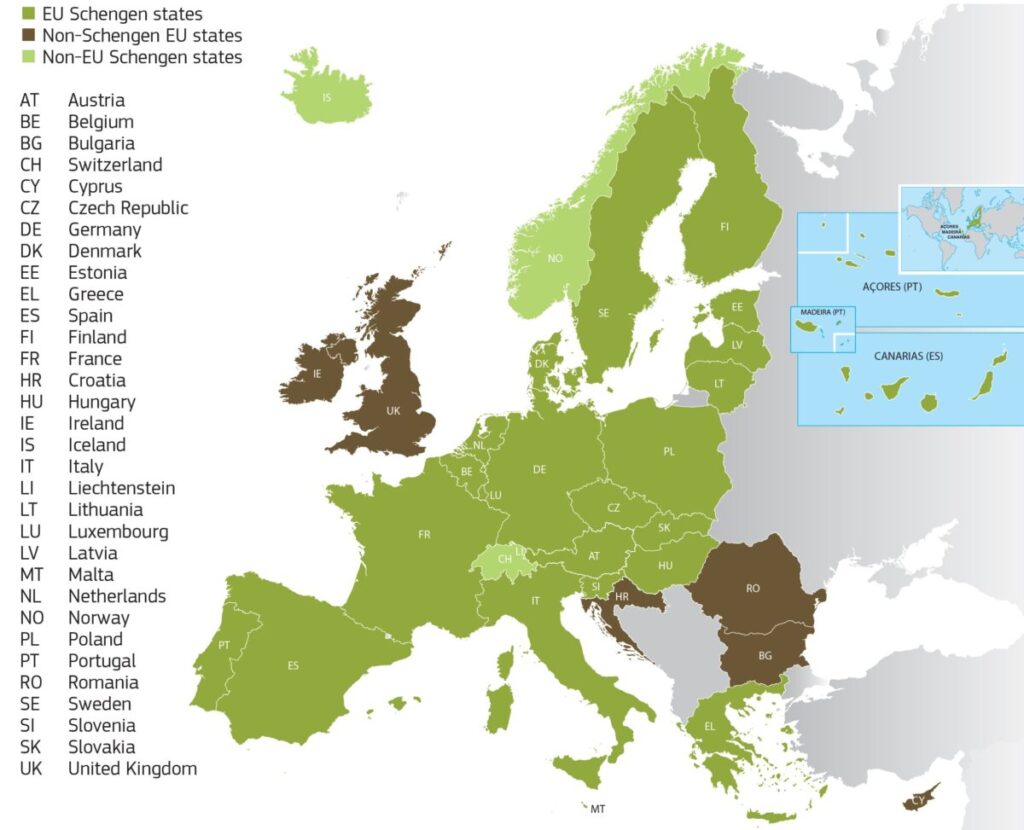
Today, the Schengen Area countries include most of continental Europe. These countries apply the same short-stay rules, share border data, and enforce a common visa policy (official country list.
Schengen Area countries include: Austria, Belgium, Croatia, the Czech Republic, Czechia, Denmark, Estonia, Finland, France, Germany, Greece, Hungary, Iceland, Italy, Latvia, Liechtenstein, Lithuania, Luxembourg, Malta, the Netherlands, Norway, Poland, Portugal, Slovakia, Slovenia, Spain, Sweden, and Switzerland.
Once admitted to any one of these countries, a traveller may move freely between all others, subject to the same stay limits.
The 90/180 Day Period Rule Explained
Most short-stay visitors may remain in the Schengen Area for 90 days within any rolling 180-day period. This rule applies across all Schengen Area countries combined, not per member state.
Authorities look back 180 days from the current date and count every day spent inside the Schengen Area. When the total reaches 90, the traveller must remain outside the area until days naturally fall outside the rolling window. To plan stays, use the official short‑stay calculator.



Schengen Visa and European Visa Policy
A Schengen visa is required for nationals of certain countries before they travel. Others may enter visa-free for short stays.
The Schengen visa policy is coordinated at the European level and overseen in part by the EuropeanCommission, while individual member states handle applications through their embassies and consulates, visa policy overview.
A valid Schengen visa allows short-term travel throughout all Schengen Area countries under the same 90-day rule.
Cost of Schengen Visas and for What Countries
The cost of Schengen visas is standardized across Schengen member states. For most adult applicants, the standard Schengen visa fee is €80. Children aged 6–11 usually pay €40, and children under 6 are exempt. Reduced or waived fees may apply for certain categories such as students, researchers, or participants in cultural or educational exchanges.
Citizens of the United States, Canada, the United Kingdom, Australia, Japan, and many other countries do not need a Schengen visa for short stays, meaning no visa fee applies for tourism or business visits under 90 days (visa‑exempt nationality list maintained by the EU. However, nationals of many countries in Africa, Asia, and the Middle East are required to apply for a Schengen visa before travel and must pay the standard fee.
How to Apply for a Schengen Visa
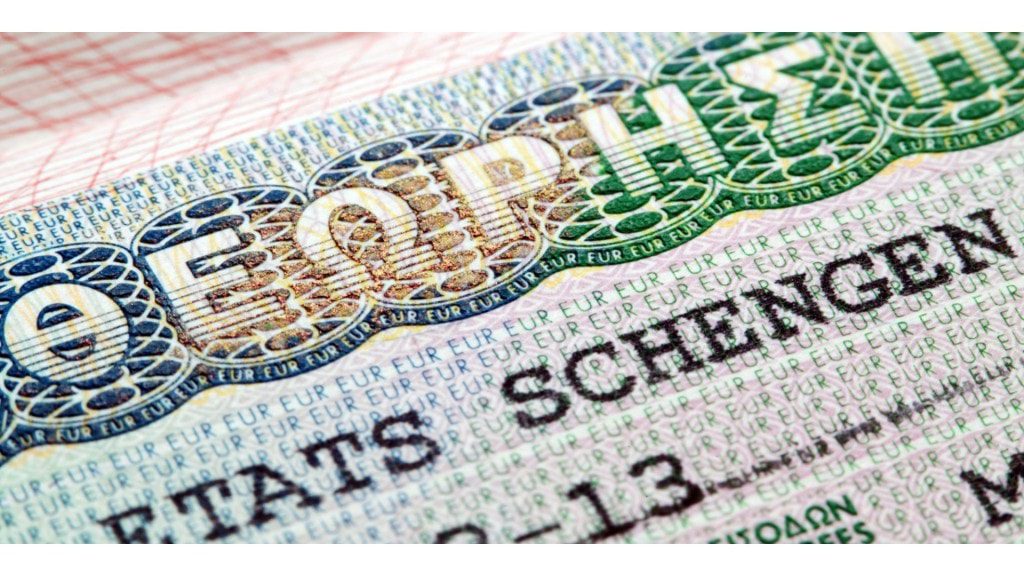
For travelers who require one, how to apply for a Schengen visa follows a standardized process across all member states. Applicants must first determine which Schengen country is responsible for their application. This is usually the country they will spend the most time in, or the country of first entry if time spent is equal.
The applicant then submits a visa application to that country’s embassy, consulate, or authorized visa center. The process typically includes submitting a completed application form, a valid passport, proof of travel insurance, evidence of accommodation, proof of financial means, and a planned itinerary. Biometric data, including fingerprints, is usually required.
Applications are normally submitted before travel, and processing times vary by country and season. Approval allows short-term travel throughout the Schengen Area under the shared rules. For country‑specific procedures, consult official national portals (e.g., France, Germany, Italy.)
ETIAS and the External Border
ETIAS is a pre-travel authorization that will apply to visa-exempt travelers entering the Schengen external border. ETIAS strengthens security screening while preserving internal free movement (ETIAS official information.)
ETIAS is not a visa, does not change who needs a Schengen visa, and does not extend the 90-day stay limit. Most applicants will pay a €7 fee; authorizations are typically valid up to three years or until passport expiry (per EU guidance).
It applies to two main groups: the travelers who need to apply, and the European countries they will be visiting. Here is a breakdown of both.

Which Countries Will Require ETIAS?
ETIAS will be required for entry into 30 European countries. This includes most members of the Schengen Area as well as a few other nations that have chosen to participate .
| Country | Country | Country |
| Austria | Germany | Netherlands |
| Belgium | Greece | Norway |
| Bulgaria | Hungary | Poland |
| Croatia | Iceland | Portugal |
| Cyprus | Italy | Romania |
| Czech Republic | Latvia | Slovakia |
| Denmark | Liechtenstein | Slovenia |
| Estonia | Lithuania | Spain |
| Finland | Luxembourg | Sweden |
| France | Malta | Switzerland |
Who Needs to Apply for ETIAS?
Citizens from around 60 countries that currently do not need a visa for short trips to Europe will need to obtain an ETIAS authorization. This list includes major nations like the United States, the United Kingdom, Canada, and Australia . For a complete list of these countries, you can check the official EU immigration portal once it’s available.
Important Exceptions
Not everyone needs ETIAS. You are exempt if you are:
- A citizen of any EU country .
- A national of one of the 30 European countries listed above (as they are the ones requiring it) .
- A holder of a valid residence permit or long-stay visa issued by any of the ETIAS-required countries .
A Quick Note on ETIAS
It is helpful to remember that ETIAS is not a visa. It is an electronic travel authorization linked to your passport. The application will be completed online, and once approved, it will be valid for three years (or until your passport expires) for multiple short stays of up to 90 days
Schengen, the European Union, and the Council
The European Union governs political and economic cooperation, including free movement rights for EU nationals and workers within the union.
These rights do not apply to third-country nationals. Immigration and visa policy affecting visitors is shaped through EU legislation adopted by institutions including the Council of the European Union.
The United Kingdom and the Common Travel Area
The United Kingdom is not part of the Schengen Area and applies its own visa policy.
The UK and Ireland participate in the Common Travel Area, which allows free movement for British and Irish nationals only. This arrangement does not apply to Schengen Area countries.


Non-Schengen European Countries
Several European countries are outside Schengen, including Ireland, Albania, Serbia, Montenegro, Bosnia and Herzegovina, North Macedonia, and Kosovo. Time spent in these countries does not count toward Schengen limits, but each applies its own visa policy, usually allowing visa-free stays of up to 90 days within a 180-day period for many Western nationals.
Leaving Schengen to visit a non-Schengen country does not reset Schengen time.
Tailored Guidance for U.S., Canadian, and UK Nationals
U.S. nationals, Canadian nationals, and UK nationals may visit the Schengen Area without a visa for 90 days in any 180-day period. ETIAS will be required prior to travel once operational (ETIAS timeline and status). Time spent in the UK, Ireland, or non-Schengen European republics does not affect Schengen day calculations and does not reset the clock.
Longer stays require a national visa or residence permit from a specific Schengen member state (national long‑stay visas are country‑specific; consult the competent authority’s official site).

Final Takeaway
The Schengen Area allows free movement across most of Europe but is governed by strict external border controls, a shared visa policy, and a fixed 90-day rule. Understanding the Schengen Area countries, the cost of Schengen visas and for what countries they apply, and how to apply for a Schengen visa is essential for lawful and stress-free travel. For the most current rules and exceptions, rely on official EU (.eu) and government (.gov) sources linked above.
This is one part of the full Europe Travel Resource Guide see also How to Pay in Europe and the Europe Travel Documents Checklist. Continue planning your trip with check Travel Scams in Europe for more on protecting your money while travelling. Other resources include Best Travel Apps for Europe and Do you need a voltage converter in Europe.
check out these European Travel Guides
If you have mobility issues here is a selection of posts that may be of help to you:
Bookmark these hubs for updates and dive into the detailed guides to build an itinerary that fits your energy, comfort, and interests.
➡️Accessible Historical sites in the UK
Fallen in love with Europe and thinking of moving here? Make sure you check our European Highlights guides.
If you’re planning a full relocation, don’t forget to read our guide on moving a pet to Europe, which covers everything from paperwork to flights.