
Tower Bridge, London: History, Ghost Stories, Legends and Little-Known Facts
Quick answer: Tower Bridge is a combined bascule and suspension bridge over the River Thames, built between 1886 and 1894 and opened on 30 June 1894. It is not London Bridge, it is not a drawbridge, and it is not medieval. Beneath its north end sits Dead Man’s Hole, a Victorian riverside mortuary that is the real source of its ghostly reputation.
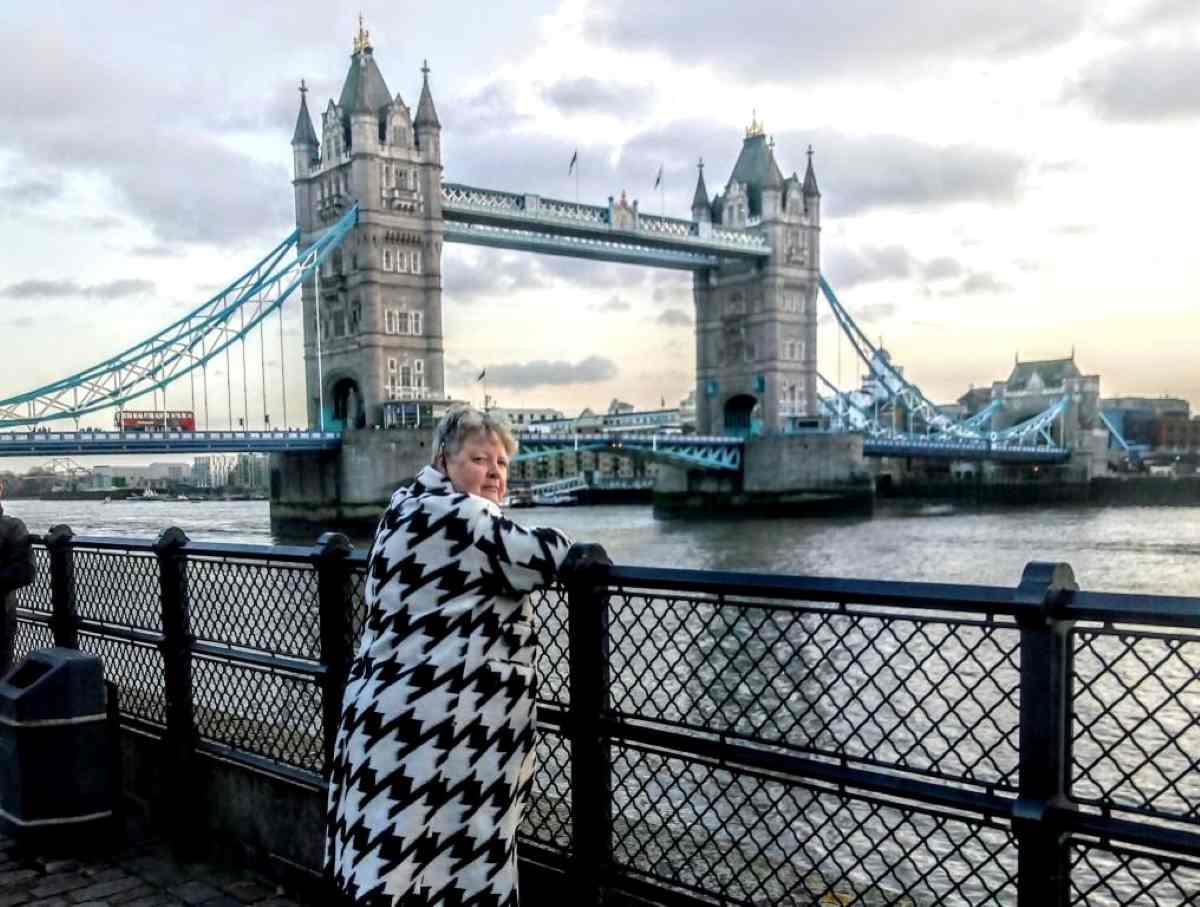
I lived in London for ten years, in South London near the Oval, and worked in an office behind Waterloo Station. I have spent a great deal of time exploring the city, and go back nearly every year to visit family and friends.
I toured Tower Bridge after a May visit to the Tower of London next door. I’ll be honest: I skipped the high-level walkways, because I hate heights. But I was lucky with my timing and watched the bridge lift as a very fancy yacht sailed underneath, which is a sight I won’t forget. If heights aren’t for you either, the towers, the Engine Rooms and a well-timed lift still make the visit worthwhile.
This guide covers the bridge’s real history, the ghost stories (and which ones hold up), the legends that refuse to die, and the details most visitors walk straight past.
Tower Bridge fast facts

A short history of Tower Bridge
Tower Bridge was built because Victorian London’s East End had outgrown its river crossings, but ships still needed to reach the busy wharves of the Pool of London. A fixed bridge would have blocked the masts, so the city needed a crossing that could open.
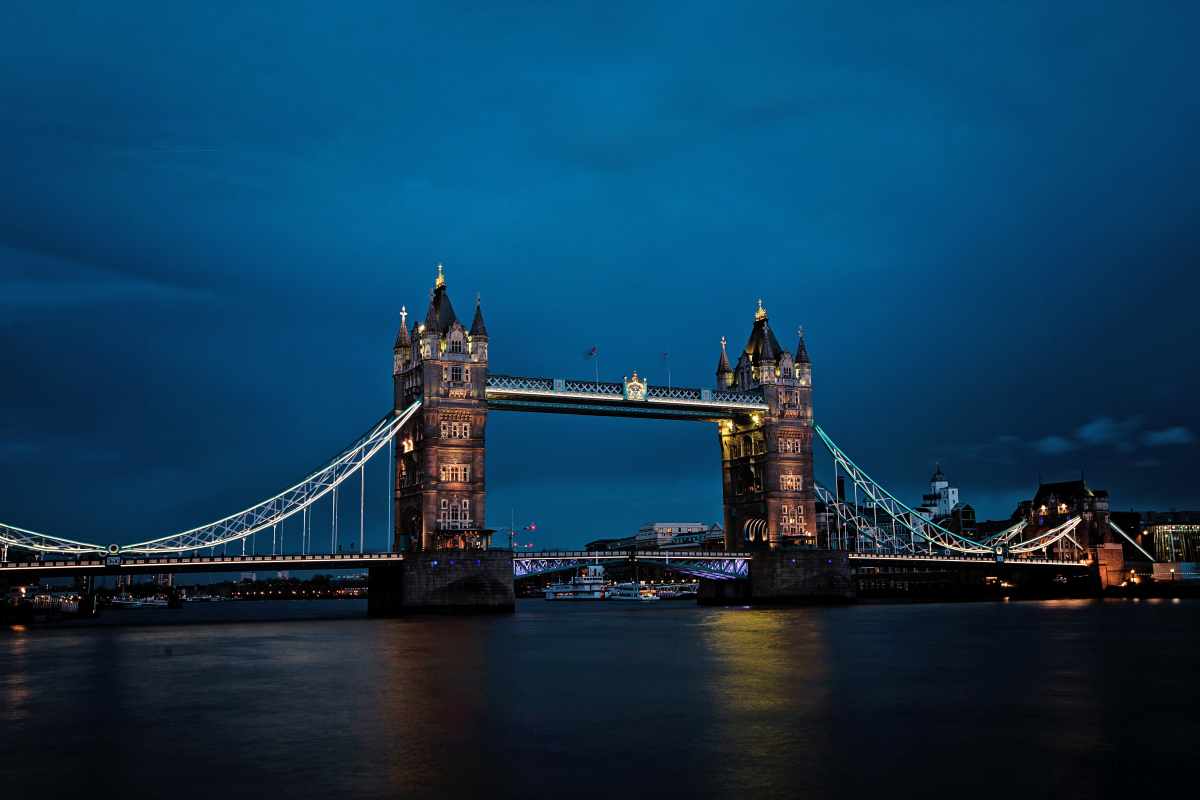
Why was Tower Bridge built?
By the 1870s, the only way across the Thames east of London Bridge was a long detour or the cramped Tower Subway, a tunnel under the river. Over 50 designs were submitted to a public competition, including one by Joseph Bazalgette, the engineer behind London’s sewers. The competition was abandoned in 1879.
Architect Sir Horace Jones then teamed up with engineer Sir John Wolfe Barry. Their bascule design went to the Court of Common Council on 28 October 1884 and was approved by Parliament that November. The Tower Bridge Act of 1885 set two rules still in force: river traffic has priority over road traffic, and lifts are free for ships.
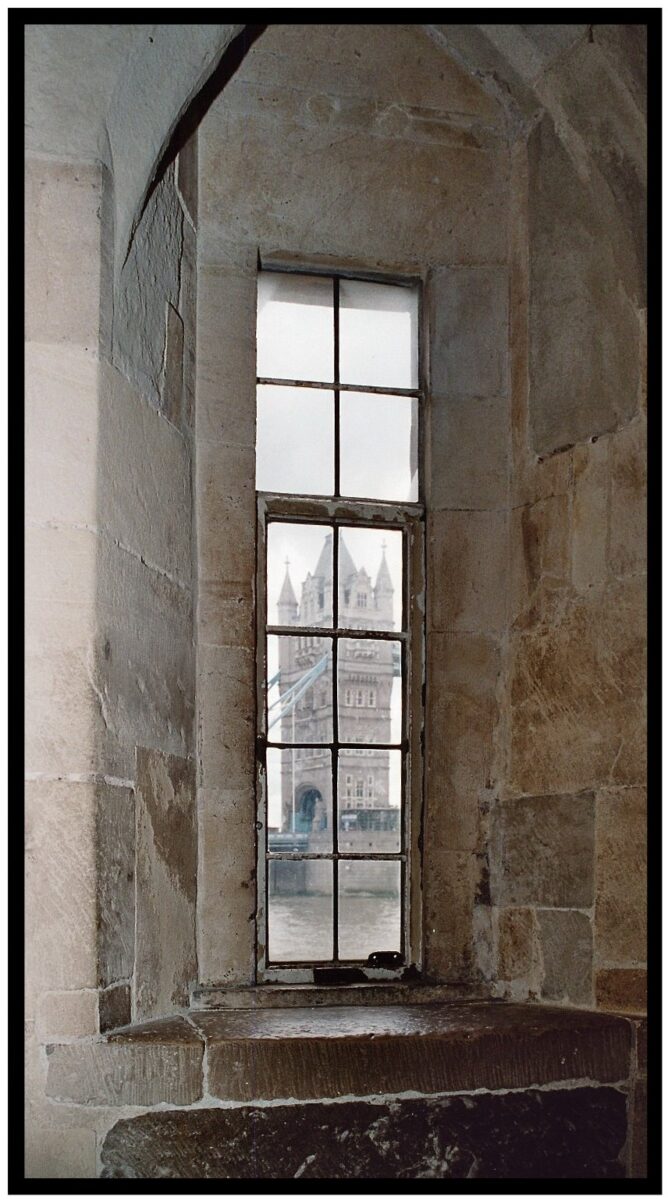
Construction (1886-1894)
Building took eight years and cost over £1 million. Divers worked in the riverbed to sink foundations almost 8 m deep, and riveters drove more than 13 million rivets into the steel frame.
Up to 848 men worked on the bridge at once. At least 10 died, including 20-year-old Richard Bacon, who fell on 25 April 1888. Horace Jones died one year into construction and never saw it finished.
The castle-like stonework is a disguise. The real structure is an 11,000-ton steel frame, dressed in granite and Portland stone so it would complement the Tower of London next door, which was a condition of the competition.

Opening day
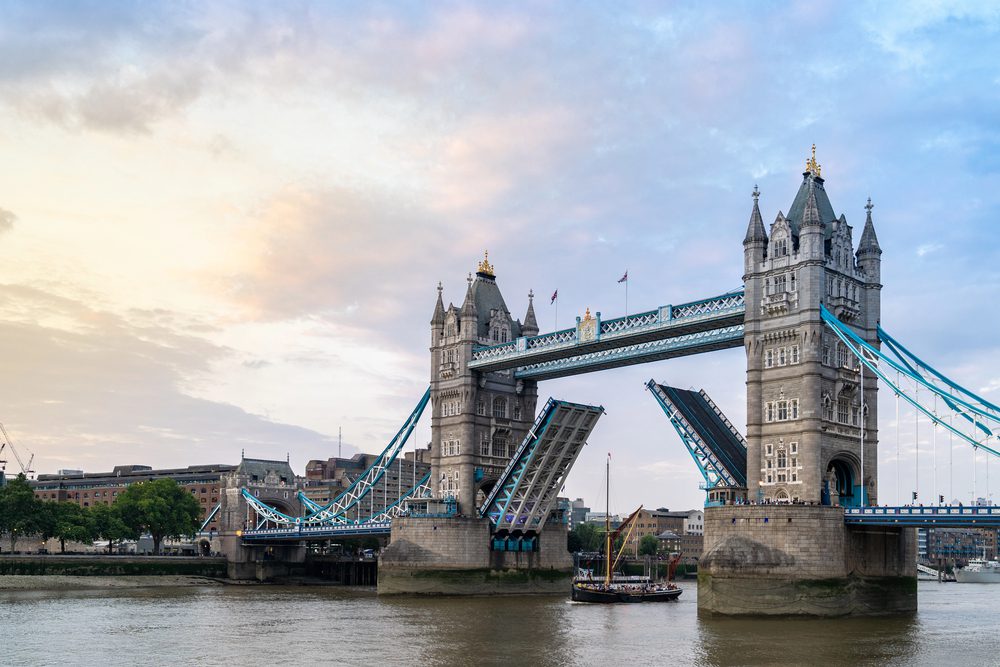
The Prince of Wales, later King Edward VII, opened Tower Bridge on 30 June 1894. It was the most sophisticated bascule bridge ever built at the time, with steam-driven hydraulic engines that could open the bascules fully in about a minute, balanced by huge counterweights swinging down into chambers inside the piers.
The walkways that nobody used
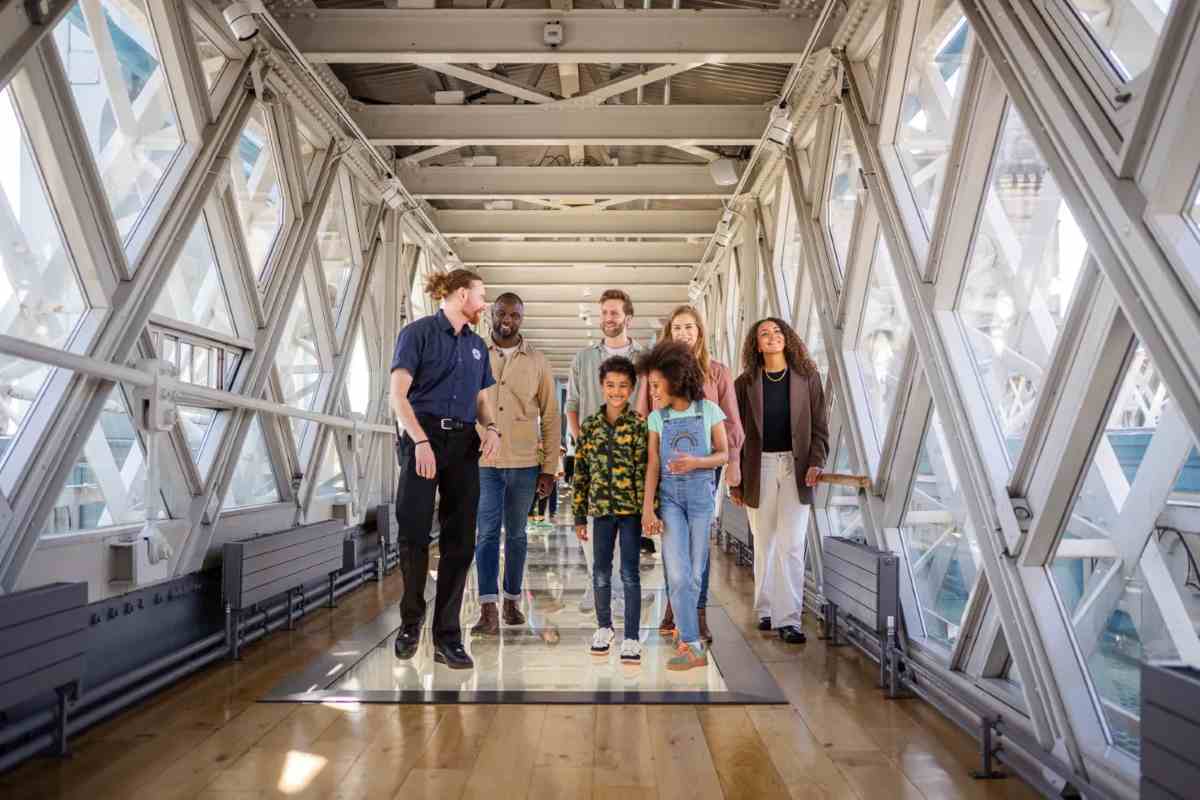
The high-level walkways were meant for pedestrians when the bridge was raised. Lifts were so fast that most people simply waited, and the walkways closed in 1910. They reopened decades later as part of the visitor exhibition, and glass floors were added in 2014.
Tower Bridge at war
In the First World War, a gun was mounted above the eastern walkway. London historian Jack Chesher reports it shot down a German Gotha bomber during the raid of 19 May 1918. In the Second World War, the bridge was painted battleship grey for camouflage and used as an observation post.
Steam to electricity
Steam powered every bridge lift until 1976. The bascules are still hydraulic, but now run on oil and electricity. The original pumping engines, accumulators and boilers are preserved in the Engine Rooms.

From brown to red, white and blue
The bridge was first painted a “bright chocolate” brown, rumoured to be Queen Victoria’s favourite. It was repainted red, white and blue in 1977 for Queen Elizabeth II’s Silver Jubilee, and you can still see original brown paint inside the towers.
Is Tower Bridge haunted? Ghost stories and Dead Man’s Hole
Tower Bridge has far fewer recorded ghost stories than the Tower of London across the road, but it has something most “haunted” sites don’t: a real, documented mortuary built into its foundations. Here is what is fact, what is folklore, and what belongs to its neighbours.
Dead Man’s Hole: the mortuary under the bridge (fact)
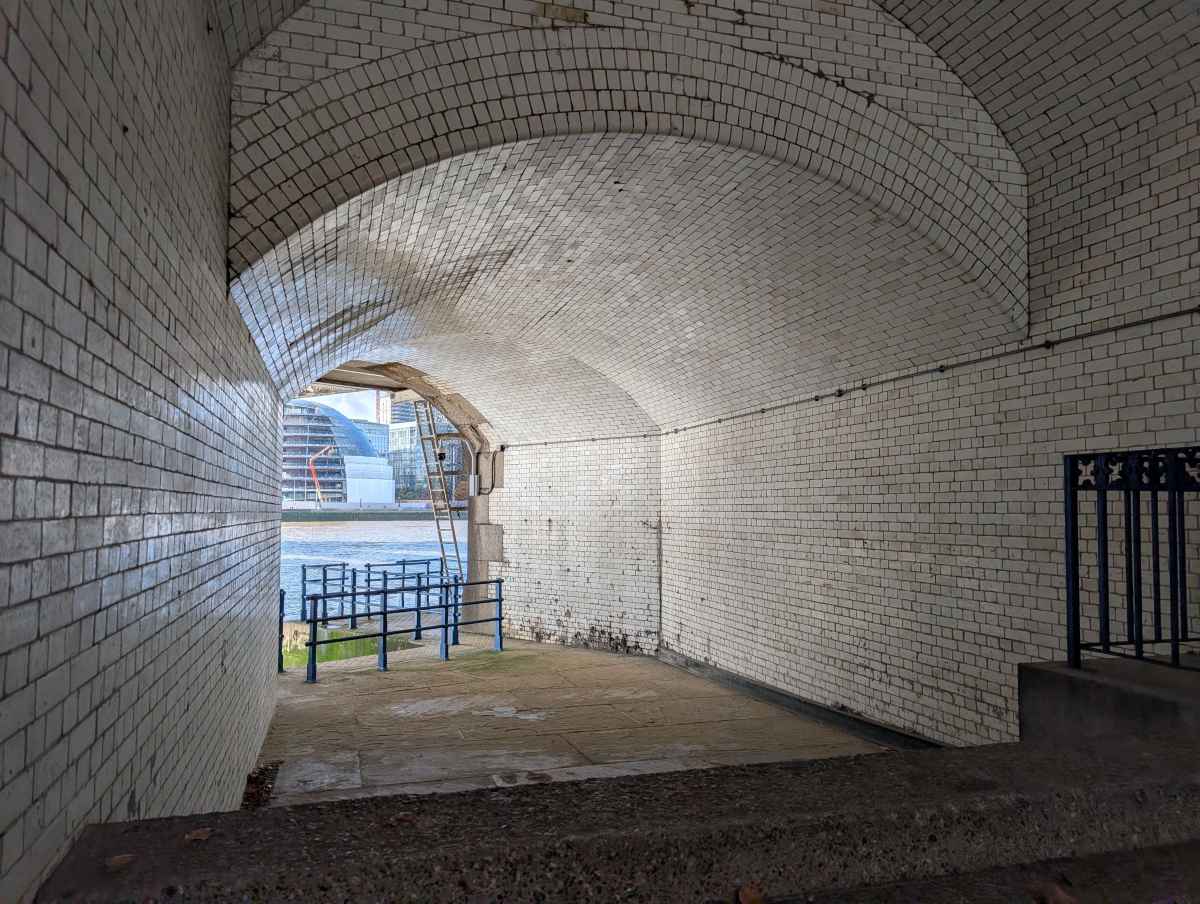
Under the north end of the bridge, on the east side by the river steps, is a white-tiled alcove known as Dead Man’s Hole. The Thames tides tended to wash bodies up on this stretch of bank, from accidents, suicides and murders. A mortuary was built into the north pier so they could be pulled out and laid out for identification.
The white tiles were practical: easy to scrub clean. Stone steps lead down into the water, and the room behind the wooden door is now a dank storeroom. The site is fenced off, but you can see it from the path as you head up the steps to the bridge.
The sign on the fence claims bodies thrown into the river “from the Tower” were stored here too. That is the shakiest part of the legend. The mortuary only dates from the 1890s, long after the great Tudor executions, and those victims were buried in the Tower’s chapel or nearby churchyards.
The spy who passed through Dead Man’s Hole (documented)
There is one well-researched exception. Josef Jakobs, a German spy, was shot at the Tower of London on 15 August 1941, the last person ever executed there. According to research by his granddaughter, Giselle Jakobs, his body was taken to the Tower Bridge mortuary, where pathologist Sir Bernard Spilsbury carried out the post-mortem. An older 1970s magazine account placed it inside the Tower, so treat the detail as strongly supported rather than settled.
Most Haunted at Tower Bridge
On 28 October 2005, the TV series Most Haunted Live filmed at Tower Bridge and inside the old mortuary. The broadcast was dramatic, complete with a Ouija board, but it remains one of the few times cameras have been inside the room.
The spectral workers (modern folklore)
Some paranormal websites describe shadowy figures on the walkways at night, cold spots near the Engine Rooms and faint shouts in the bascule chambers, linked to the men who died building the bridge. None of these accounts name witnesses or dates, so they are best read as modern ghost-walk lore. The deaths behind them, however, were real.
Ghosts that belong to the neighbours
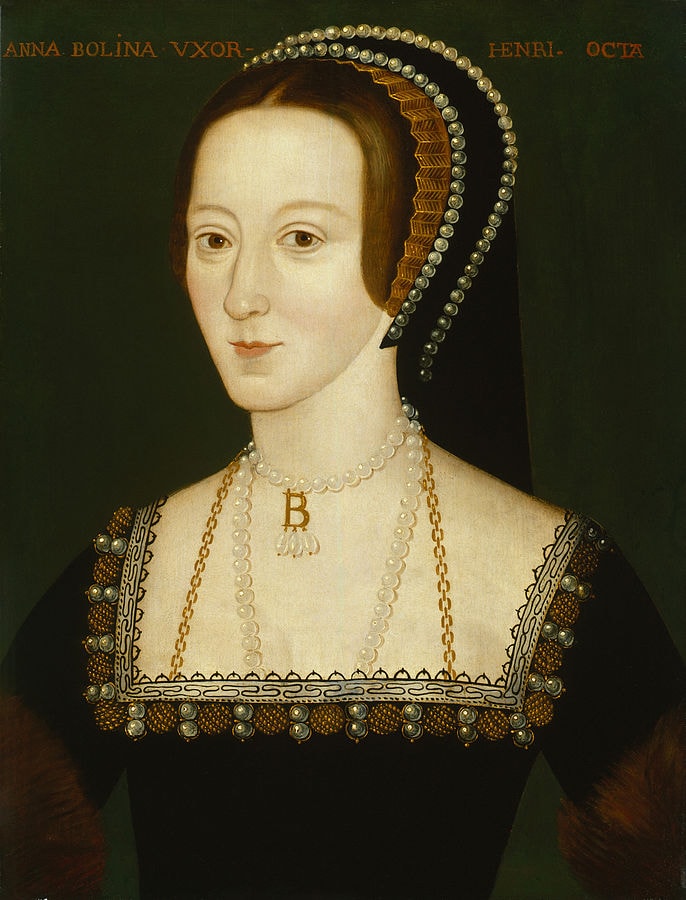
Many “Tower Bridge ghost” stories online are really Tower of London stories. Historic Royal Palaces records tales of Anne Boleyn’s ghost on Tower Green, spectres in the Salt Tower and even a phantom bear. These are a two-minute walk from the bridge, which is why evening ghost tours often start at All Hallows by the Tower and end with the lit-up bridge.
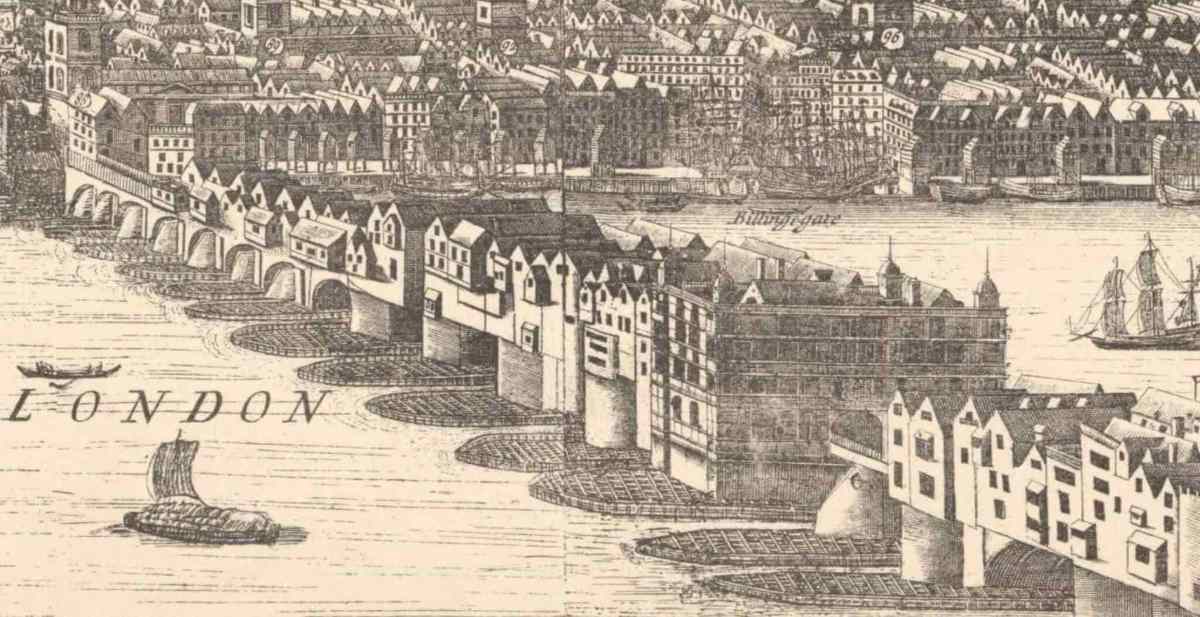
The traitors’ heads on spikes are another mix-up. They were displayed on the old London Bridge upstream, from 1305 until 1660, not on Tower Bridge, which didn’t exist until 1894.
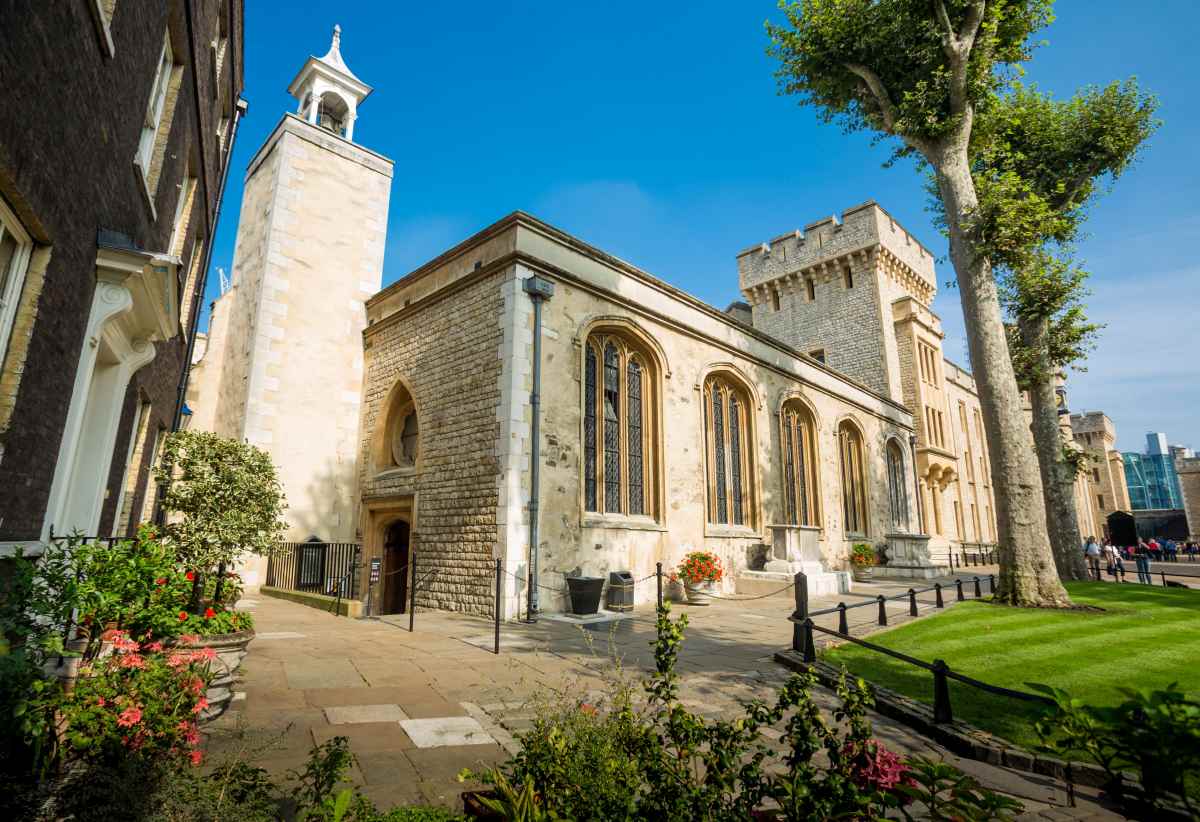
I went to the Tower of London in May specifically to see the red roses left on Anne Boleyn’s tomb, and stood at Traitors’ Gate, the river entrance where prisoners were brought in by boat. Standing there, with Tower Bridge right beside you, you understand why the whole riverbank has gathered so many ghost stories. You can feel the weight of all that history walking these areas.


Tower Bridge legends and myths: what’s true?
Tower Bridge attracts tall tales the way the Thames attracts fog. Some are wildly true, others have been debunked for decades.
| Legend | Verdict |
| An American bought London Bridge thinking it was Tower Bridge | False |
| A double-decker bus jumped the gap as the bridge opened | True (1952) |
| A jet fighter flew between the towers | True (1968) |
| Tower Bridge is a drawbridge | False |
| The walkways closed because of prostitutes and pickpockets | Unproven |
| The brown paint was Queen Victoria’s favourite colour | Rumour |
| “London Bridge Is Falling Down” is about Tower Bridge | False |
The American who “bought the wrong bridge” – False
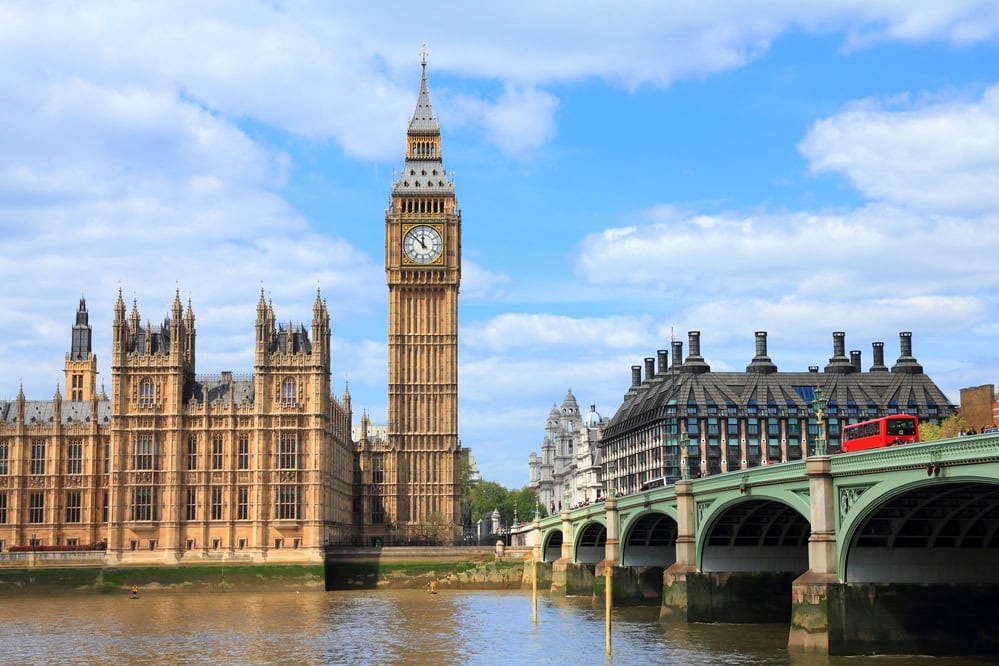
In 1968, American entrepreneur Robert P. McCulloch bought the 1830s London Bridge and rebuilt it in Lake Havasu City, Arizona, where it was dedicated in 1971. The story that he thought he was buying Tower Bridge has been denied by McCulloch himself and by Ivan Luckin, who arranged the sale. In October 2024, his grandson Michael McCulloch visited London to put the myth to rest for good.
The bus that jumped Tower Bridge – True
On 30 December 1952, bus driver Albert Gunter was driving the number 78 across the bridge when the road ahead began to rise. The watchman had not stopped the traffic. Gunter accelerated and leapt the widening gap, landing on the north bascule. He broke a leg, some passengers had minor injuries, and he was given £10 and a day off for his bravery.
The jet through the towers – True
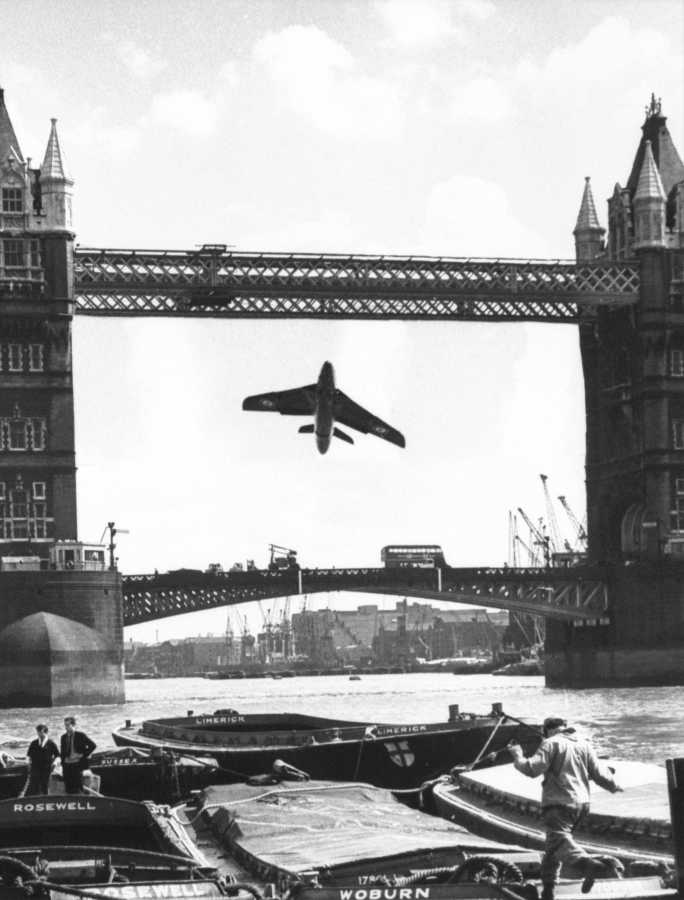
On 5 April 1968, RAF Flight Lieutenant Alan Pollock broke formation in protest at defence cuts and the lack of plans for the RAF’s 50th anniversary. He flew his Hawker Hunter over Parliament and then straight through the gap between Tower Bridge’s road and walkways. It remains the only time a jet has flown under the walkways.
“It’s a drawbridge” – False
A drawbridge is pulled up by chains or ropes. Tower Bridge’s roadways are far too heavy for that. It is a bascule bridge, from the French for “see-saw”: each half pivots on an axle, balanced by counterweights.
The walkways’ wicked reputation – Unproven
The high-level walkways closed in 1910. A popular story says they had become a haunt of prostitutes and pickpockets. Historians point out there is no real evidence for this; the simpler explanation is that lifts were fast and almost nobody climbed the towers.
Queen Victoria’s favourite brown – Rumour
The Bridge was originally chocolate brown Victoria’s favourite colour but the folks of London supposedly used the term “favourite brown” referring to the rumoured relationship of the Queen and John Brown. The official Tower Bridge story itself calls this a rumour. It is a lovely detail, but no document has been produced to prove it.
London Bridge is falling down – False
The nursery rhyme is far older than Tower Bridge and refers to the medieval London Bridge, which was repeatedly damaged and rebuilt. Tower Bridge has never fallen down and stands much as it was built in 1894.
15 little-known Tower Bridge facts
These are the details most visitors walk straight past.
- One lamp-post is a fake. On the north approach, one “lamp-post” has no lamp. It is a chimney for the coal fire in a guardroom below, used by soldiers guarding the Tower. It has been cold since the 1956 Clean Air Act.
- The law demands a bundle of hay. When maintenance work reduces the clearance under the bascules, a bundle of hay must be hung from the bridge to warn ships.
- Ships always win. The 1885 Act gives river traffic priority over cars, and lifts are free. Drivers stuck in rush hour have no appeal.
- The record is 64 lifts in one day. When it opened, it lifted 20 to 30 times a day; today it averages two or three.
- It sits in two boroughs. The south side is in Southwark (listed 6 December 1949); the North Tower is in Tower Hamlets (listed 27 September 1973).
- Look for the Bridge Mark. A small shield-like symbol on the bridge belongs to Bridge House Estates, the charity founded in 1282 to maintain London Bridge, now City Bridge Foundation.
- People lived inside it. Until the early 1900s, the Bridge Master lived in the south abutment and his deputy in the north.
- A seaplane flew through it in 1912. Frank McClean flew his Short-Farman hydroplane between the road and walkways on 10 August 1912, then was blown into the river trying it again on the way back. He was unhurt.
- It launched the parachute regiment idea. On 11 November 1917, Major Thomas Orde-Lees leapt from the roadway with a Guardian Angel parachute, just 150 feet above the water. It was the lowest jump yet recorded.
- A father flew through it on his son’s dare. In 1951, Essex chemist Frank Miller flew a plane through the bridge, blaming his 13-year-old son’s 35-shilling dare. The court fined him £100.
- A motorbike backflipped over it. On 13 July 2009, Australian stuntman Robbie Maddison jumped the partly raised bascules and did a backflip mid-air.
- “The Queen” flew through it. At the 2012 Olympic opening ceremony, two helicopters carrying a stunt double of Queen Elizabeth II flew between the towers in the James Bond sequence.
- Two wingsuit flyers threaded it in 2024. On 12 May 2024, Austrians Marco Fürst and Marco Waltenspiel flew through at up to 246 km/h, 35 m above the river.
- Seven workers are hidden in the roof. Statues in the South Tower’s roof structure honour the “unsung heroes” who built and ran the bridge, and the Blue Line on the path to the Engine Rooms names its workers.
- The glass floor is tougher than it looks. The glass floors on the walkways can hold more than the weight of two black cabs, 42 m above the Thames.
Visiting Tower Bridge in 2026
Walking or driving across Tower Bridge is free at any time. A ticket is only needed to go inside: the North and South Towers, the high-level walkways with glass floors, and the Victorian Engine Rooms. Allow 1 to 1.5 hours.
Tower Bridge ticket prices 2026
| Ticket | Price |
| Adult (18+) | £18.00 |
| Concession (60+, students 18+, ages 16-17, disabled adults) | £13.50 |
| Child (5-15) | £9.00 |
| Disabled child (5-15) | £6.80 |
| Companion / carer | Free |
| Under 5 | Free |
| Local ticket (Southwark, Tower Hamlets, City of London residents) | £1.00 |
Prices from the official Tower Bridge site, checked 31 October 2026. Many third-party guides still show older £12-£13.40 prices.

- Opening hours: daily 09:30-18:00, last entry 17:00.
- Booking: up to 8 weeks ahead online. A pre-booked ticket secures your time slot but is not fast-track entry.
- Included free: audio tour (bring headphones), the Tower Bridge Cat Trail for children, and drop-in family activities.
- Savings: National Rail 2FOR1 offers apply, and groups of 15+ get a discount.
- Extras: 90-minute guided tours, plus autumn and winter behind-the-scenes tours into the bascule chambers.
Tip: time your visit with a bridge lift
The best moment to be on the glass floor is during a lift, when you can look straight down as the roadway rises. Lift times are published on the official Bridge Lifts page. Watching from the riverside path by the Tower of London or Shad Thames is free.
Accessibility at Tower Bridge
- Lifts: one in each tower up to the walkways, plus an external lift on the south-east side down to the Engine Rooms and gift shop.
- Queue: outside on the bridge. If a disability means you can’t queue, ask staff at the Ticket Office (north-west side) for priority entry.
- Borrow on site: wheelchairs, rollators, stools, braille guides and sensory access kits.
- Toilets: step-free accessible toilets in both towers and the Engine Rooms. There is no Changing Places toilet; the nearest is at the Tower of London, about 700 m away.
- Hearing: induction loops at key points, BSL-interpreted tours and Deaf-led tours.
- Neurodivergent visitors: monthly Relaxed Opening with reduced capacity and sound, plus a downloadable visual story.
- Lighting: some areas are dim; the walkways are naturally lit.
- Dogs: assistance dogs and pets on leads are welcome.
Lifts can go out of service at short notice, so call 020 7407 9191 before a visit if you rely on them.
Getting there
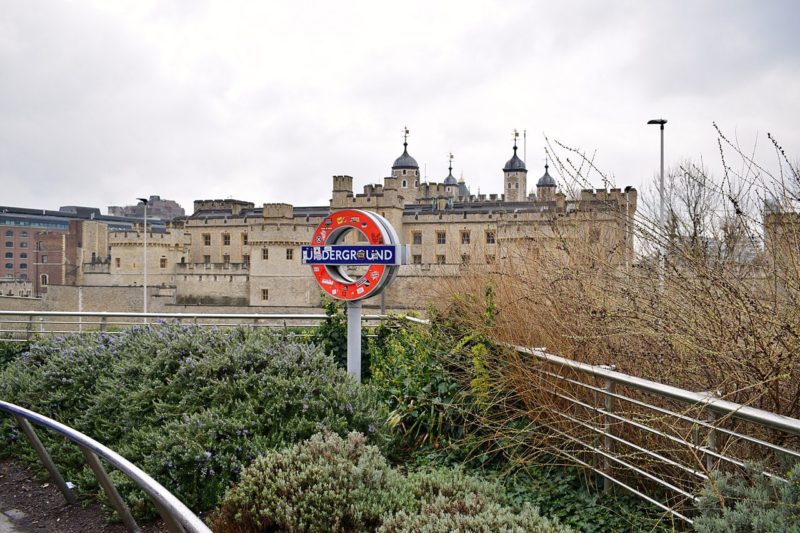
The nearest stations are Tower Hill (District and Circle lines), Tower Gateway (DLR) and London Bridge (Jubilee and Northern lines, plus National Rail). From London Bridge it is a pleasant riverside walk past HMS Belfast.
What to pair with Tower Bridge
The Tower of London is right next door, St Katharine Docks is just east, and Shad Thames on the south bank has the classic photo angle. Borough Market is about 15 minutes’ walk west. On my last London trip I ate a pork ciabatta from Black Pig and a sausage roll from The Ginger Pig there, so it makes an easy lunch stop before or after the bridge.


Tower Bridge FAQ
Is Tower Bridge haunted?
There are no well-documented ghost sightings on Tower Bridge itself. Its eerie reputation comes from Dead Man’s Hole, a real Victorian mortuary under the north end where bodies from the Thames were laid out. Most famous “Tower” ghosts, like Anne Boleyn, belong to the Tower of London next door.
What is Dead Man’s Hole at Tower Bridge?
Dead Man’s Hole is a white-tiled alcove and mortuary in the bridge’s north pier. Tides washed bodies up on this stretch of the Thames, and they were retrieved via steps and stored there for identification. It is fenced off but visible from the riverside path.
How old is Tower Bridge?
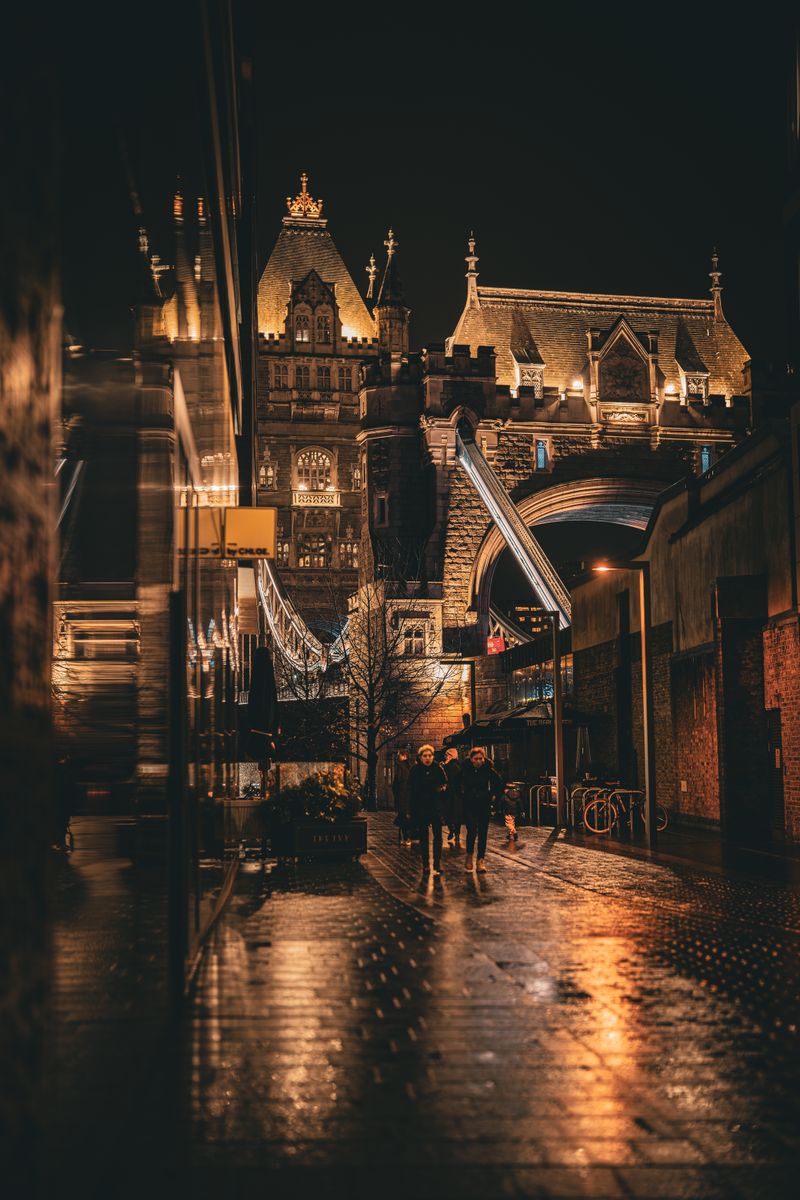
Tower Bridge was built between 1886 and 1894 and opened on 30 June 1894, making it over 130 years old. It looks medieval because its stone cladding was designed to match the Tower of London, but it is a Victorian steel bridge.
Is Tower Bridge the same as London Bridge?
No. London Bridge is the plain concrete bridge about a 13-minute walk upstream, opened in 1973. Tower Bridge is the one with two Gothic towers and lifting roadways.
Did an American really buy Tower Bridge by mistake?
No. Robert P. McCulloch bought the old London Bridge in 1968 and rebuilt it in Lake Havasu City, Arizona. Both he and the man who sold it denied he thought it was Tower Bridge, and his grandson publicly debunked the myth in 2024.
Did a bus really jump Tower Bridge?
Yes. On 30 December 1952, driver Albert Gunter accelerated his number 78 bus across the gap when the bridge began opening beneath him. He landed safely on the other side and received £10 and a day off.
How much does it cost to go inside Tower Bridge in 2026?
An adult ticket costs £18, concessions £13.50 and children aged 5-15 £9. Under-5s and carers go free, and local residents pay £1. Crossing the bridge on foot is free.
How often does Tower Bridge open?
Tower Bridge now lifts around two or three times a day on average, always free for ships. Times are published in advance on the official Bridge Lifts page. The record is 64 lifts in a single day.
Is Tower Bridge wheelchair accessible?
Yes. There are lifts in both towers to the glass-floored walkways and an external lift to the Engine Rooms. Wheelchairs can be borrowed, and accessible toilets are on site, though there is no Changing Places facility.
Why is Tower Bridge painted blue and white?
Tower Bridge was painted red, white and blue in 1977 for Queen Elizabeth II’s Silver Jubilee. It was originally chocolate brown and was painted grey for camouflage in the Second World War.

How long do you need at Tower Bridge?
Allow 1 to 1.5 hours to see the towers, walkways and Engine Rooms. Add time to watch a bridge lift or explore the Tower of London next door.
More reading for you:
Unesco Heritage Sites in the UK