
Stone Circles in Ireland: Exploring Ireland’s Ancient Megalithic Landscapes
Stone circles in Ireland are far easier to find today than they were even a few decades ago. Modern mapping, heritage signage, GPS coordinates, and dedicated archaeological databases have transformed what was once an unpredictable adventure into a far more accessible journey. That accessibility, however, has not diminished the sense of wonder that comes with discovering these ancient monuments in the Irish landscape.

I remember well the earlier days of searching for stone circles across Ireland. Directions were vague, signposts unreliable, and more than once I found myself following an arrow at the edge of a country road only to end up standing in a quiet field with nothing but wind, grass, and the strong sense that something ancient should have been there. Those experiences, frustrating as they were at the time, made the moments of discovery all the more powerful.
Ireland’s stone circles are not monuments that announce themselves boldly. They often sit quietly on hilltops, in grazing land, or on the edge of remote valleys. They are protected not by fences or ticket booths, but by tradition, folklore, and the respect of local landowners. These are places that reward patience, curiosity, and an appreciation for deep time.
- Stone Circles in Ireland: Exploring Ireland’s Ancient Megalithic Landscapes
- How Many Stone Circles Are There in Ireland?
- Drawn to the Mystery of Irelands Stone Circles
- Irish Mythology and stone Circles
- Stone Circles, Standing Stones, and Henges: Understanding the Differences
- What Were Stone Circles Used For?
- Uncover ancient Irelands standing stones
- Stone Circles in Northern Ireland
- Stone Circles Ireland
- Beltany Stone Circle, County Donegal
- Bocan Stone Circle, Inishowen Peninsula
- Carrowmore Megalithic Complex, County Sligo
- Knocknarea and Queen Maeve’s Cairn, Sligo
- Glebe Stone Circles, County Mayo
- Knappogue Stone Circle, County Clare
- Drombeg Stone Circle, County Cork
- Grange Stone Circle, County Limerick
- Kenmare Stone Circle, County Kerry
- Kealkil Stone Circle, County Cork
- Uragh Stone Circle, County Kerry
- Ardgroom Stone Circle, County Cork
- Athgreany (The Piper’s Stones), County Wicklow
- Conservation, Access, and Respect
- Final Reflections
- Exploring the fascinating regions of Ireland
How Many Stone Circles Are There in Ireland?
Stone circles in Ireland (both Northern Ireland and the Republic of Ireland) generally date from the Late Neolithic to the Early Bronze Age (roughly 3000 BC to 1000 BC). There are roughly 340+ known stone circle sites across the entire island, with two major regional concentrations: Mid-Ulster (North) and Cork/Kerry (South).
Based on current heritage inventories:
In the Republic of Ireland, approximately 187 stone circles have been identified
County Cork contains the greatest concentration, followed by Kerry, Mayo, Clare, and Wicklow
In Northern Ireland, more than 140 stone circles and related standing stone monuments are recorded
These figures are maintained and periodically revised by the National Monuments Service and Northern Ireland’s Historic Environment Division. It is worth noting that some monuments are reclassified as research develops, and new sites continue to be rediscovered through aerial surveys and peatland erosion.

Drawn to the Mystery of Irelands Stone Circles
Ireland’s landscape is layered with human history stretching back over 10,000 years. From Mesolithic hunter-gatherers to Neolithic farmers and Bronze Age communities, each generation left marks upon the land. Stone circles belong primarily to the late Neolithic and early Bronze Age, roughly between 3000 and 1500 BC.
Unlike castles, churches, or monastic ruins, stone circles predate written history. Everything we understand about them comes from archaeology, landscape analysis, comparative studies, and oral tradition. They are among the earliest deliberately constructed ceremonial monuments in Ireland and form part of a wider megalithic tradition shared across Atlantic Europe.
Irish Mythology and stone Circles
In Irish mythology, stone circles are not merely ancient structures but liminal places where the human world overlaps with the Otherworld. Folklore holds that many circles were created or guarded by the Tuatha Dé Danann, a supernatural race said to have retreated underground after the coming of humans, becoming the Aos Sí—the fairy folk of later tradition. Stone circles are often described as fairy rings, places where time bends, music is heard without a source, and those who linger risk being “taken” or returned changed.
Local legend frequently warns against disturbing stones, as they are believed to be fairy dwellings or gathering places, protected by powerful enchantments. Many circles are also said to lie on ley lines, invisible pathways of earth energy linking sacred sites such as hills, tombs, and standing stones across Ireland. While ley lines are not recognised by mainstream archaeology, their presence in folklore reflects a long-held belief that stone circles were placed deliberately along natural currents of power, reinforcing their role as spiritual anchors in the landscape rather than random constructions.
What Exactly Is a Stone Circle?
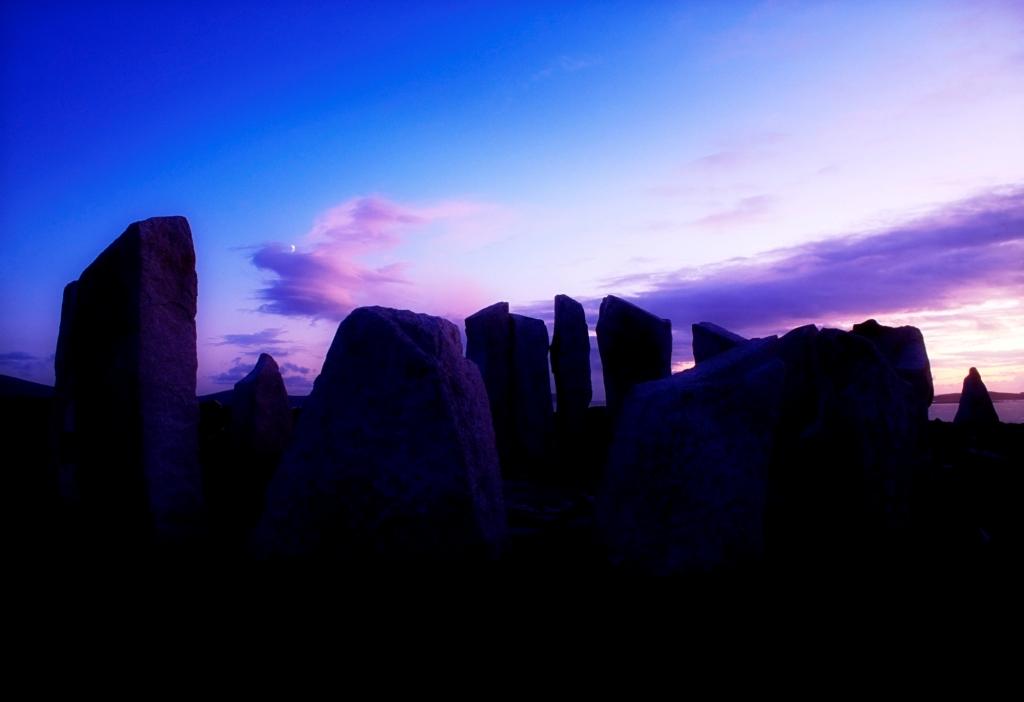
A stone circle is a prehistoric monument consisting of upright stones arranged in a roughly circular formation. In Ireland, these circles are usually relatively small compared to their British counterparts, often containing between five and twenty stones, though there are notable exceptions.
Irish stone circles typically share several characteristics:
- Carefully selected locations within the landscape
- Deliberate orientation, often toward solar or lunar events
- Stones of varying height, frequently arranged with a prominent axial stone
- A lack of domestic debris, suggesting non-residential use
Some circles contain a central stone, cairn, or altar-like feature, while others are defined purely by their perimeter.

Stone Circles, Standing Stones, and Henges: Understanding the Differences
Stone circles are often confused with other prehistoric monument types, particularly standing stones and henges.
Standing Stones
Standing stones are individual upright stones or small groups arranged in rows or lines. Across Europe, particularly in France, these are known as menhirs. Standing stones may mark territorial boundaries, ceremonial routes, or significant landscape features.
Stone Circles
Stone circles are deliberate circular arrangements of standing stones. In Ireland, they are usually Bronze Age constructions and are often integrated into ritual landscapes that include cairns, wedge tombs, and stone rows.

Henges
Henges are circular earthworks defined by banks and ditches, sometimes enclosing stones or timber structures. True henges are rare in Ireland.
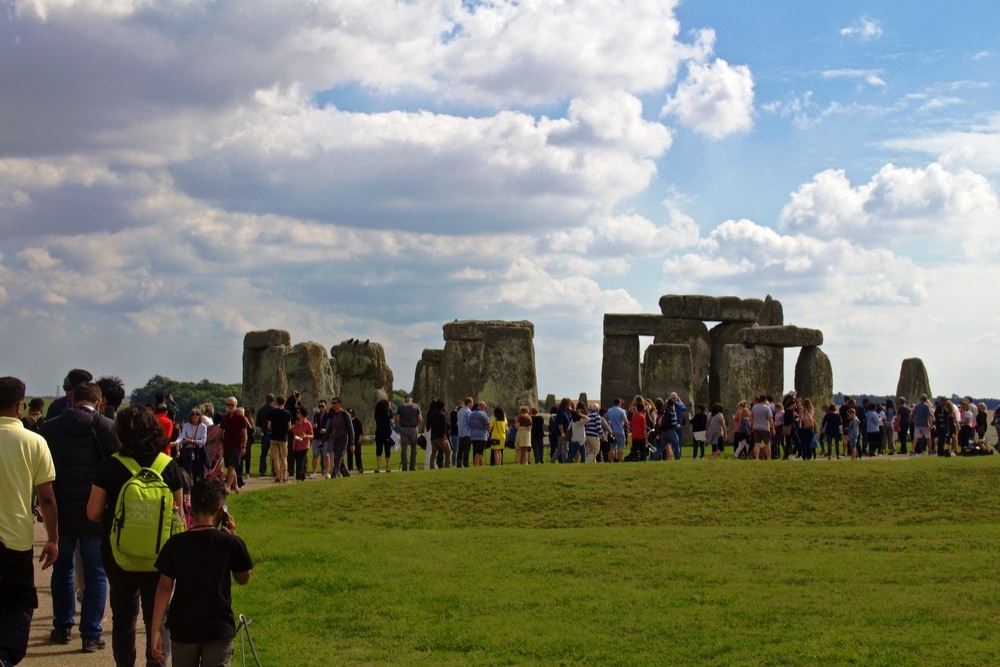
Famous British sites such as Stonehenge and Avebury are henges and should not be used as direct comparisons for Irish stone circles, which are generally smaller and more subtle.

What Were Stone Circles Used For?
Despite decades of archaeological investigation, there is no single explanation that fits every stone circle. However, several interpretations are widely accepted.
Ritual and Ceremonial Use
Most archaeologists agree that stone circles functioned as ceremonial gathering places. Their design, placement, and lack of domestic evidence strongly suggest ritual rather than everyday activity.
Astronomical Observation
Many stone circles show alignments with key solar and lunar events, particularly solstices and equinoxes. This suggests that prehistoric communities tracked seasonal change and incorporated celestial observation into their ritual practices.
Social and Symbolic Function
Stone circles may have acted as neutral meeting places where dispersed communities gathered to reinforce shared beliefs, exchange goods, and mark important moments in the agricultural calendar.
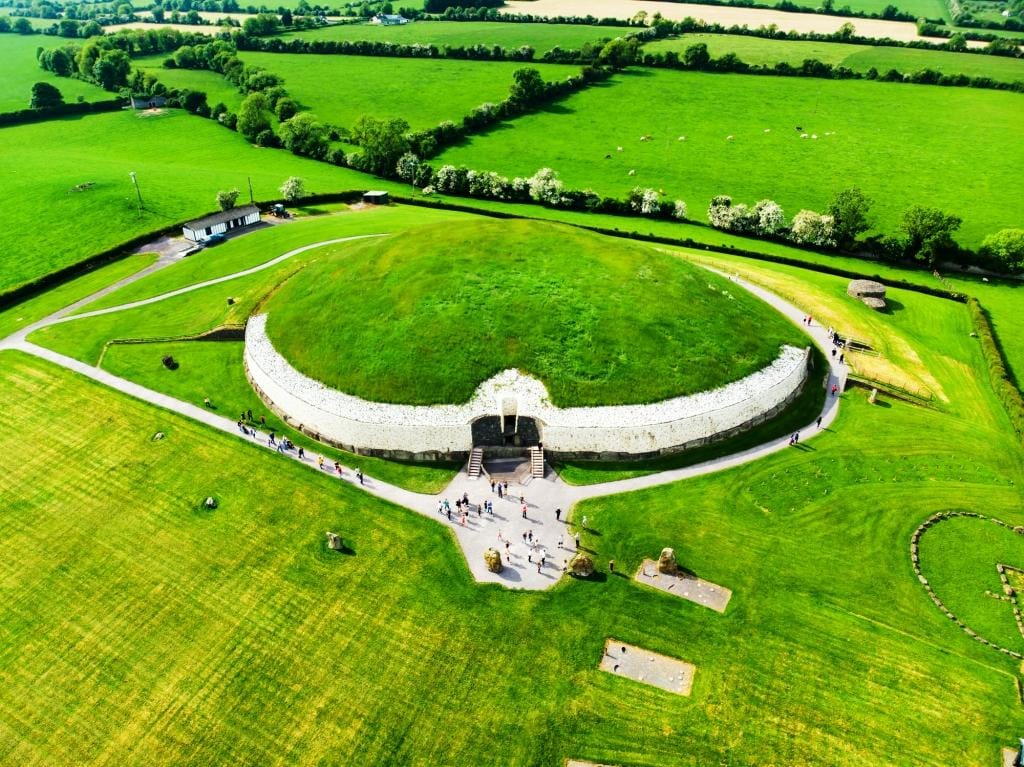
Although human remains have occasionally been found near stone circles, they are not present in sufficient quantities to suggest that most circles were burial sites. Even monuments such as Newgrange, which contains human remains, are now understood primarily as ceremonial and symbolic structures rather than simple tombs.

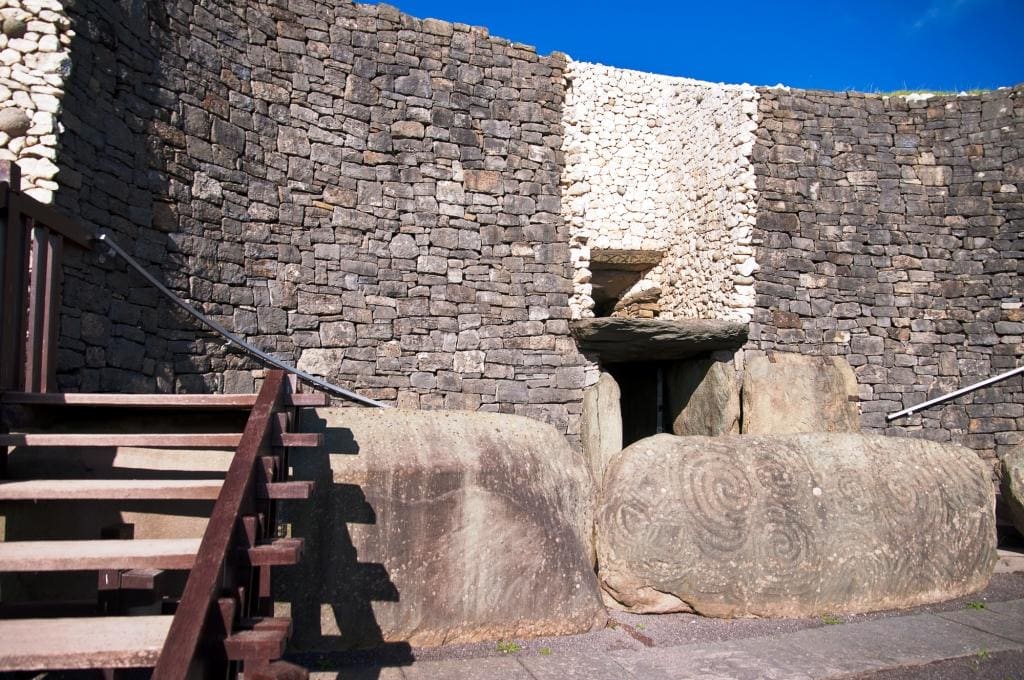
Uncover ancient Irelands standing stones
Stone circles rarely exist in isolation. Many form part of broader megalithic landscapes that include cairns, passage tombs, standing stones, and stone rows. These clusters suggest long-term use of specific areas for ritual activity.
One of the most valuable modern resources for exploring these connections is Megalithic Ireland, which provides detailed site descriptions, maps, and historical references.
Stone Circles in Northern Ireland
The Giant’s Ring, County Antrim
Located approximately 7 kilometres from Belfast city centre, the Giant’s Ring is one of the largest prehistoric monuments in Ireland. It is a true henge, consisting of a circular bank enclosing a central passage tomb and a massive standing stone. Archaeologists believe it was a major ceremonial centre during the late Neolithic period.
Accessibility: The site is accessible via a public park with relatively flat grassy terrain, though surfaces can become muddy after rain and there are no formal paved paths around the monument itself.


Ballynoe Stone Circle, County Down
Ballynoe in Down is among the largest stone circles in Ireland, containing over 50 closely spaced stones. Within the circle are burial cists containing cremated remains, indicating a complex ritual history that evolved over time.
Accessibility: Access requires a short walk along a country lane and uneven ground, which may be challenging for wheelchair users or those with limited mobility.
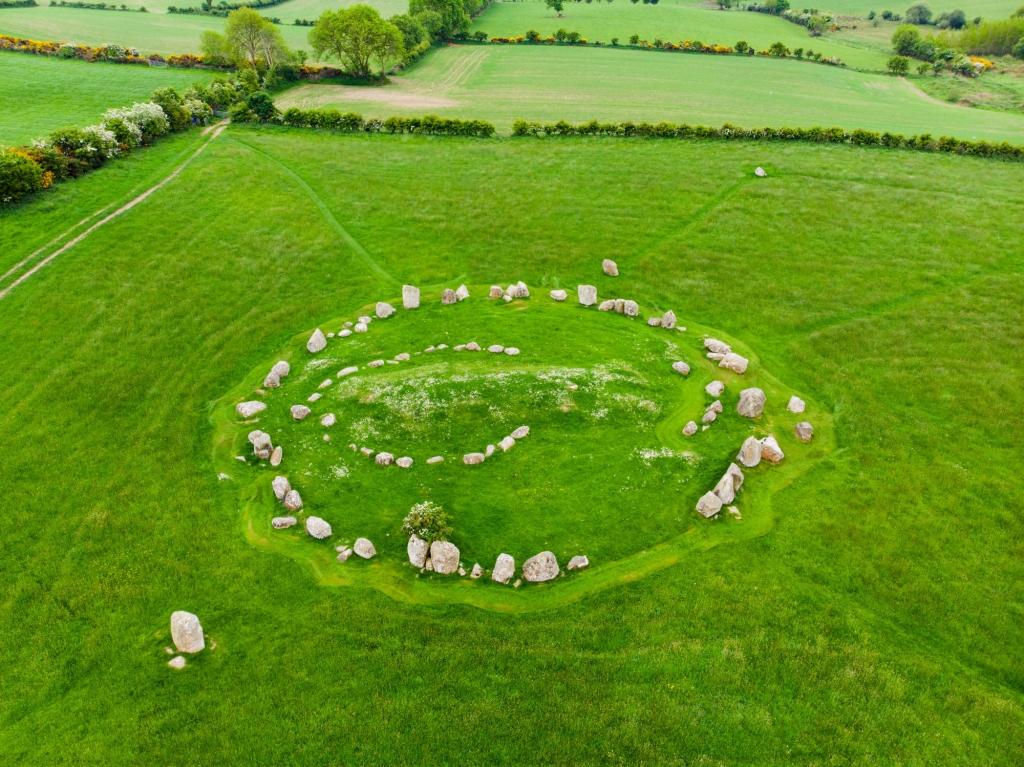
Drumskinny Stone Circle, County Fermanagh
Drumskinny in Fermanagh (home to the Janus Stone and the Stairway to Heaven) is a State Care Historic Monument and dates to approximately 2250 BC. The site consists of 39 stones surrounding a small central cairn and is easily accessible via a maintained path. Drumskinny remains overlooked. Its 39 stones form an unusually complete circle, with a small central cairn. It feels balanced, contained, and remarkably intact.
Accessibility: Drumskinny has one of the easier approaches, with roadside parking and a short maintained path, although the final section remains uneven grass.
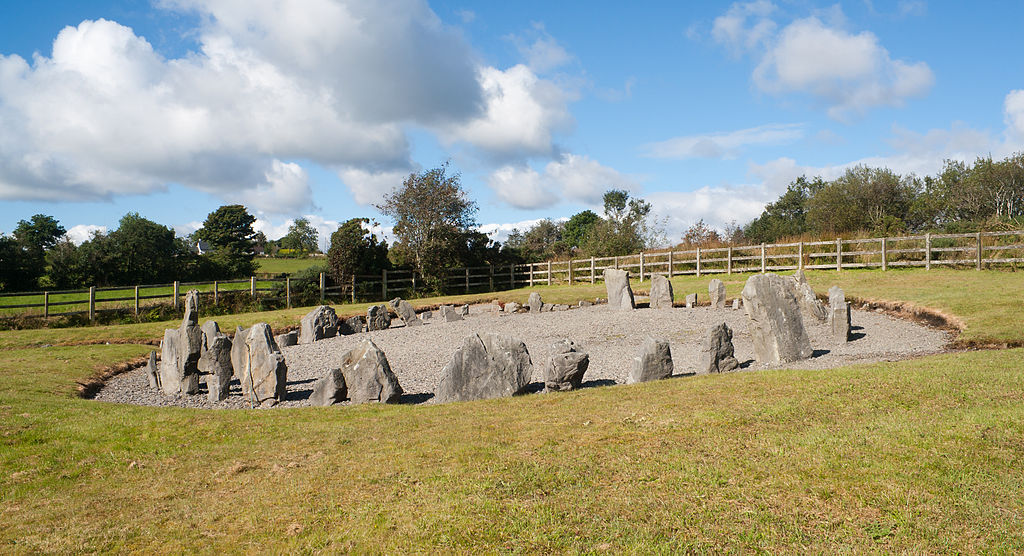
Beaghmore Stone Circles, County Tyrone
Beaghmore in Tyrone is one of the most extraordinary prehistoric landscapes in Ireland. Discovered during peat cutting in the 1940s, it contains seven stone circles, stone rows, and cairns. One circle, known as the Dragon’s Teeth, contains over 800 small stones.
Accessibility: Beaghmore provides parking and maintained paths, but visitors should expect natural surfaces and limited step-free access across the wider complex.

Clogherny Wedge Tomb and Circle, County Tyrone
Near Plumbridge, this well-preserved site features a wedge tomb surrounded by standing stones. Dating to around 2000 BC, it is a Scheduled Historic Monument and highlights the overlap between burial and ceremonial traditions.
Accessibility: Access involves rural roads and grassy ground, and while close to parking, the terrain is uneven and may not suit mobility aids.
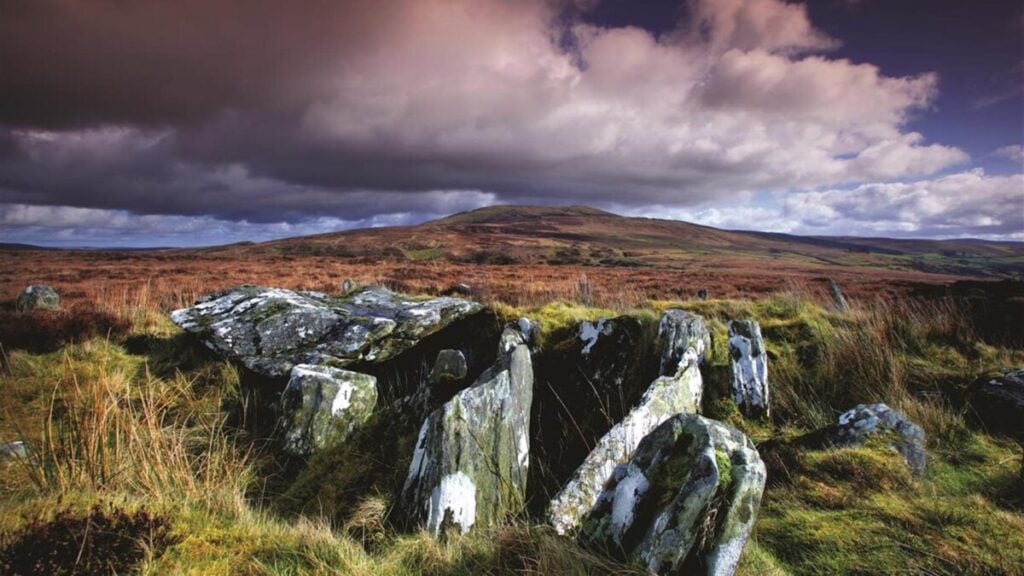
Aughlish Stone Circles, County Derry
Aughlish in Derry comprises five stone circles, stone rows, and small cairns. The subtlety of the site makes it easy to overlook, yet it represents a sophisticated prehistoric ritual landscape.
Accessibility: The site is reached via open countryside with no formal pathway, so sturdy footwear is essential and wheelchair access is not currently feasible.

Stone Circles Ireland
Beltany Stone Circle, County Donegal
Beltany was the first stone circle I ever visited, and it remains one of the most powerful. Located near Raphoe, the hilltop circle once contained up to 80 stones and commands panoramic views across Donegal. Local legend associates the site with ancient fire festivals and seasonal rites.
Accessibility: Visitors must walk uphill from a small roadside parking area along a grassy track, which may be difficult for those with mobility limitations.

Bocan Stone Circle, Inishowen Peninsula
Dating to between 1500 and 2500 BC, Bocan in Inishowen once held over 30 stones. Although several have been lost, the site remains a protected national monument and retains strong connections to local folklore. Rarely visited weathered stones emerge from rough pasture, and the site feels deeply embedded in local folklore rather than tourism. It is one of Donegal’s most atmospheric prehistoric monuments.
Accessibility: Access is via farmland and uneven ground, and visitors should check conditions locally as there are no formal facilities or paved paths.
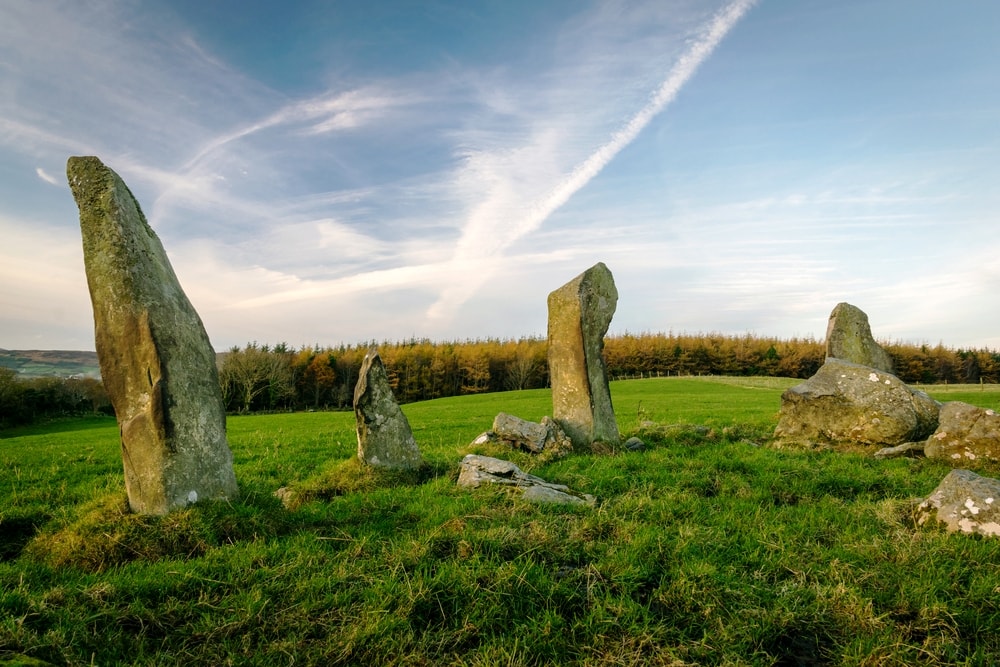
Carrowmore Megalithic Complex, County Sligo
Carrowmore is Ireland’s largest and oldest megalithic cemetery, with monuments dating back more than 6,000 years. Historian George Petrie recorded over 65 monuments in the 19th century; approximately 40 survive today.
Accessibility: Carrowmore Sligo has a visitor centre with parking and managed walkways, though some outer monuments require walking across grass and gravel paths.
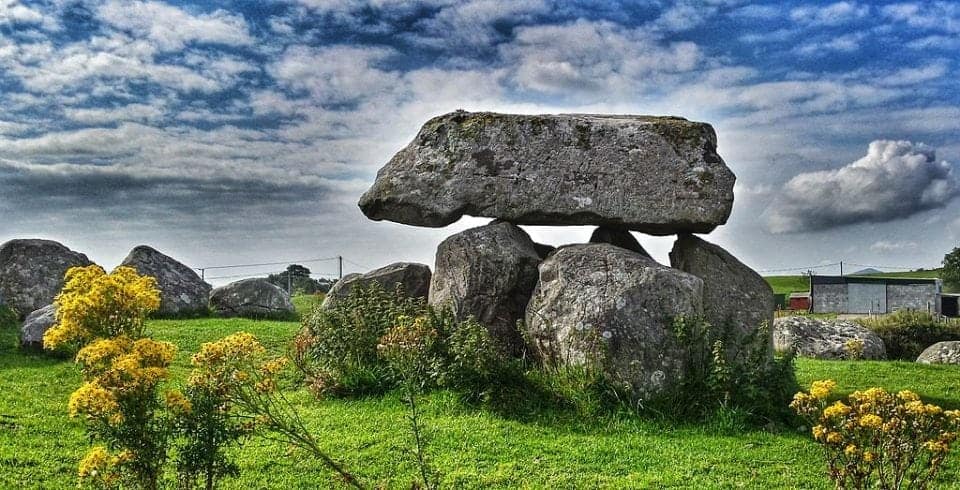
Knocknarea and Queen Maeve’s Cairn, Sligo
Knocknarea rises dramatically above the surrounding landscape and is crowned by Queen Maeve’s cairn. Sadly, modern foot traffic has caused damage, and visitors are urged not to climb the cairn.
Accessibility: The summit requires a steep uphill walk on a gravel path; this is not suitable for wheelchairs and can be strenuous even for able-bodied visitors.

Glebe Stone Circles, County Mayo
Near Cong, the Glebe complex contains four stone circles alongside cairns, forts, caves, and standing stones. The density of monuments indicates prolonged ceremonial use.
Accessibility: Access involves open farmland with uneven surfaces, and there are no designated paths or accessibility features in place.

Knappogue Stone Circle, County Clare
Located beside Knappogue Castle (about an hours drive from the Cliffs of Moher) this limestone circle sits within a broader prehistoric landscape that includes wedge tombs and stone rows. The stones bear the marks of centuries of Atlantic weather.
Accessibility: Located near a roadside entrance, the circle is relatively easy to approach, though the ground around the stones remains natural and uneven.

Drombeg Stone Circle, County Cork
Known as the Druid’s Altar, Drombeg is Ireland’s most visited stone circle. Excavations revealed human remains and a nearby fulacht fiadh. The circle is aligned with the winter solstice sunset and is protected under the National Monuments Act.
Accessibility: Drombeg has a small car park and a maintained path to the circle, making it one of the more accessible sites, although surfaces are still gravel and grass.
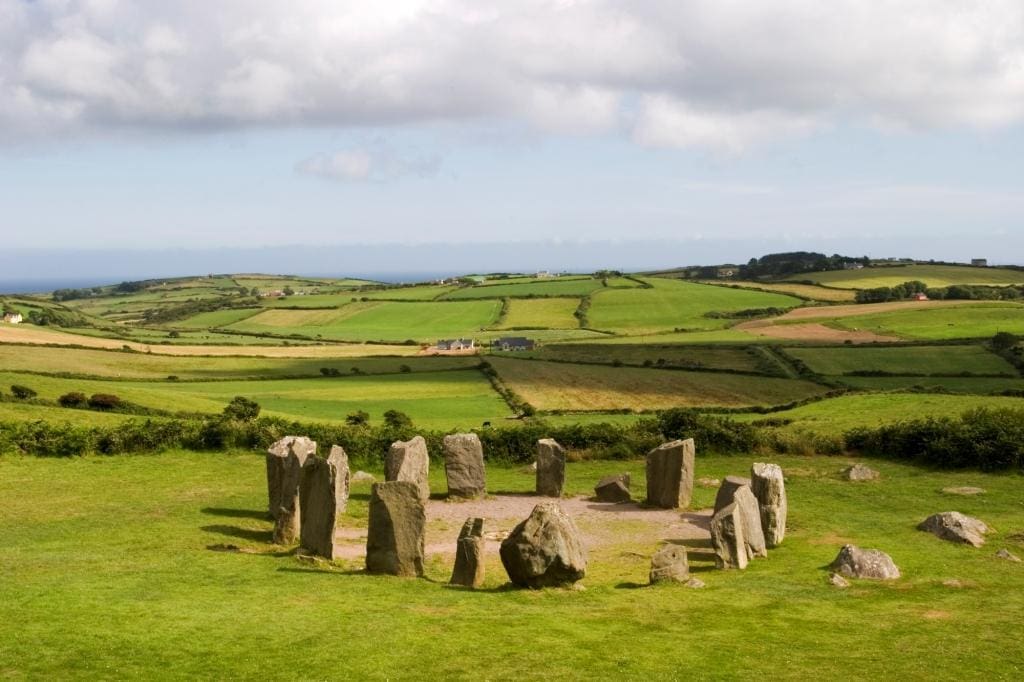
Grange Stone Circle, County Limerick
Near Lough Gur, Grange contains 113 stones and a central post hole. Archaeological studies suggest alignment with Samhain sunset, linking the monument to seasonal ritual observance.
Accessibility: Situated near Lough Gur, the circle benefits from nearby parking and relatively level access, but the monument itself sits on natural ground.

Kenmare Stone Circle, County Kerry
Known as The Shrubberies, this egg-shaped circle contains a central dolmen. Although tree growth now obscures its original views, the site remains one of Ireland’s largest stone circles.
Accessibility: Located within walking distance of Kenmare town centre, access is straightforward via a short path, though surfaces are grassy rather than paved.

Kealkil Stone Circle, County Cork
This small but dramatic circle lies near Carriganass Castle. Two stones originally stood over four metres high, and the site offers sweeping views across Bantry Bay.
Accessibility: Reaching Kealkil involves a steady uphill walk along a rural road and grassy terrain, which may not be suitable for those with limited mobility.
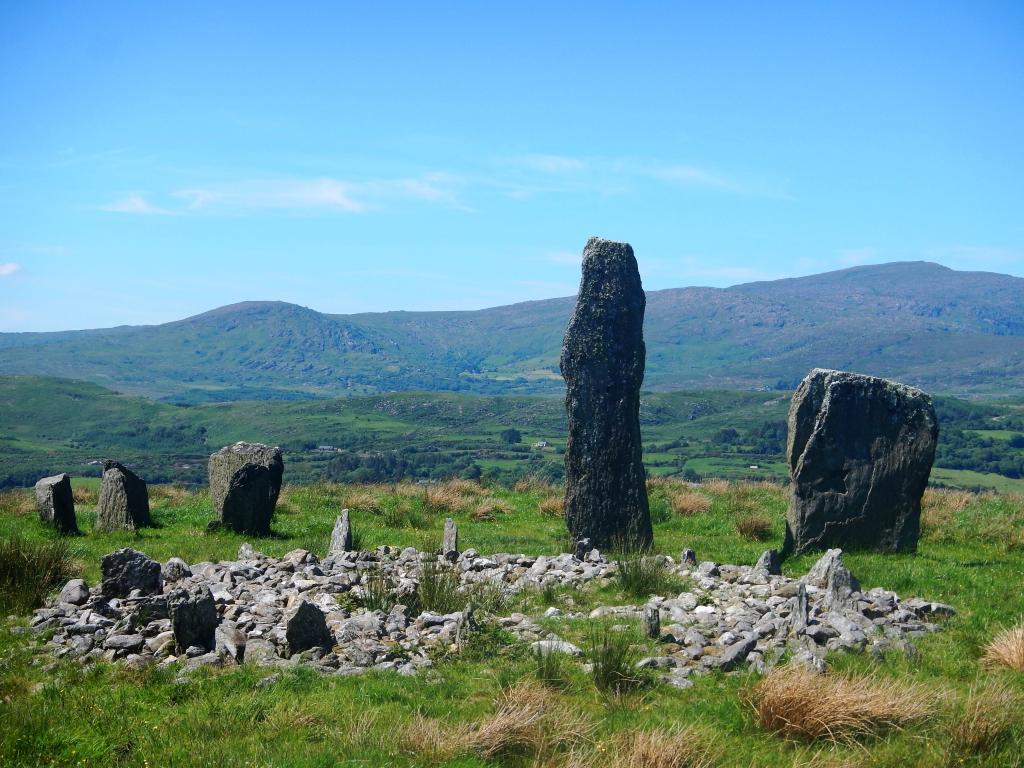
Uragh Stone Circle, County Kerry
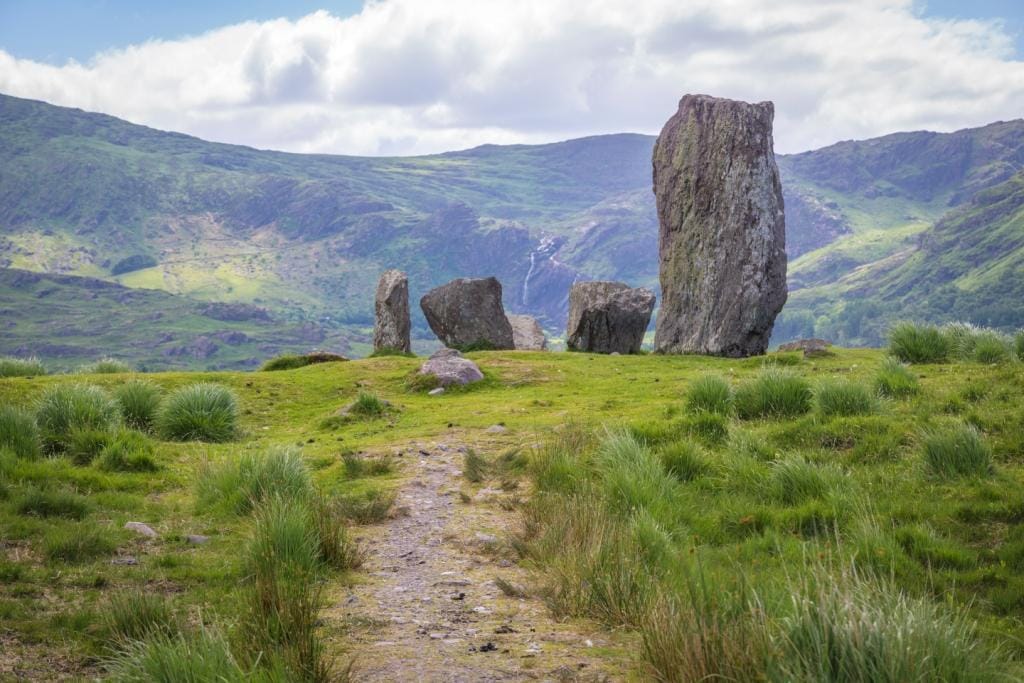
Uragh is one of the most visually stunning stone circles in Ireland. Dominated by a tall axial stone, it sits beneath rugged mountains and overlooks Inchaquin Waterfall. A hidden gem with its remote location and dramatic landscape
Accessibility: A short uphill walk from roadside parking is required, and while not long, the path is uneven and may present difficulty for wheelchair users.
Ardgroom Stone Circle, County Cork
Situated on the Beara Peninsula, this circle offers outstanding views over Kenmare Bay. Nine stones remain standing, with a flat slab within the circle.
Accessibility: Located close to the roadside with a small lay-by, Ardgroom is relatively easy to reach, though the immediate ground around the stones is natural grass.

Athgreany (The Piper’s Stones), County Wicklow
Athgreany translates as “Field of the Sun.” Fourteen stones remain, along with a central hawthorn tree. Local folklore speaks of petrified dancers and a piper punished for breaking the Sabbath.
Accessibility: The circle is accessible from a small roadside parking area, but visitors must cross uneven grass and low vegetation to reach the stones.

Conservation, Access, and Respect
Many stone circles are located on private farmland. Visitors should always:
- Ask permission where required
- Respect livestock and crops
- Avoid climbing or disturbing stones
- Leave no trace
Organisations such as the Archaeology Ireland and the National Monuments Service emphasise that these sites are irreplaceable cultural resources.

Final Reflections
Stone circles in Ireland are not simply relics of the past. They are enduring expressions of how prehistoric communities understood time, landscape, and meaning. Standing within one today, with the wind moving through grass that has grown undisturbed for millennia, it becomes clear why these places continue to matter.
They ask us to slow down, to listen, and to remember that long before modern Ireland existed, people gathered here to mark the turning of the world.
Start Planning Your Trip
👉 Public Transportation in Ireland
👉 Hidden Gems in Ireland – 32 Secret places to visit
👉 Answering all your travel questions about Ireland
👉What to pack for your Ireland trip
👉 Northern Ireland Public Transportation
I’m so happy to have seen this site.
We were to go to Ireland this past October but it was closed due to covid.
We will go next year,with the help of God. I will be looking forward to your next post.
My Father in law was born and raised in County Roscommon, we went about ten years ago,and I can’t wait to get back there. I have a friend who lives in Dublin,so that will be my first stop.
Thanks Again, Catherine
Thank you that makes my day, hopefully, my stories are useful to you. If you have any questions please feel free to ask. I know you will have a fabulous time next year when everything opens up again.