
Every Game of Thrones Filming Location in Ireland You Can Actually Visit (Updated 2026/27)
Northern Ireland is the world capital of Game of Thrones filming locations, with more than 25 real sites spread across Counties Antrim and Down. Most are free to visit, a few charge modest entry fees, and the official Game of Thrones Studio Tour in Banbridge (tickets from around £39.50 per adult) is the one indoor experience worth building your trip around. House of the Dragon filmed primarily in England, Spain and Portugal, not Ireland. The newest Westeros spinoff, A Knight of the Seven Kingdoms, returned to Northern Ireland in 2024 and premiered in January 2026.
Ireland transformed into Westeros over eight seasons of HBO’s Game of Thrones, and the landscapes that stood in for Winterfell, the Iron Islands, the Kingsroad and beyond are still right there, waiting. I have been to every one of these locations more than once, usually dragging willing accomplices who became converts by the end of the day. Some of these places are genuinely jaw-dropping in their own right and would earn a visit even if you had never seen a single episode. Check out my Northern Ireland Travel Tips Guide before you go.
This guide covers every major Game of Thrones filming site in Ireland and Northern Ireland, the real story on House of the Dragon and its successor A Knight of the Seven Kingdoms, and the global locations from Croatia to Morocco. I have added current prices, parking details, accessibility notes and places to eat and sleep near each site, because a great trip is about more than finding the right Instagram spot.

- Every Game of Thrones Filming Location in Ireland You Can Actually Visit (Updated 2026/27)
- The Top 5 Game of Thrones Filming Locations in Northern Ireland
- How to Plan Your Game of Thrones Filming Locations Trip
- Game of Thrones Filming Locations in Northern Ireland: The Complete Guide
- The Game of Thrones Studio Tour: Everything You Need to Know
- A Knight of the Seven Kingdoms: New Filming Locations in Northern Ireland (2026)
- A Knight of the Seven Kingdoms filming locations in Northern Ireland: (all publicly accessible except Galboly)
- Game of Thrones Filming Locations Around the World
- A Personal Note on Visiting These Places
- Frequently Asked Questions About Game of Thrones Filming Locations in Ireland
- Walking Through Westeros
The Top 5 Game of Thrones Filming Locations in Northern Ireland
If you have limited time, these five deliver the most impact and cover the widest range of what made Northern Ireland Westeros.
- Castle Ward (Winterfell) – The Stark family home, with archery experiences and the actual courtyard arch from Season 1. National Trust Castle Ward
- The Dark Hedges (Kingsroad) – One of the most photographed spots in Ireland, now pedestrian-only to protect the trees.
- Ballintoy Harbour (Lordsport, Iron Islands) – Small, rugged harbour with filming plaques and direct connections to Theon Greyjoy’s return to House Greyjoy’s lands.
- Cushendun Caves (where Melisandre’s shadow was born) – Atmospheric, free to visit and impossible to forget.
- Game of Thrones Studio Tour (Banbridge) – The only place to see original sets, costumes and props from inside. Book here
How to Plan Your Game of Thrones Filming Locations Trip
Getting to and around the filming locations in Northern Ireland is straightforward if you plan ahead. Renting a car gives you the most freedom; several sites, including Ballintoy Harbour and Murlough Bay, are not accessible by public transport.
Best time to visit:
May through September gives you the best weather and longest daylight hours. That said, a misty November morning at the Dark Hedges is something quite different, and crowds are much thinner from October onward.
Suggested itineraries:
- One Day: Castle Ward, Ballintoy Harbour, Dark Hedges (combine all three in a single Causeway Coast loop from Belfast).
- Three Days: Add Cushendun Caves, Downhill Strand, the Studio Tour and Fair Head.
- Five Days: The full Westeros tour, including Tollymore Forest, Dunluce Castle, Larrybane Quarry and overnight stays near each cluster of sites.
- Family visit: Start with the Studio Tour at Banbridge, then Castle Ward with its archery experiences and playground.

Game of Thrones Filming Locations in Northern Ireland: The Complete Guide
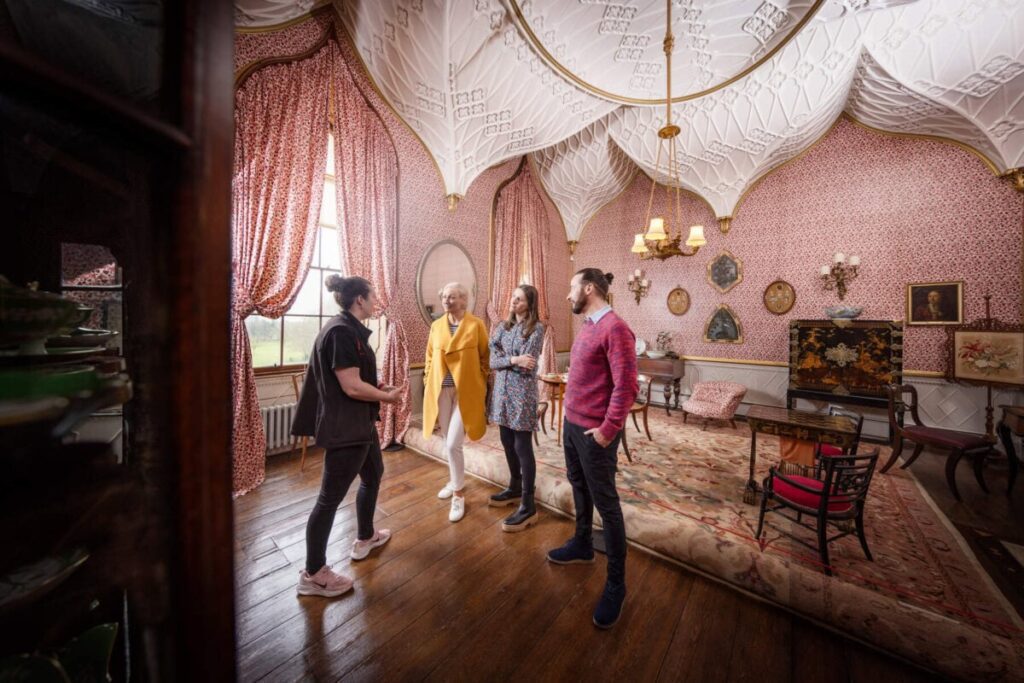
Castle Ward (Winterfell) – Near Strangford, Co. Down
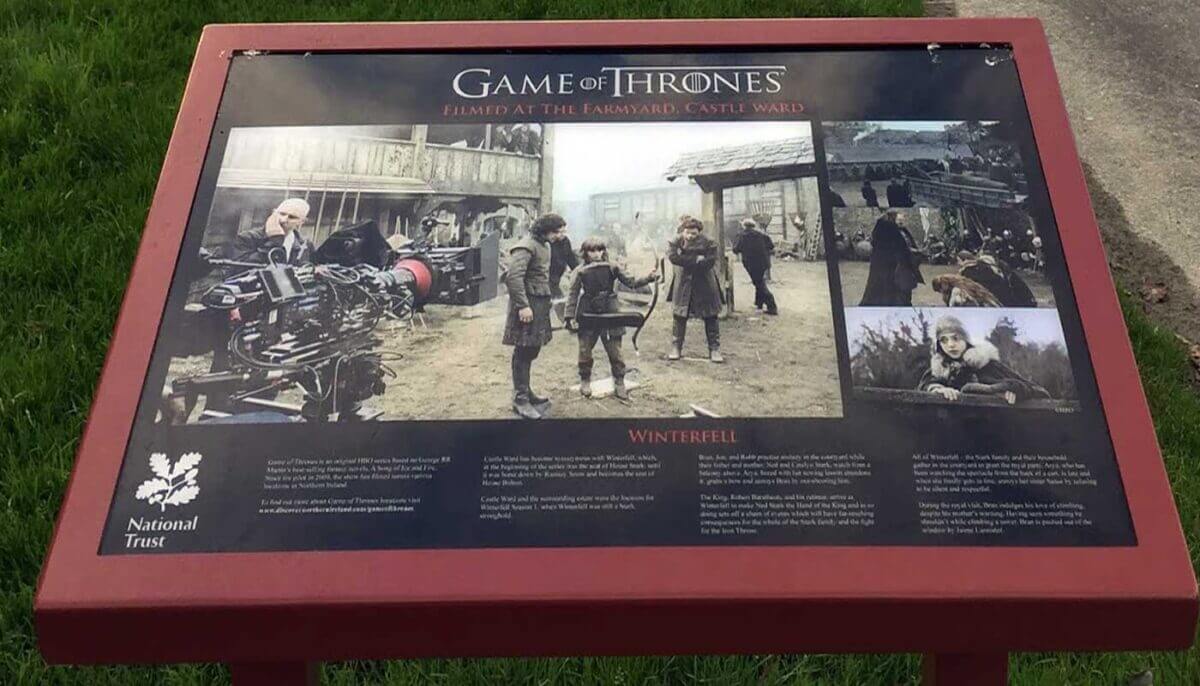
Castle Ward is as close to a pilgrimage site as this guide gets. The 18th-century estate managed by the National Trust was transformed into Winterfell for Season 1, and the historic farmyard and clock tower remain instantly recognisable. You can try archery on a replica Winterfell set, meet the Northern Inuit dogs that played the Stark direwolves, and pick up a filming location map at the visitor reception.
This is one of those rare places where the filming location is genuinely beautiful on its own terms, with 32km of trails through woodland and along the shores of Strangford Lough. Allow two to three hours minimum. The stableyard tea-room does excellent lunches, and there is a gift shop and second-hand bookshop.
- Tickets: £13.20 adults, £6.60 children. Free for National Trust members. Parking: Free with entry. Blue Badge spaces in the main accessible car park and the Trails Car Park. On busy days a shuttle bus runs between the overflow car park and the Stableyard.
- Accessibility: Wheelchairs, mobility scooters and sensory packs available to borrow from Visitor Reception (book in advance). Step-free access to Visitor Reception, bookshop, Stableyard picnic area and some garden areas. Some routes have steep slopes; shuttle available on busy days.
- Eating: Stableyard tea-room on site, serving hot and cold food. Strangford village is a 15-minute walk with pubs and restaurants. Staying: National Trust holiday cottages on the estate (Downpatrick Gate Lodge, The Potter’s Cottage and Gamekeeper’s Lodge). Caravan park with pitches and camping pods also on site.


The Dark Hedges (Kingsroad) – Near Ballymoney, Co. Antrim
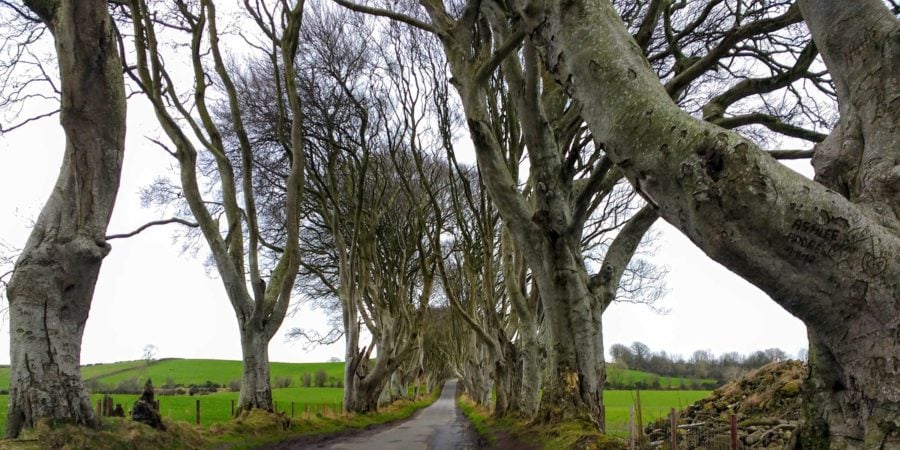
The tunnel of ancient beech trees planted in 1775 by the Stuart family became the Kingsroad in Season 2, the road Arya Stark and Gendry walked away from King’s Landing. It is one of the most photographed places in the whole of Ireland, and rightly so. The trees have weathered storms and tourism pressure, and several have fallen over the years, but what remains is still otherworldly.
Cars have been banned from Bregagh Road since 2019 to protect the root systems. Free parking is available at The Hedges Hotel a short walk away. Arrive before 8am if you want the road to yourself; by mid-morning the tour coaches have found it.

- Cost: Free to visit. Parking: Free car park at The Hedges Hotel, short walk to the trees. Cars are no longer permitted on Bregagh Road itself.
- Accessibility: The road surface is uneven in places. Wheelchair access is possible along the avenue but the ground is not fully level.
- Eating: The Hedges Hotel has a bar and restaurant on site, and they also have facilities for disabled guests.
Ballintoy Harbour (Lordsport Harbour, Iron Islands, House Greyjoy) – Co. Antrim
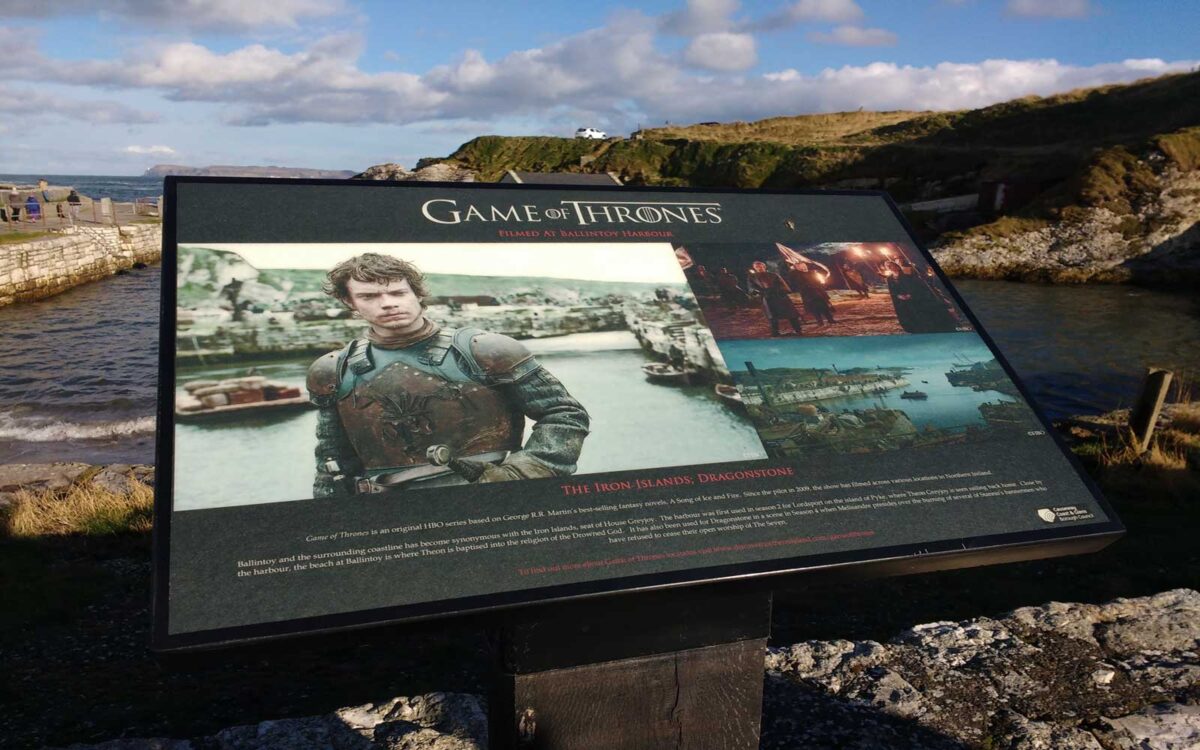
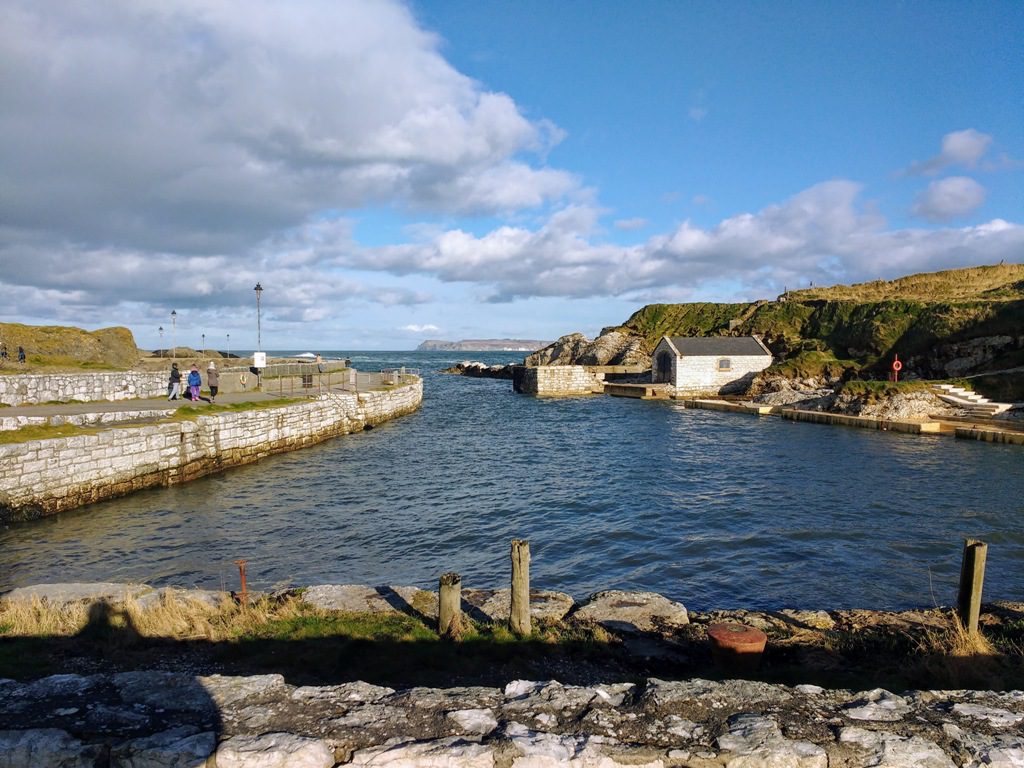
Ballintoy Harbour is the spot where Theon Greyjoy stepped ashore to return to his family’s Iron Islands seat in Season 2. The rugged harbour, backed by limestone cliffs, is visually striking and unmistakably the world of House Greyjoy. A plaque at the harbour explains the filming connection.
The road down to the harbour is steep and narrow. Arrive early in the morning or in the early evening to avoid tour buses and to catch the best light on the rocks. Wear shoes with grip; the rocks are slippery at any time of year.
- Where: Ballintoy, Co. Antrim. Cost: Free to visit. Parking: Small car park at the top of the hill above the harbour. Limited spaces. Limited Blue Badge provision at the harbour itself due to the narrow road.
- Accessibility: The descent to the harbour is steep and the surface is uneven. The harbour itself is not suitable for wheelchairs without assistance.
- Eating: Roark’s Kitchen at the harbour serves hot drinks and light snacks in season. The village of Ballintoy a short drive away has a small tearoom.
Cushendun Caves (Where Melisandre’s Shadow Was Born) – Co. Antrim
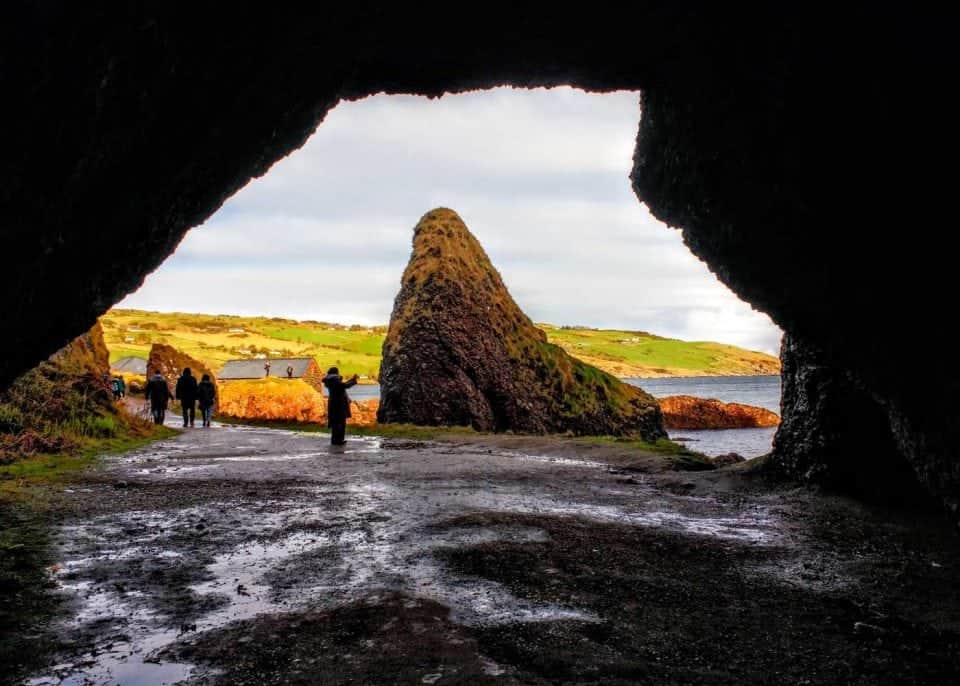
Few moments in Game of Thrones were more unsettling than the one filmed inside these ancient red sandstone caves in Season 2, Episode 4. Melisandre gave birth to the shadow assassin here, and standing inside the caves today, you understand exactly why the location was chosen. They are atmospheric in a way that goes beyond the filming connection.
The caves are a short coastal walk from the pretty village of Cushendun, which was built in the style of a Cornish village and is itself managed by the National Trust. Check tide times before visiting; access can be limited at high water. Allow 30 minutes for the site, longer if you want to explore the village.
- Where: Near Cushendun village, Co. Antrim. Cost: Free. Parking: Small car park in Cushendun village, short coastal walk to the caves.
- Accessibility: The path to the caves involves uneven coastal terrain. Not suitable for wheelchairs without significant assistance.
- Eating: Mary McBride’s Bar and Restaurant in Cushendun village is a local institution.

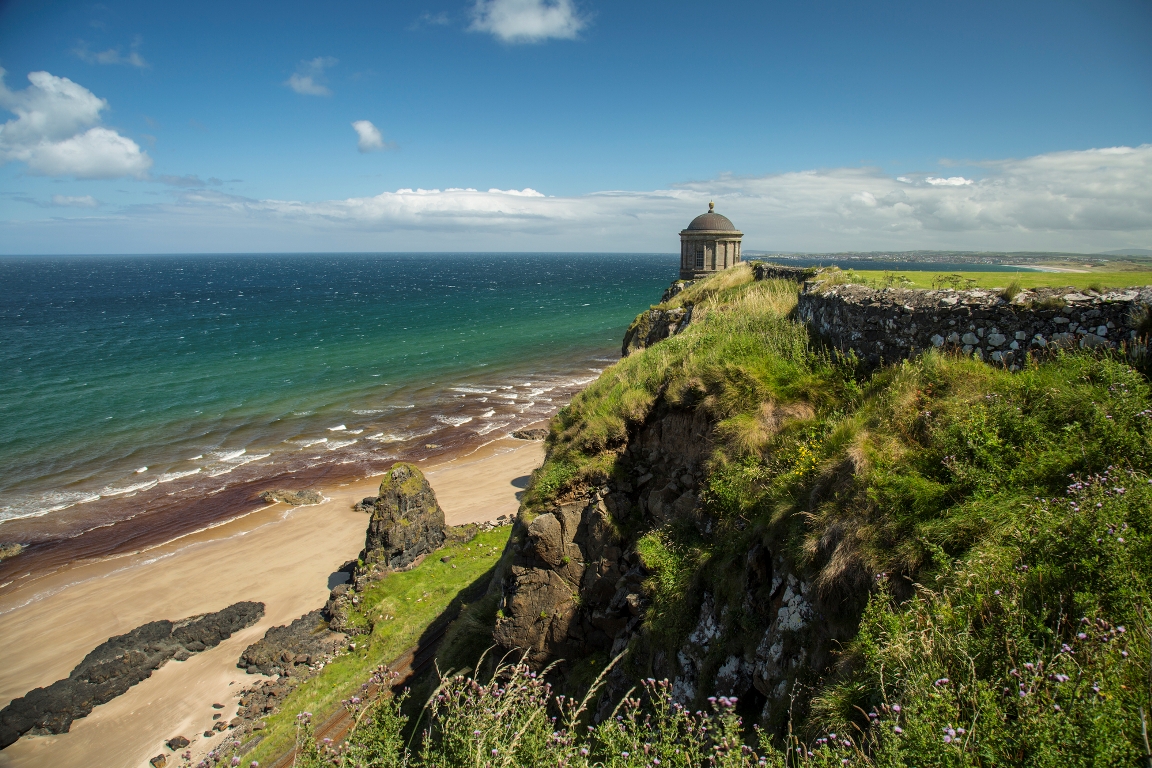
Downhill Strand and Mussenden Temple (Dragonstone) – Near Castlerock, Co. Londonderry
This is one of the most visually striking locations on this entire list, and it doubles up beautifully. Downhill Strand served as Dragonstone’s beach in Season 2, where Stannis Baratheon burned the statues of the Seven gods under Melisandre’s influence. Looking down from the clifftop, with Mussenden Temple balanced on the edge above, you get a scene that needs no CGI at all.
Combine both in a single visit. The beach is accessible directly from Castlerock train station, which makes it one of the few filming sites you can reach without a car. The National Trust manages Downhill Demesne and Mussenden Temple. Tide times matter if you want to walk the full length of the strand.

- Where: Below Mussenden Temple Cost: Pay and display parking at Lion’s Gate (check current signage, approximately £5 per vehicle). The beach itself is free. Mussenden Temple and demesne have a separate National Trust entry fee. Parking: Lion’s Gate car park off Mussenden Road. Blue Badge parking available in the National Trust car park. Castlerock train station is within walking distance of the beach for those travelling without a car.
- Accessibility: Mussenden Temple area has a level path to the cliff-edge viewpoint. The beach involves a descent and is on soft sand, less suitable for wheelchairs.
- Eating: No on-site cafe at the demesne. Castlerock village is a short drive or walk and has a handful of cafes.
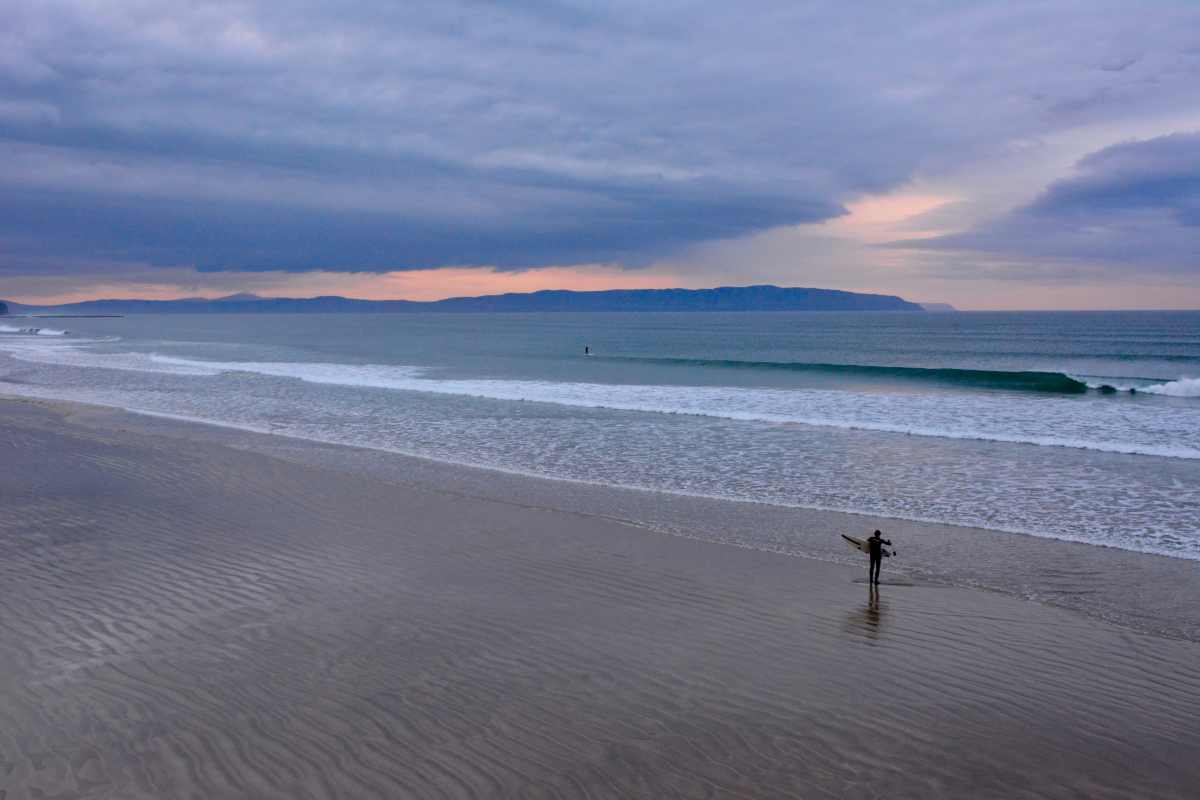
Portstewart Strand (Dorne, the Sand Snakes) – Co. Londonderry
Portstewart Strand is one of the finest beaches in Northern Ireland and deserves a visit on those merits alone. For Game of Thrones fans it holds a specific significance: this was Dorne, where Ellaria Sand and the Sand Snakes plotted against the Lannisters, and where Jaime Lannister and Bronn were captured by Dornish soldiers.
The National Trust manages Portstewart Strand. In summer, cars can drive onto the beach, which is one of the more unusual experiences on the whole Causeway Coast. The dune system is an important nature reserve.
- Where: Portstewart, Co. Londonderry. Cost: National Trust car park fees apply. Free for National Trust members. Parking: National Trust car park at the strand entrance. Blue Badge spaces available. In summer, limited vehicle access to the beach itself.
- Accessibility: Hard-packed sand at the top of the beach is manageable for wheelchairs at low tide. Soft sand further down is more difficult.
Dunluce Castle (Pyke, House Greyjoy’s Seat) – Near Bushmills, Co. Antrim
Dunluce Castle needs no fictional connection to justify a visit. The 16th-century ruin hanging off sea cliffs above the Atlantic is one of the most dramatic medieval sites in Ireland, and it is easy to see why it stood in for Pyke, the seat of House Greyjoy and the Iron Islands. The silhouette alone is worth the detour.
There is a visitor centre, a cafe, and the ruins are accessible. Visit at low tide to see coastal features and rock formations not visible at high water. Sunset here is dramatic.

- Where: Dunluce Road, Bushmills, Co. Antrim. Near the Causeway Coastal Route. Cost: Approximately £5.50 per adult. Parking on site (free or included). Parking: Car park adjacent to the castle. Blue Badge spaces available.
- Accessibility: The visitor centre is accessible. The ruins involve uneven ground and steps; some areas are not accessible by wheelchair.
- Eating: On-site cafe. Old Bushmills Distillery, one of the world’s oldest working whiskey distilleries, is a short drive away and has a restaurant.
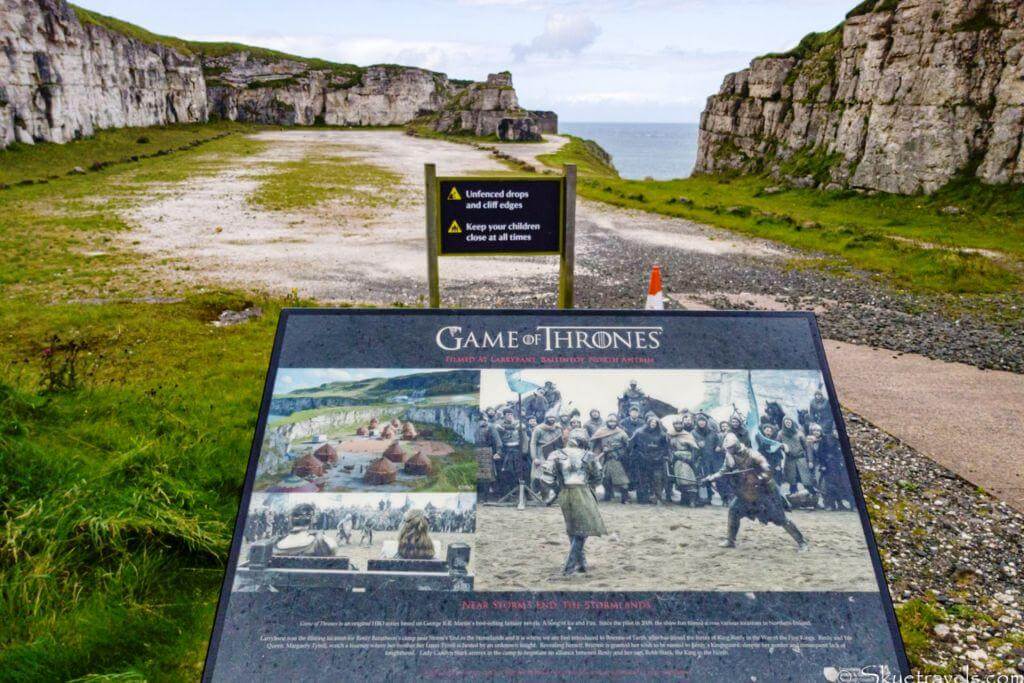
Larrybane Quarry (Renly’s Camp, Brienne’s Duel) – Co. Antrim
This clifftop quarry near the Giant’s Causeway coast served as Renly Baratheon’s tournament camp in Season 2, where Brienne of Tarth defeated Ser Loras Tyrell and earned her place in Renly’s Kingsguard. The quarry itself is not publicly accessible, but viewpoints from public land give you the scale of the setting.
Where: Near Carrick-a-Rede and Ballintoy, Co. Antrim. Cost: Free from public viewpoints. The quarry floor is not open to the public.
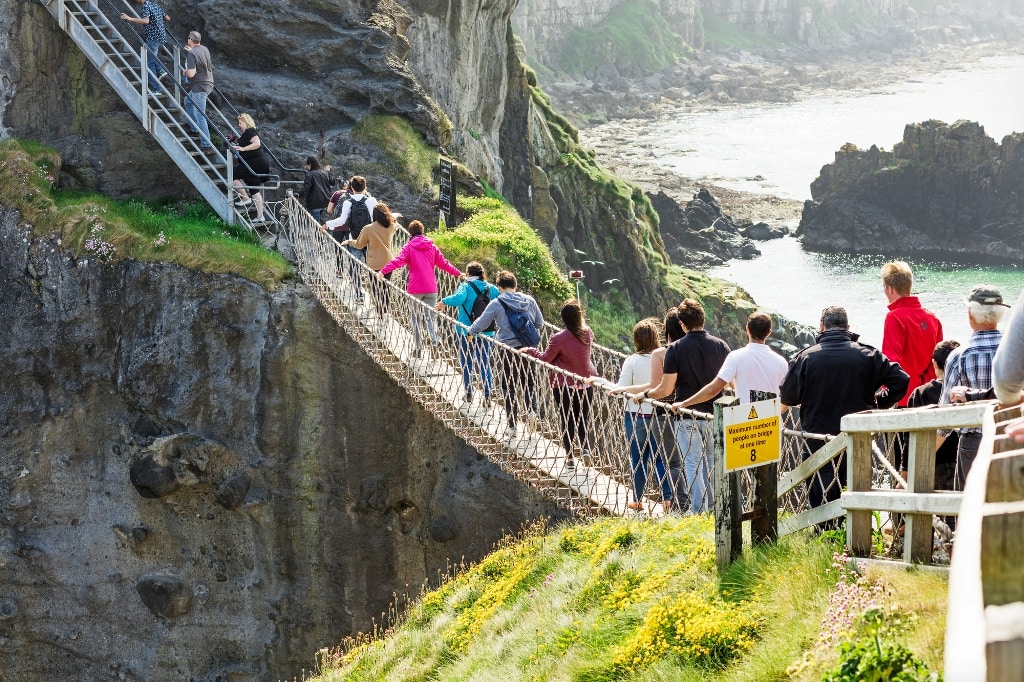
Tip: Combine with Carrick-a-Rede Rope Bridge (National Trust, tickets required) for a half-day coastal loop.
Credit: Skyetravels.com
Tollymore Forest Park (Where the Starks Found the Direwolves) – Near Newcastle, Co. Down
The filming location for the iconic opening of Game of Thrones, where the Stark children discover the direwolf pups, is one of Northern Ireland’s most beautiful forest parks. Ancient stone bridges, gothic arches, the River Shimna rushing through the trees, and the Mourne Mountains visible on the horizon on a clear day: it is worth every minute.
Tollymore also returned to the Westeros map in 2024, used for exterior scenes in A Knight of the Seven Kingdoms. It is one of the most accessible filming locations on this list, with well-maintained marked trails. Waterproof footwear is recommended; parts of the park are muddy after rain.

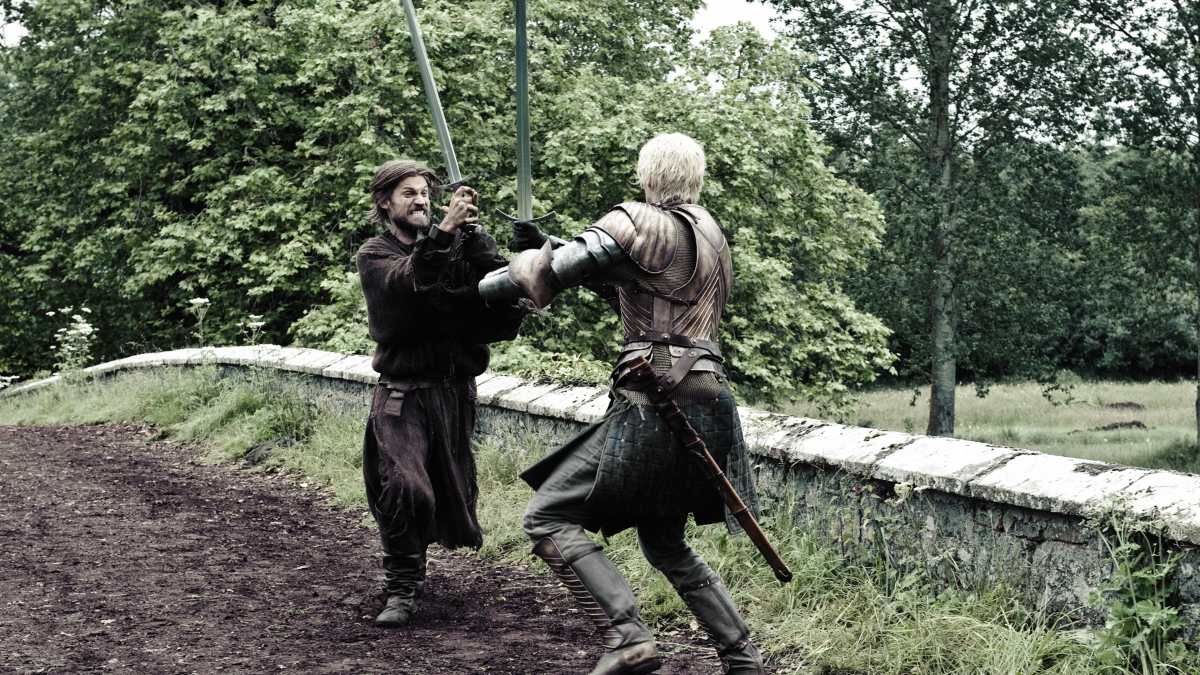
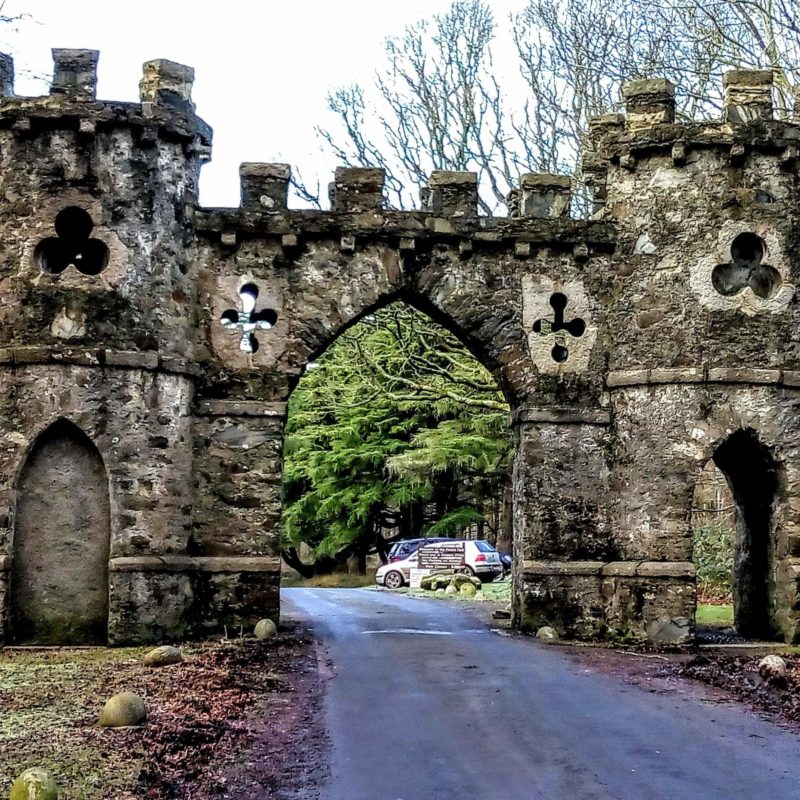
- Where: Near Newcastle, Co. Down, in the foothills of the Mourne Mountains. Cost: Modest car entry fee (check nidirect for current rates). Guided Game of Thrones walks available from some local operators, approximately £8-£10.
- Parking: Main car park at the entrance. Suitable for standard and accessible vehicles. Accessibility: Main trails are well-maintained paths. Some areas are steep or uneven. The flat riverside path is the most accessible route.
- Eating: Newcastle town, a short drive away, has cafes, restaurants and chip shops. No on-site cafe in the park.
Fair Head (Jon and Daenerys, Dragonstone Cliffs) – Co. Antrim
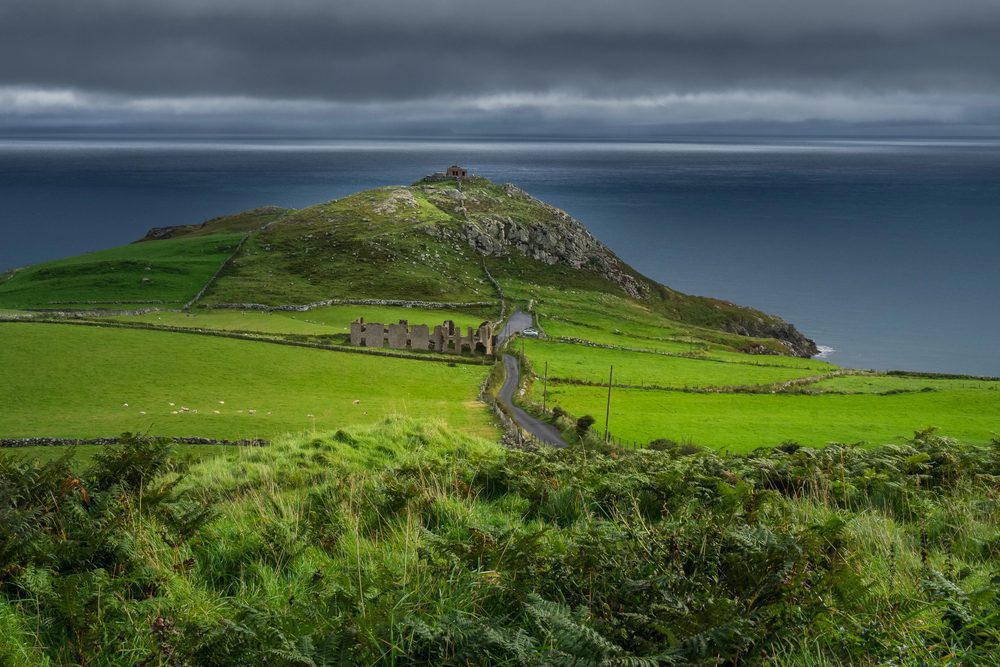
Fair Head’s basalt cliffs rising around 600 feet above the sea provided the dramatic backdrop for the meeting between Jon Snow and Daenerys Targaryen, and for wide-angle Dragonstone exterior shots. On a clear day you can see the Scottish island of Rathlin and the Mull of Kintyre from the clifftop.
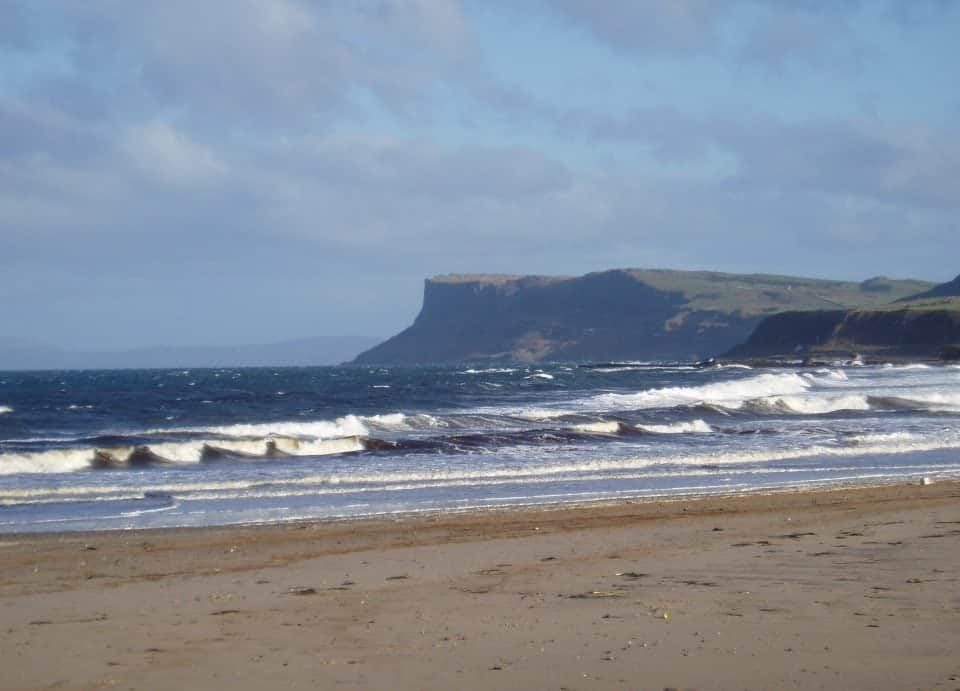
- Where: North Antrim coast. Cost: Free. Small car park fee may apply. The land is private farmland with permissive access; respect any seasonal restrictions.
- Parking: Small car park near the trail head. Accessibility: The walk to the cliff edge is steep and uneven. Not suitable for wheelchairs. Suitable footwear essential.
- Note: Access may be restricted during lambing season. Check locally before visiting in spring.
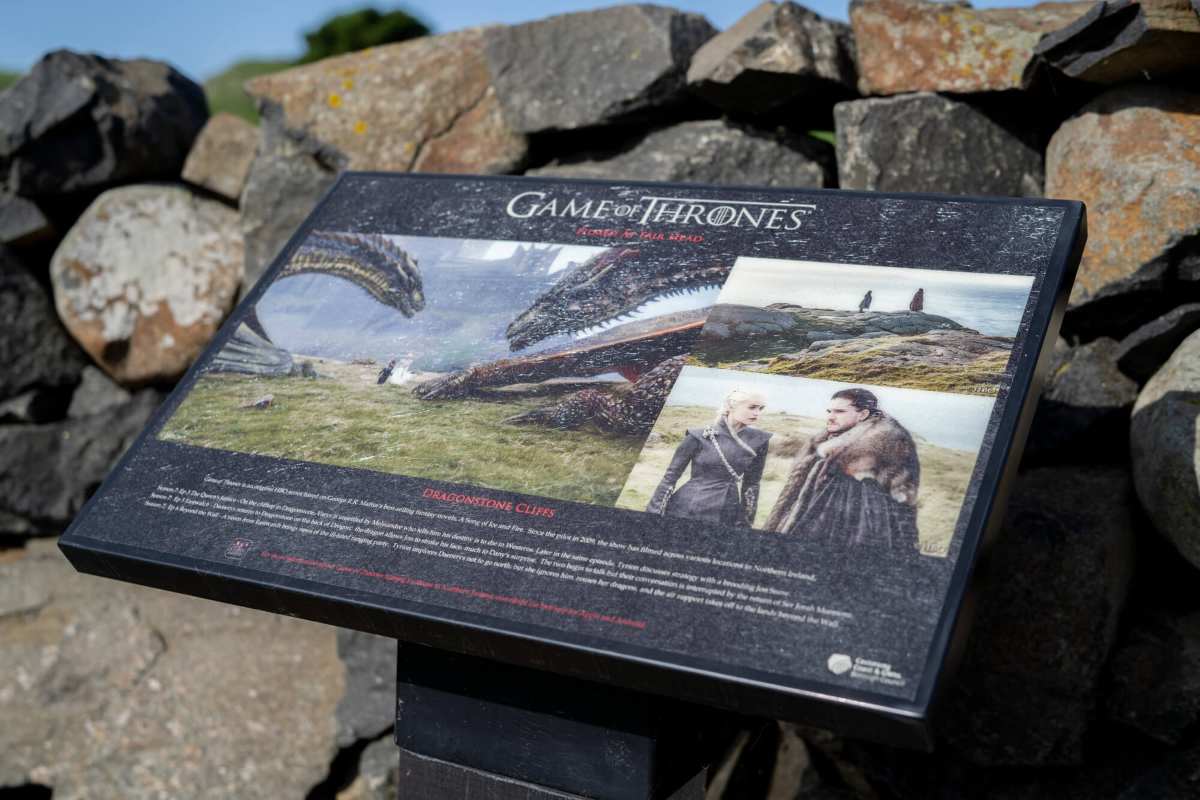
Murlough Bay (Renly vs Stannis War Council) – Co. Antrim
Remote, quiet, and strikingly beautiful, Murlough Bay is the kind of place you have to work a little to reach. The single-track road from Ballycastle requires patience and careful driving, but the reward is a sheltered bay of unusual peace. This was used for war council scenes between Renly and Stannis Baratheon.
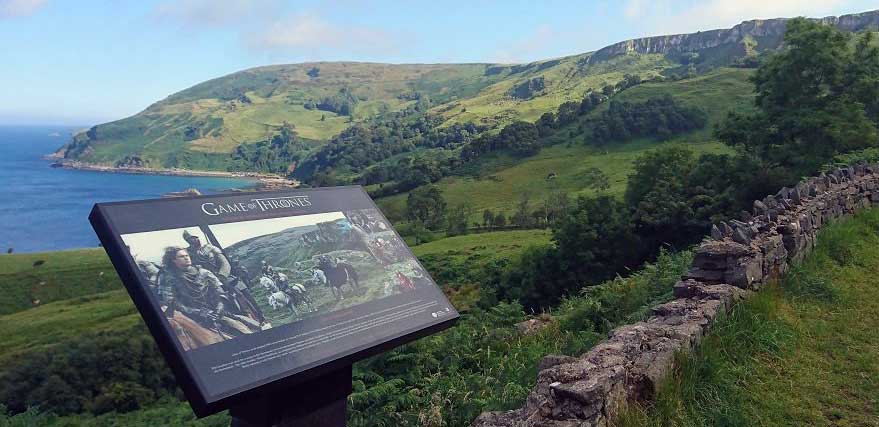
- Where: Between Ballycastle and Torr Head, North Antrim. Cost: Free. Informal parking only; no visitor facilities.
- Note: The road can be closed in bad weather. Allow extra travel time from Ballycastle.

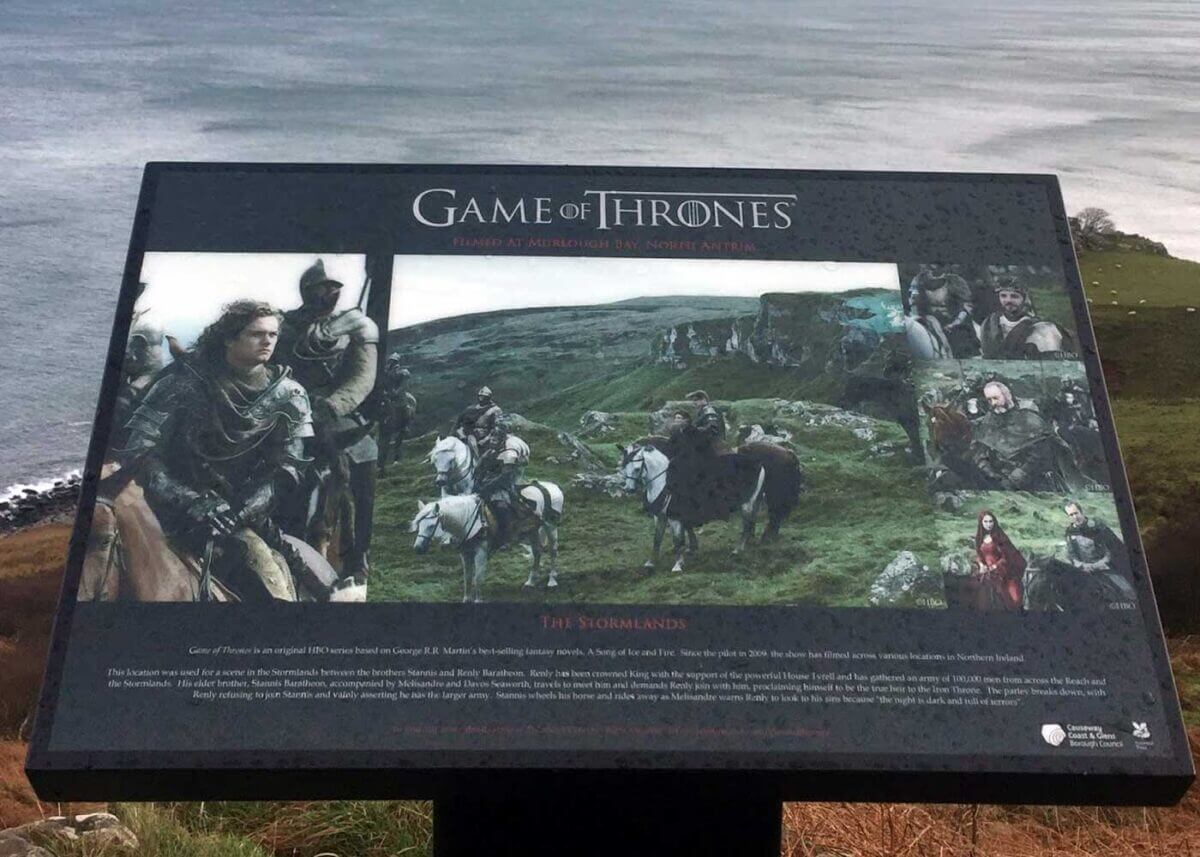
Inch Abbey (Robb Stark Proclaimed King in the North) – Near Downpatrick, Co. Down
The 12th-century Cistercian ruins of Inch Abbey on the bank of the River Quoile are where Robb Stark’s bannermen proclaimed him King in the North. The ruins are free to enter, compact and quiet, and combine well with a visit to Downpatrick’s St Patrick’s Cathedral nearby.

- Where: Near Downpatrick, Co. Down, beside the River Quoile. Cost: Free. Parking: Small car park near the site.
- Accessibility: Level paths around the ruins suitable for most visitors. The riverbank path is mostly flat.


Glenariff Forest Park (Vale of Arryn, Runestone) – Co. Antrim
One of the nine Glens of Antrim, Glenariff is often described as the queen of the glens, and with good reason. Lush waterfalls, deep gorges and ancient woodland made it the visual stand-in for the Vale of Arryn. The Waterfall Walk is particularly beautiful after rain.
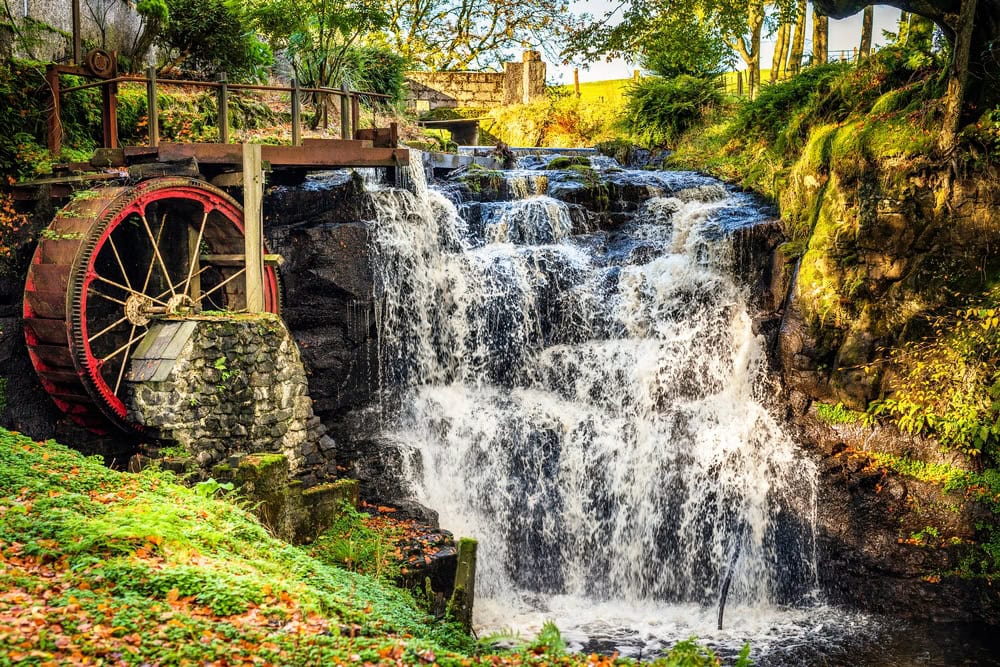
- Where: County Antrim, the Glens of Antrim. Cost: Approximately £5.50 adults, £3.50 children. Family tickets available. Parking: Car park at the main entrance.
- Accessibility: Main trails are well-signed. The waterfall path involves steps; the glen rim trail is more accessible.
- Eating: Tea-room at the park entrance.

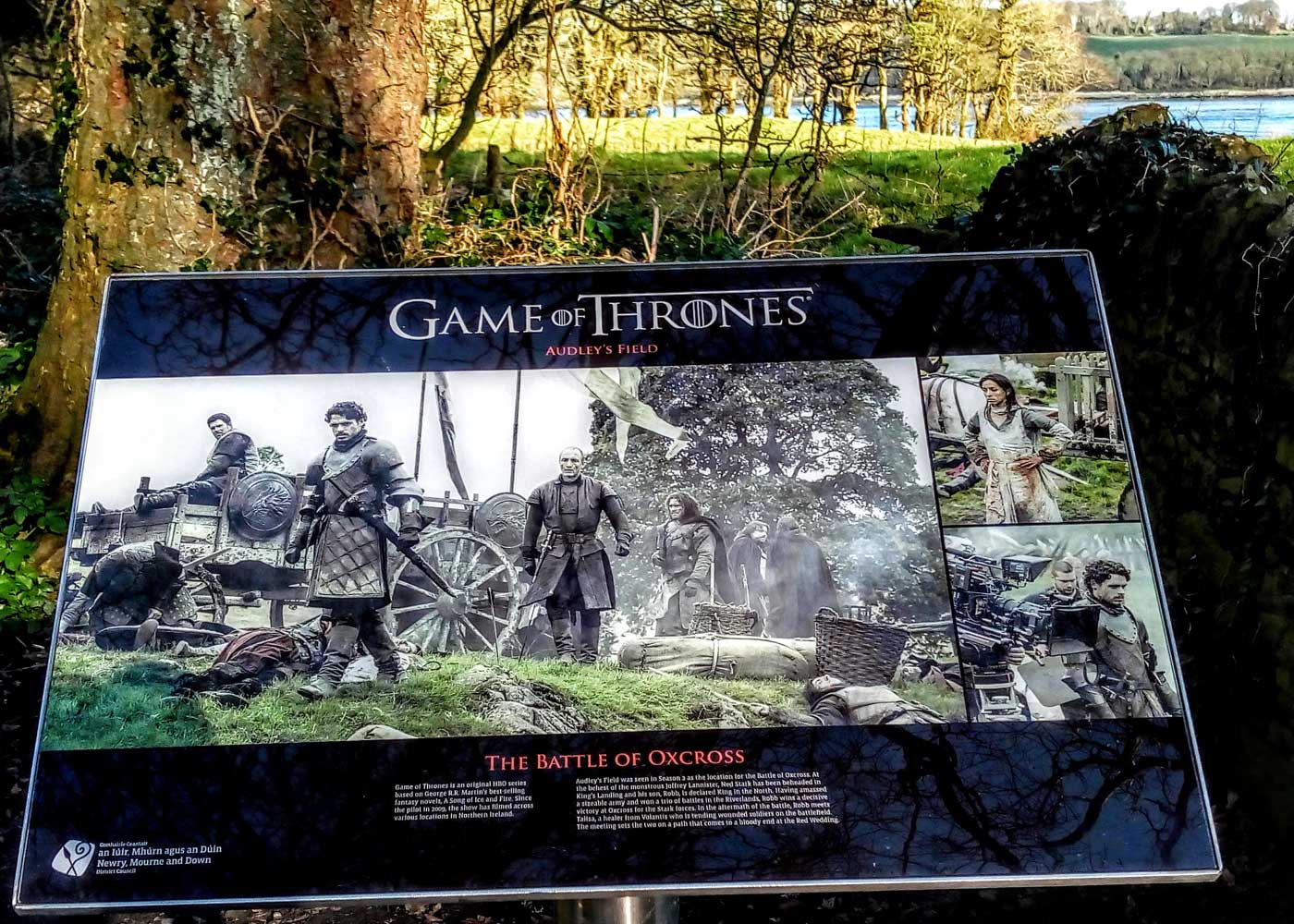
Audley’s Castle (Robb’s Camp and the Twins) – Strangford, Co. Down
This 15th-century tower house overlooking Strangford Lough was used in the Red Wedding sequence as the Twins, and for Robb Stark’s camp. It is a short walk from Castle Ward and free to visit externally, making it an easy add-on to a Winterfell day.
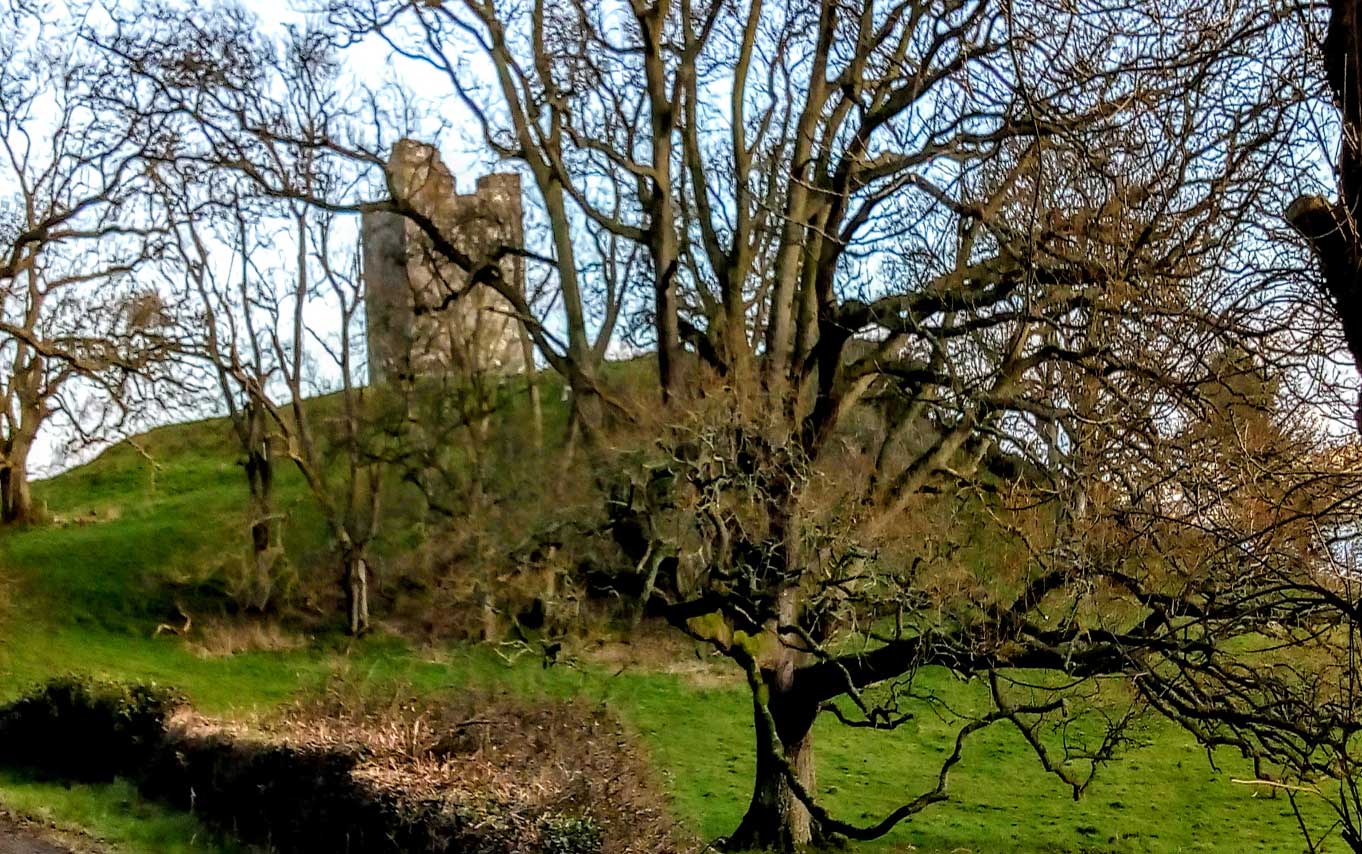
- Where: Strangford, Co. Down, near Castle Ward. Cost: Free to visit externally.
- Tip: Visit earlier in the day for softer light and fewer tour groups.
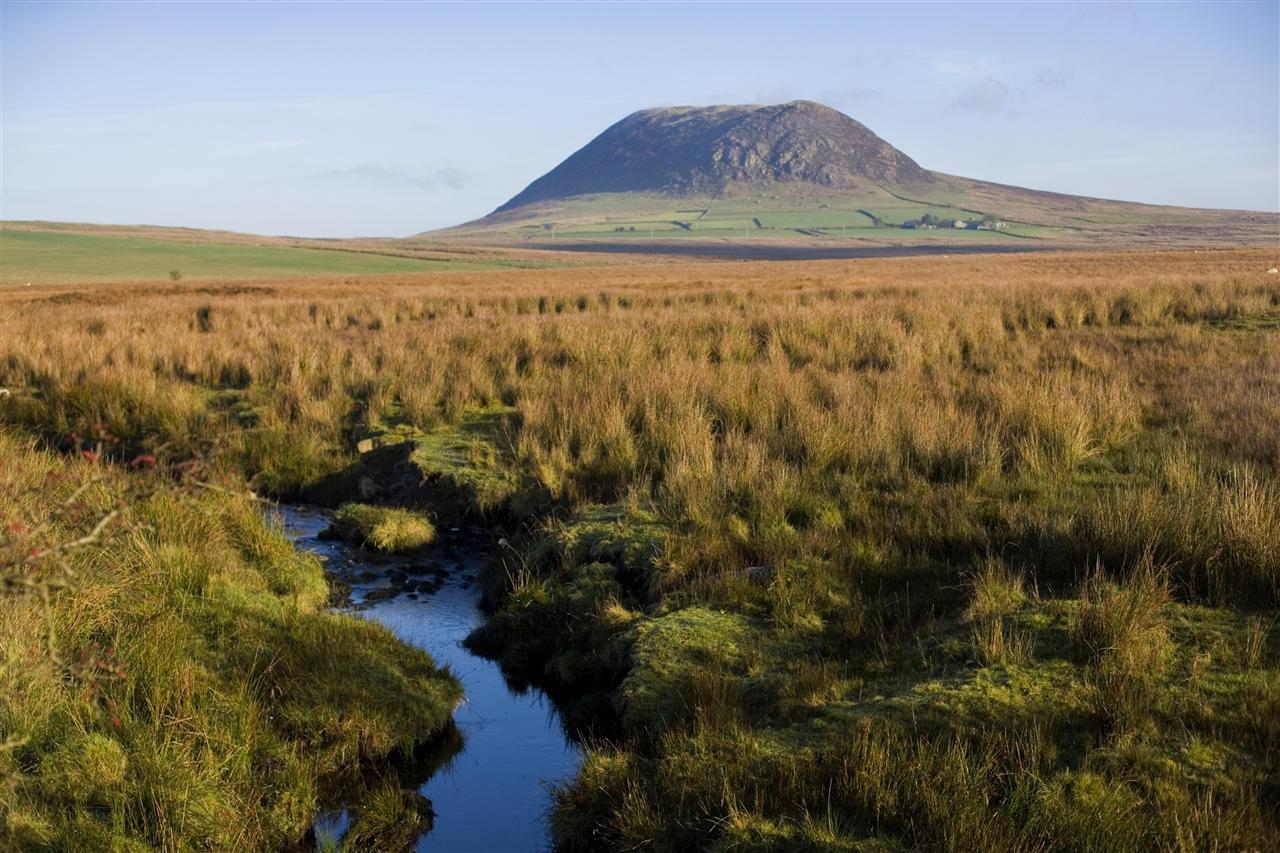
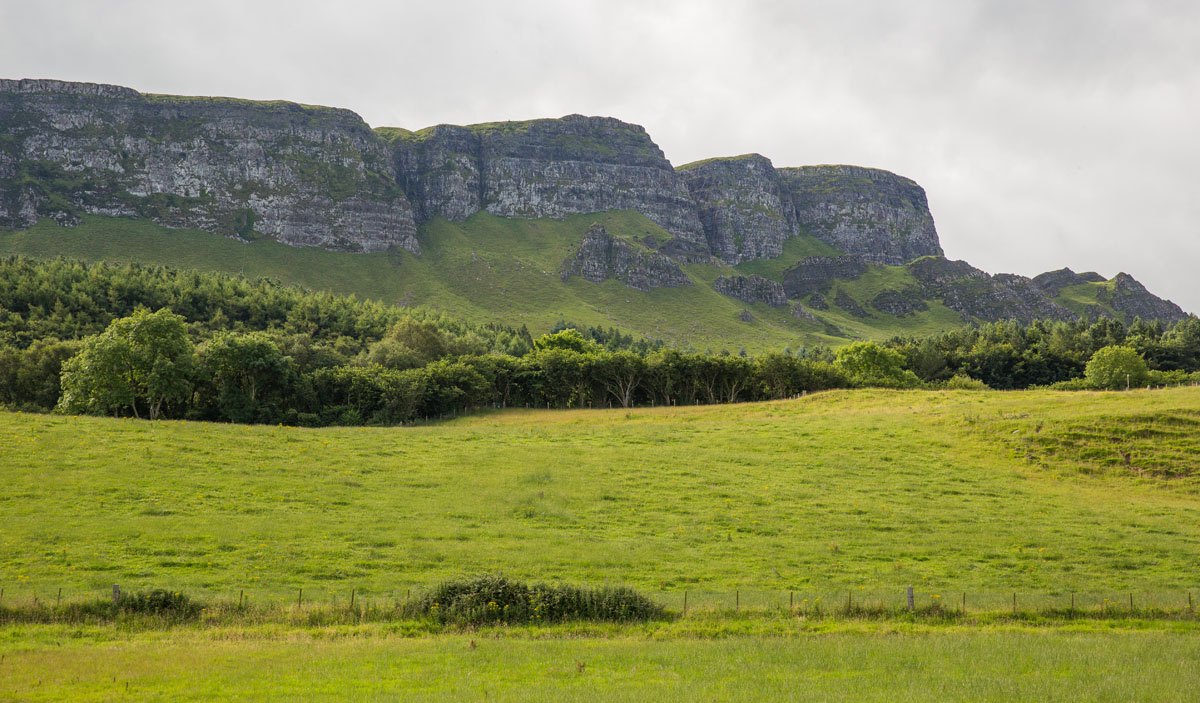
Dothraki Grasslands: Shillanavogy Valley and Binevenagh Mountain – Co. Antrim / Co. Londonderry
The wide open grasslands that stood in for the Dothraki Sea were filmed across two locations: Shillanavogy Valley at the foot of Slemish Mountain near Broughshane, and Binevenagh Mountain above Limavady. Both are quiet, less-touristed spots, best combined with nearby walks or the Causeway Coast.

- Shillanavogy: Near Broughshane, Co. Antrim. Free access; stick to public rights of way.
- Binevenagh: Near Limavady, Co. Londonderry. Free access; narrow roads to viewpoints. Excellent for sunrise or sunset photography.
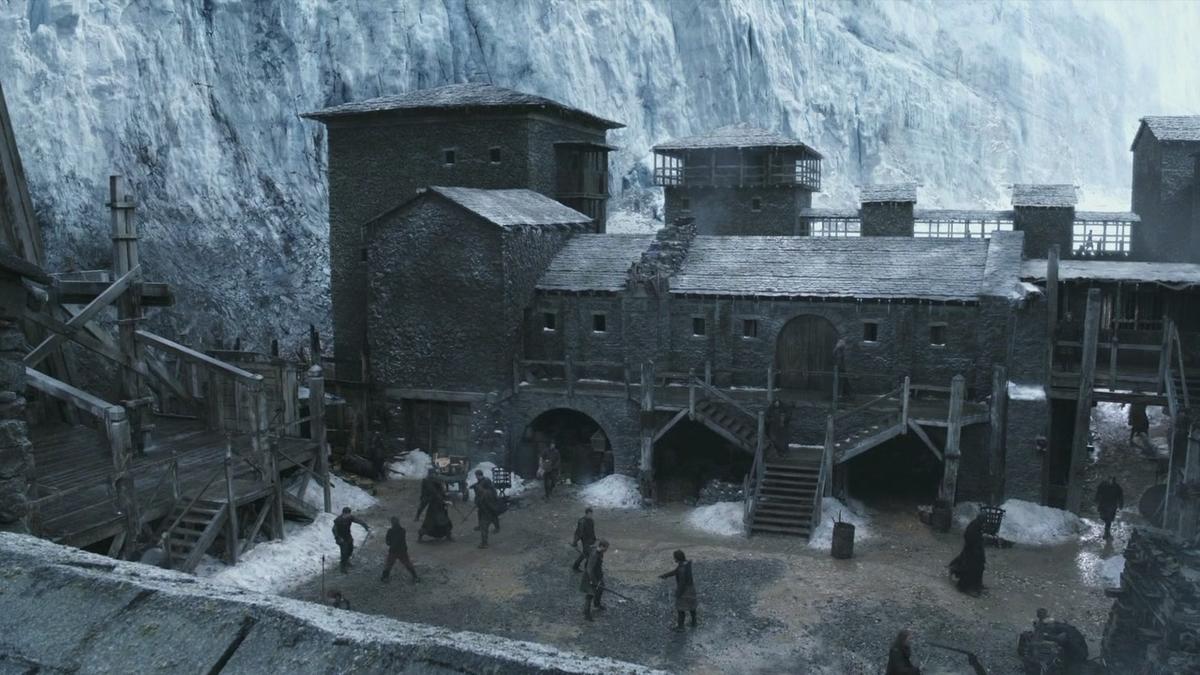
Magheramorne Quarry (Castle Black and The Wall) – Near Larne, Co. Antrim
The quarry used for Castle Black, The Wall and Hardhome sequences is private and closed to public access. Sets have been removed and the site is fenced. It can be seen from a distance on public roads; treat it as a drive-by stop only. Do not attempt to enter.
The Game of Thrones Studio Tour: Everything You Need to Know
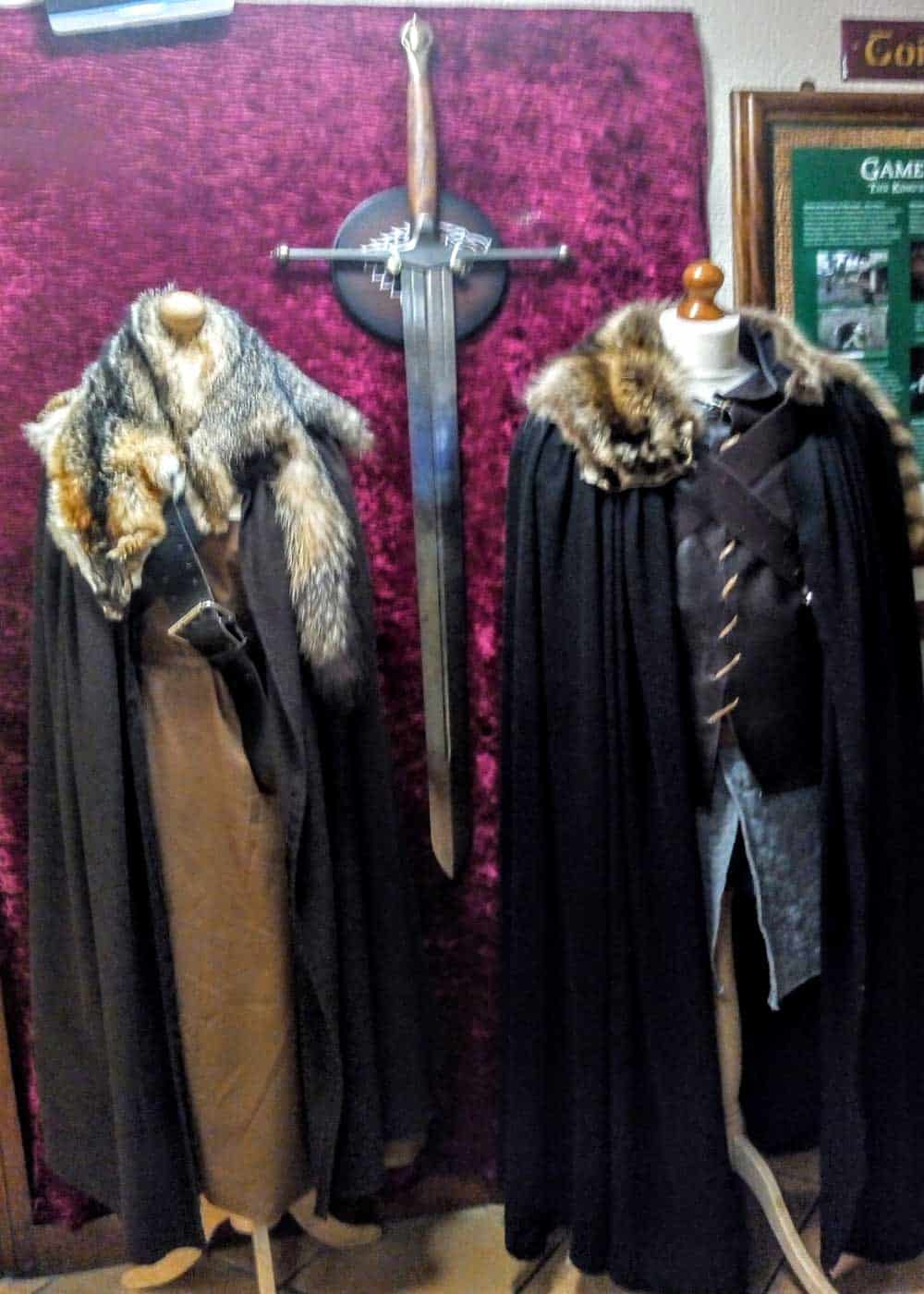
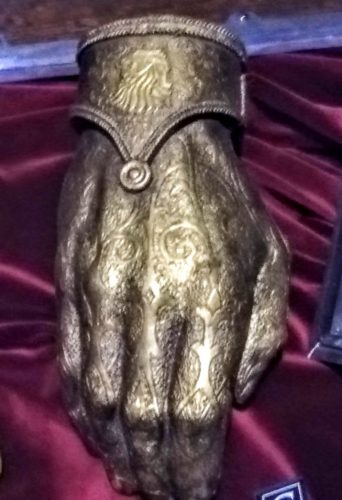
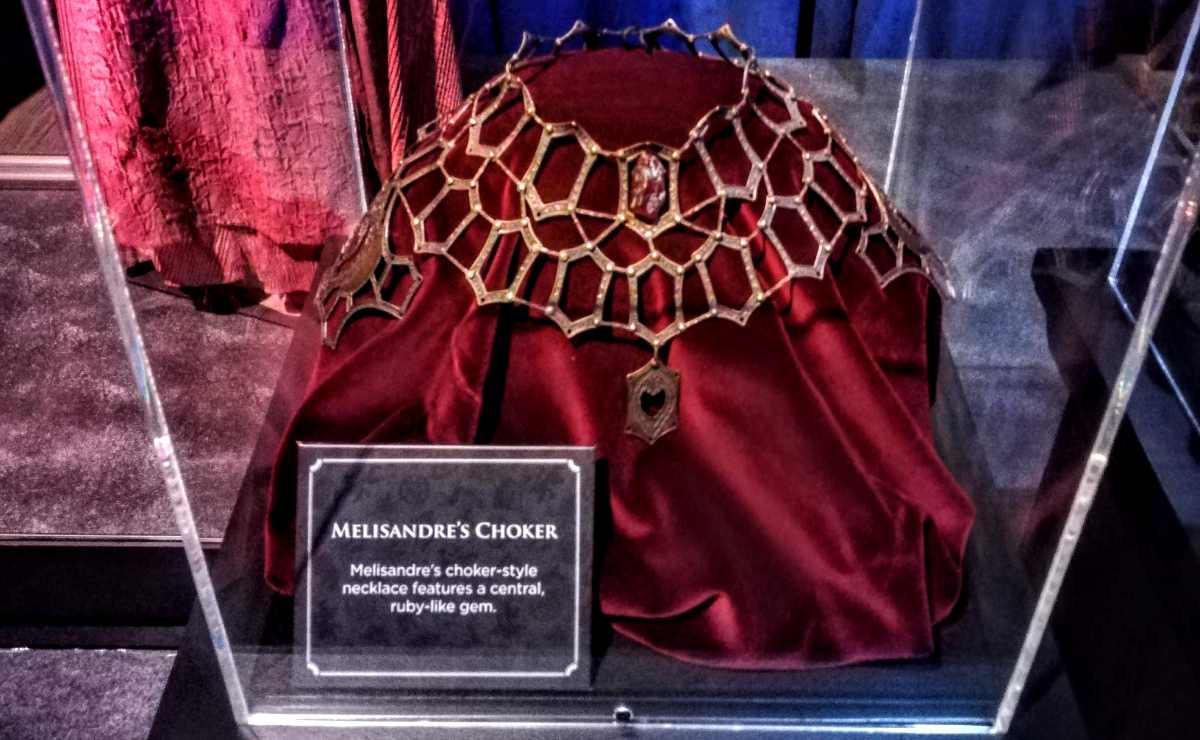
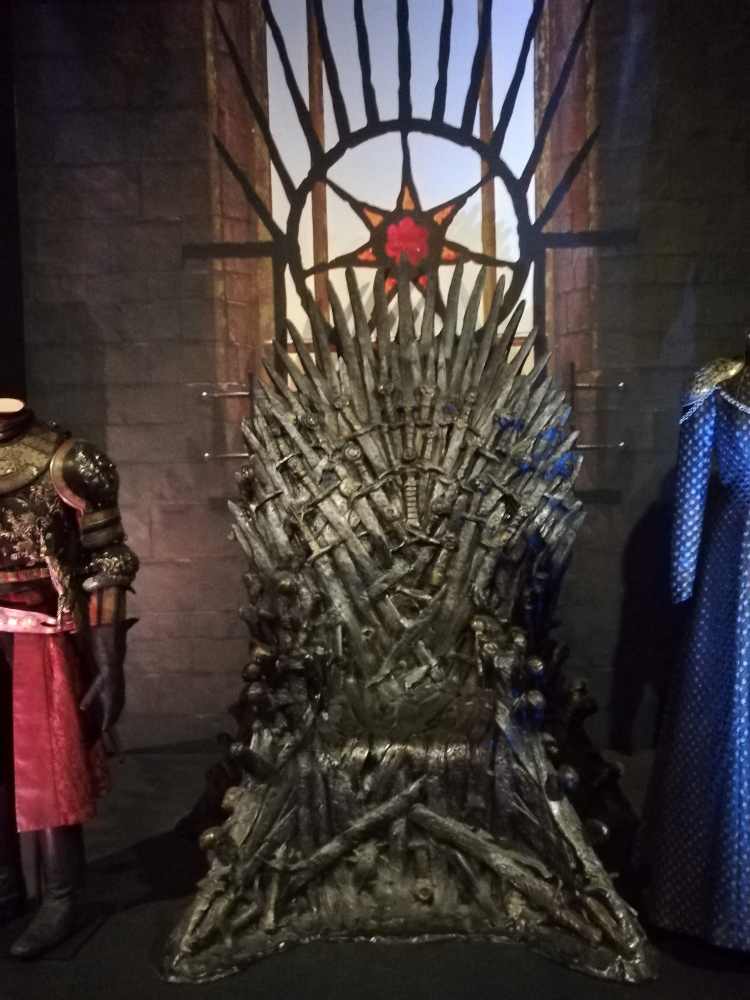
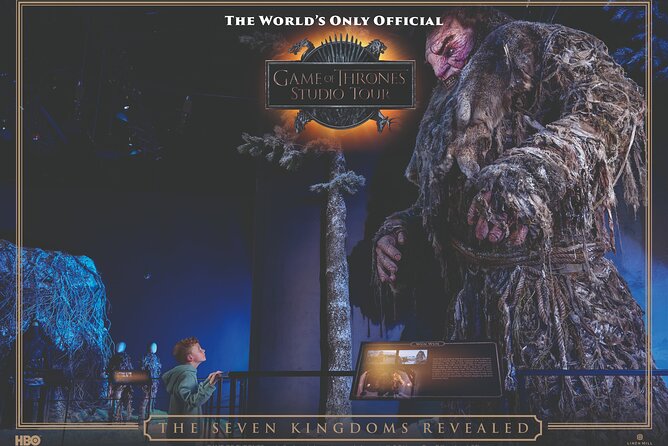
If you visit only one paid attraction on a Game of Thrones trip, make it this one. The official Studio Tour at Linen Mill Studios in Banbridge is the only place in the world where you can walk through the original sets, see the actual costumes, weapons and props, and understand the scale of what it took to build Westeros.
The Great Hall of Winterfell is preserved exactly as it was when filming ended. Jon Snow’s Longclaw is there. Sansa’s wedding dress. The Hall of Faces. The scale and detail are genuinely impressive, even if you are not a dedicated fan.
- Where: Linen Mill Studios, Banbridge, Co. Down. GPS: 54.3552, -6.2709. 30 minutes from Belfast, 90 minutes from Dublin.
- Tickets: Adult tickets approximately £39.50. Book online in advance; peak season sells out. Official booking page
- Parking: No parking at the studio itself. Free car park at The Boulevard shopping centre in Banbridge (BT32 4LF), with a free shuttle bus to the studio for ticket holders. Journey time approximately 10 minutes. Blue Badge holders should park at The Boulevard and take the shuttle. A limited number of Blue Badge spaces are available at the studio itself; contact visitor services in advance: +44 28 40 464 777.
- Accessibility: The tour is fully on one level with no steps between exhibits. Wheelchair accessible throughout. One complimentary carer ticket with each paid disabled guest ticket (aged 16+; book via visitor services in advance).
- Eating: The Mess Hall restaurant on site serves themed meals, burgers and hot food. Visitors have praised it as a highlight in its own right. The restaurant is only accessible if you are doing the tour.
- Time needed: Allow 2.5 to 3 hours minimum.
- Tip: The Studio Tour periodically adds seasonal events and limited-run experiences. Check the website before booking to see what is on. Current promotions include a House of the Dragon Season 3 discount (use code DRAGON at checkout).
- A Knight of the Seven Kingdoms: Some props from the 2026 spinoff are now on display at the tour.
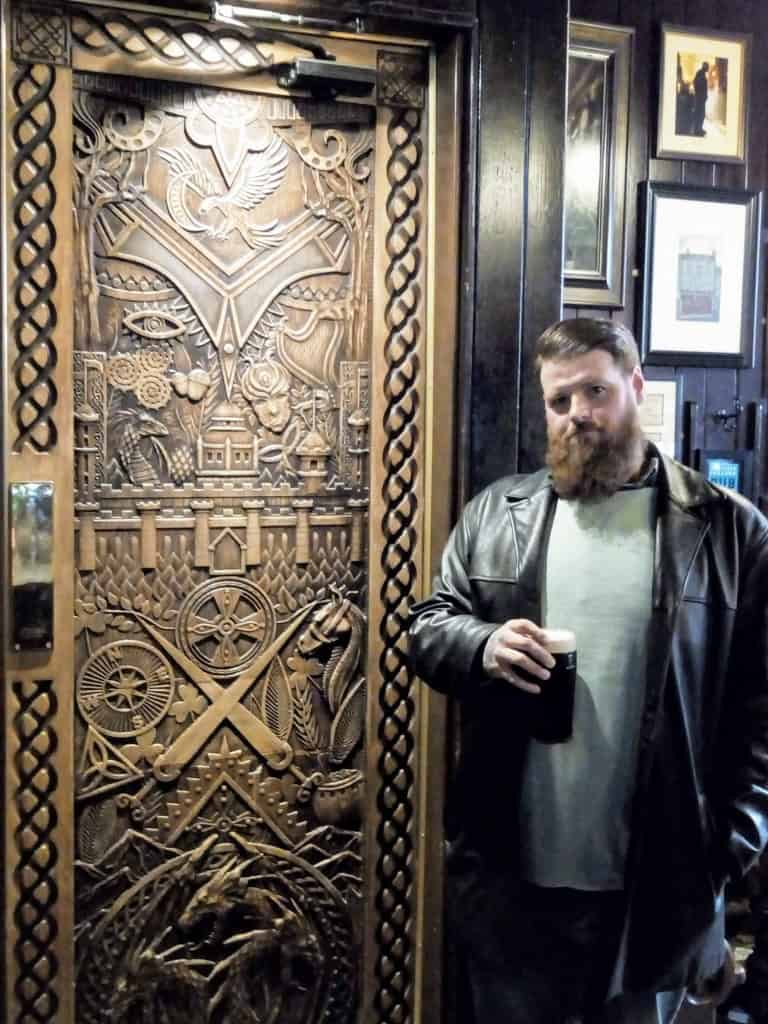
The Doors of Thrones Trail
After storms damaged the Dark Hedges and brought down several of the ancient beech trees, the fallen timber was carved into ten remarkable doors, each depicting a scene from Season 6. These doors were installed in pubs and restaurants across Northern Ireland, creating a unique trail that weaves together filming history and local hospitality.
The Doors of Thrones trail is free to follow and gives you a reason to visit some excellent local pubs. Find the full map at Doors of Thrones

A Knight of the Seven Kingdoms: New Filming Locations in Northern Ireland (2026)
House of the Dragon did not film in Northern Ireland at all, choosing Warner Bros. Leavesden Studios in Watford and locations in Spain, Portugal, Cornwall and Derbyshire instead. Fans visiting Ireland specifically for House of the Dragon will be disappointed to find no filming sites here.
The picture is very different for A Knight of the Seven Kingdoms, HBO’s 2026 prequel series following Ser Duncan the Tall and his squire Egg. Filming took place in Northern Ireland between June and September 2024, returning the franchise to its spiritual home.
A Knight of the Seven Kingdoms filming locations in Northern Ireland: (all publicly accessible except Galboly)
- Titanic Studios, Belfast (interior sets, not open to public)
- Glenarm Castle, Co. Antrim (Ashford Meadow; the 13th-century castle estate with open grounds)
- Tollymore Forest Park, Co. Down (Crownlands forest scenes; publicly open)
- Mourne Mountains, Co. Down (opening scenes; publicly accessible hillwalking country)
- Cave Hill, Belfast (publicly accessible, above the city)
- Galboly, Glens of Antrim (abandoned village used in Episode 2; on private land, visible from approach road only)


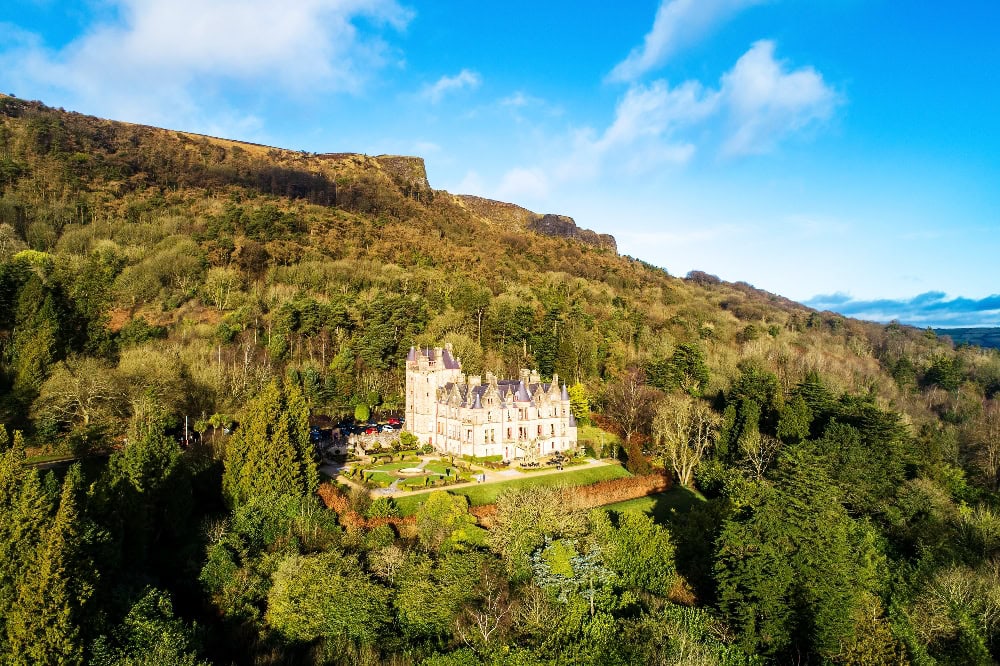
A second season of A Knight of the Seven Kingdoms has been confirmed for 2027. More location information: A Knight of the Seven Kingdoms filming locations
Game of Thrones Filming Locations Around the World
Croatia – King’s Landing
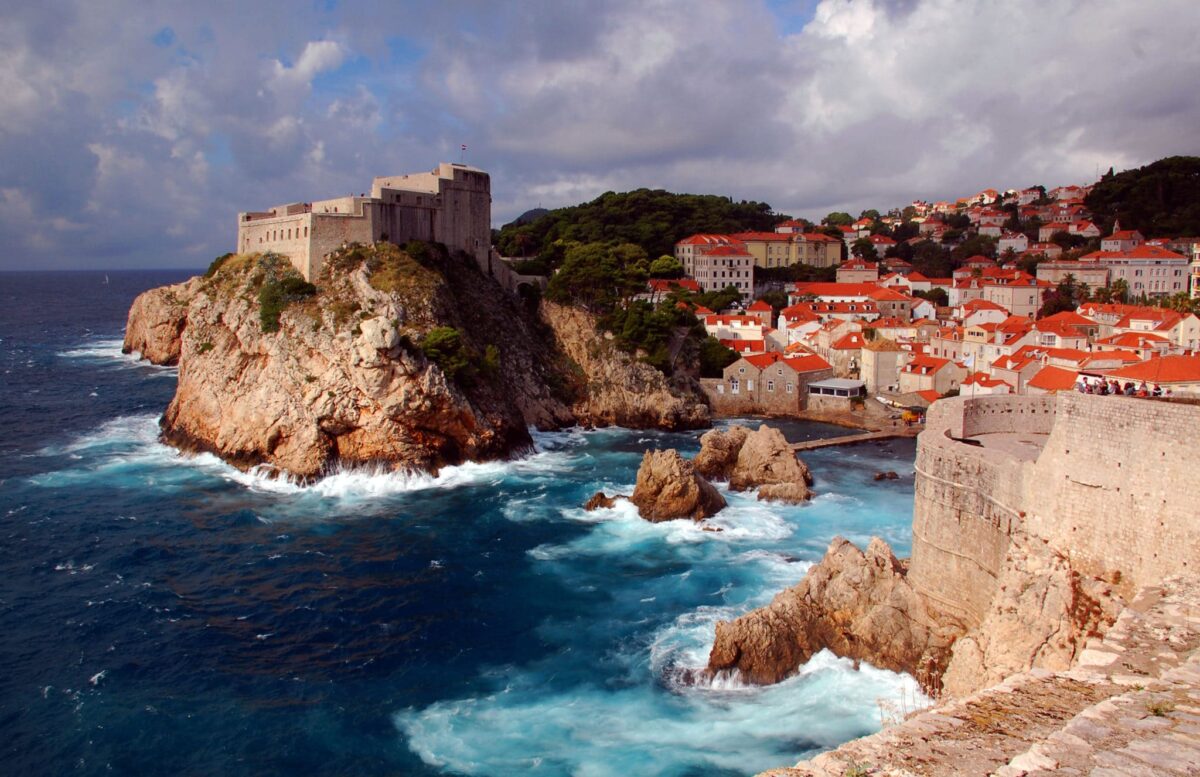
From Season 2 onward, the walled city of Dubrovnik doubled as King’s Landing, the capital of the Seven Kingdoms. The city walls where Cersei walked in her Season 5 humiliation, Fort Lovrijenac which served as the Red Keep’s exterior, and the Old Town streets are all publicly accessible.
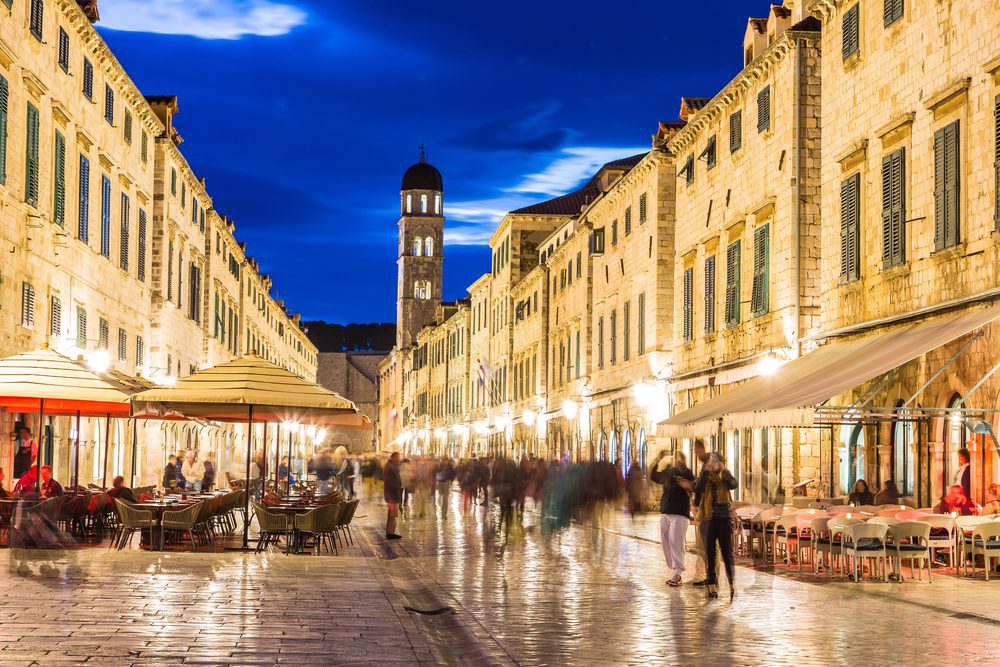
- Dubrovnik Old Town: City walls entry approximately €35 for adults. The Old Town streets are free to walk.
- Fort Lovrijenac: Entry often included with the wall ticket.
- Lokrum Island (Qarth): Ferry from Dubrovnik Old Port approximately €27 return, including island entry.
- Tip: Dubrovnik offers official Game of Thrones walking tours from approximately €25-€40 per person.
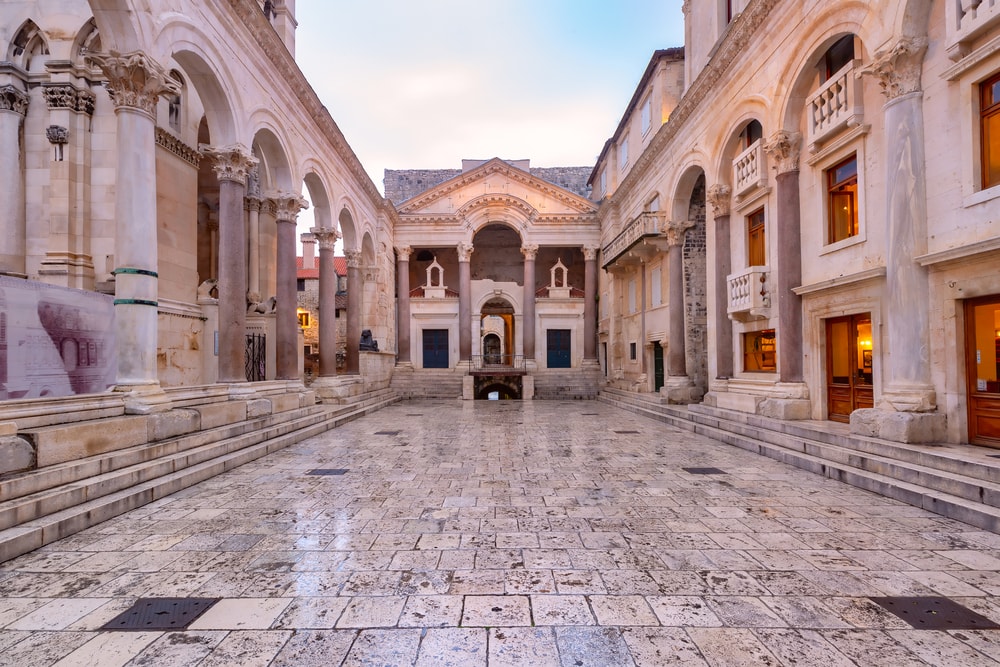
Spain – Dorne, Dragonstone, Meereen, House of the Dragon
Spain provided locations for some of the most visually distinctive settings in Game of Thrones, and then for key scenes in House of the Dragon too.
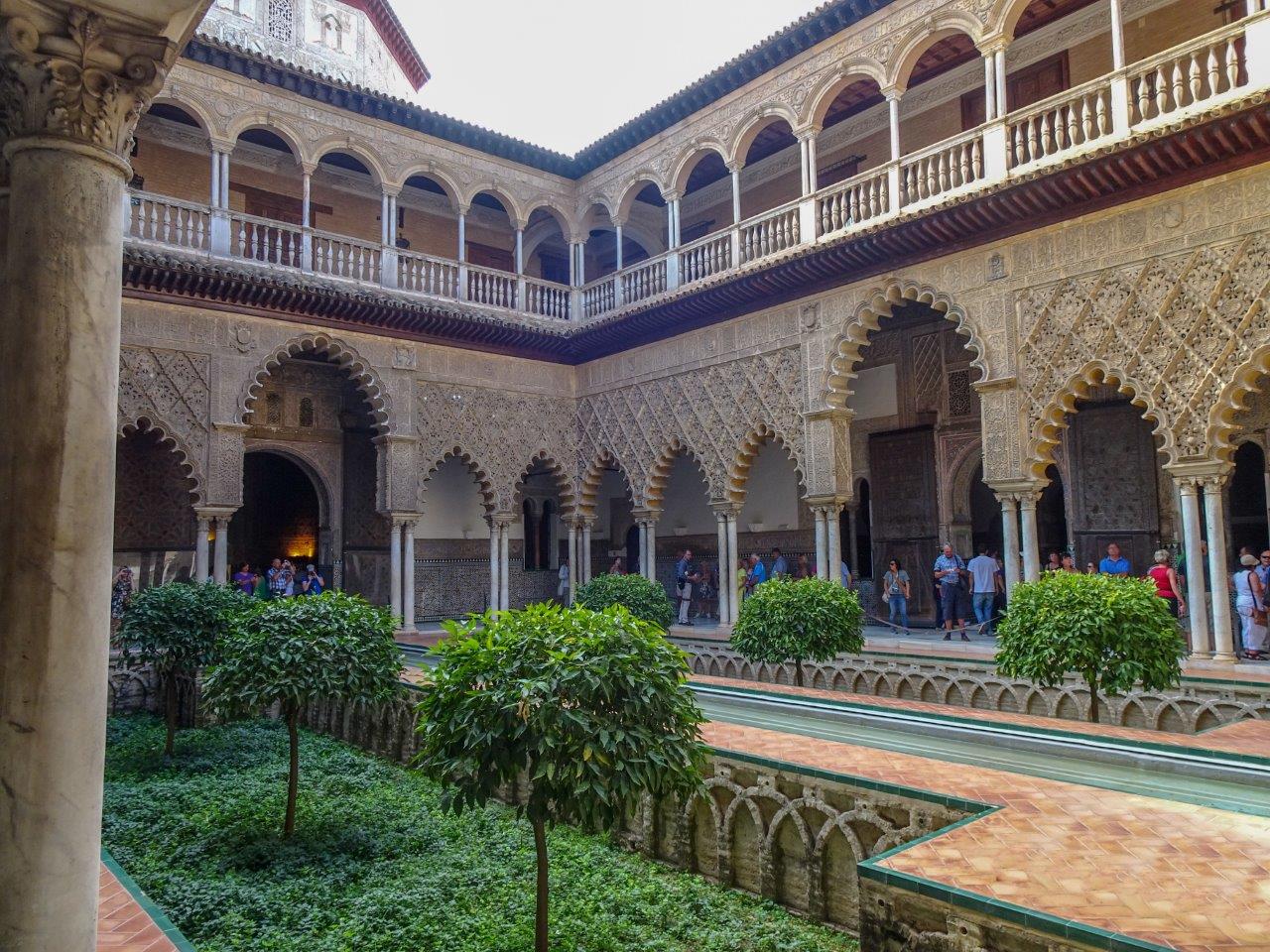
- Real Alcazar, Seville (Water Gardens of Dorne): Entry approximately €13.50. Book online in advance.
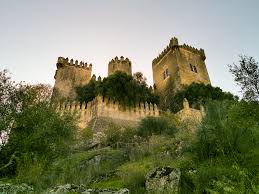
- Castillo de Almodovar del Rio, Cordoba (Highgarden): Entry approximately €10 for adults.
- San Juan de Gaztelugatxe, Basque Country (Dragonstone causeway): Free to visit; timed tickets required in peak season via local authorities.
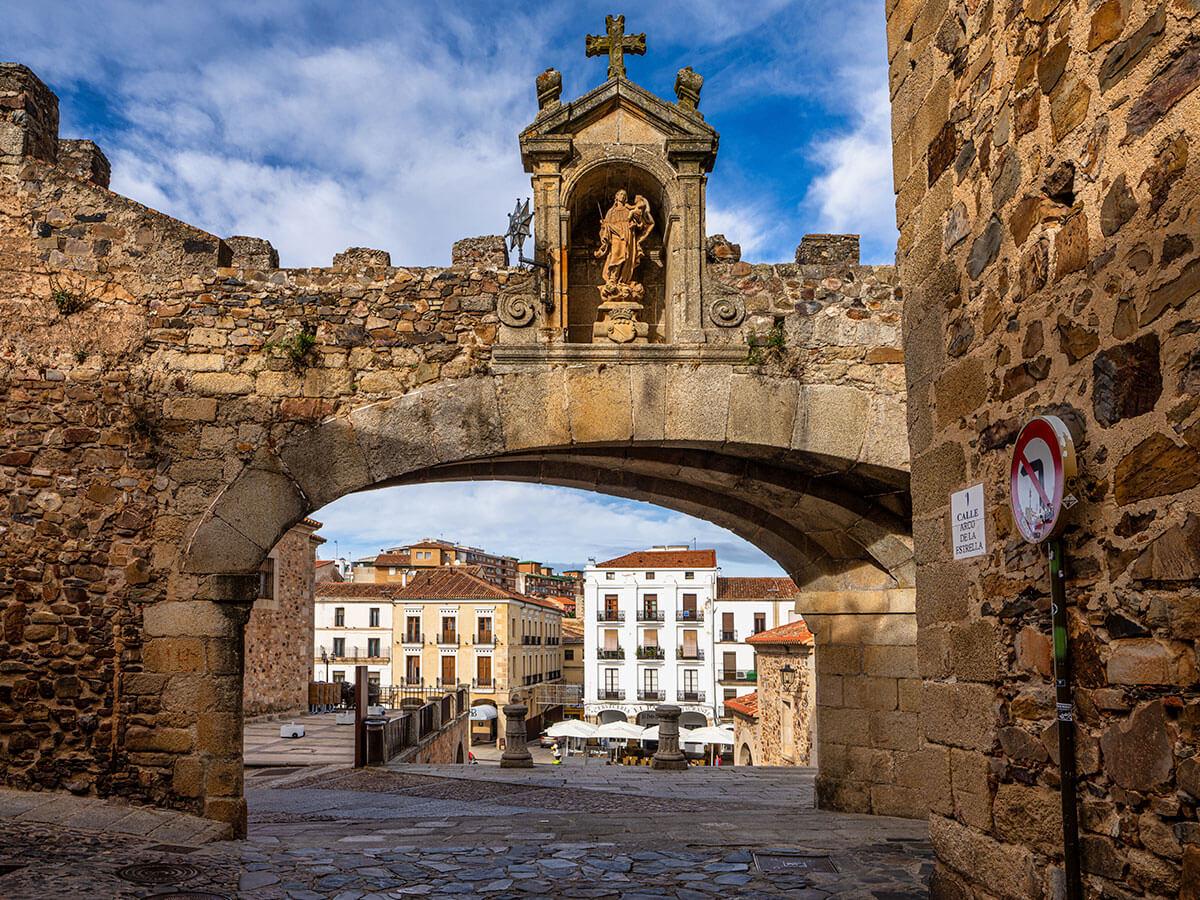
- Caceres Old Town (King’s Landing in House of the Dragon): UNESCO World Heritage site, free public access to old town. Used extensively for House of the Dragon’s King’s Landing streets.
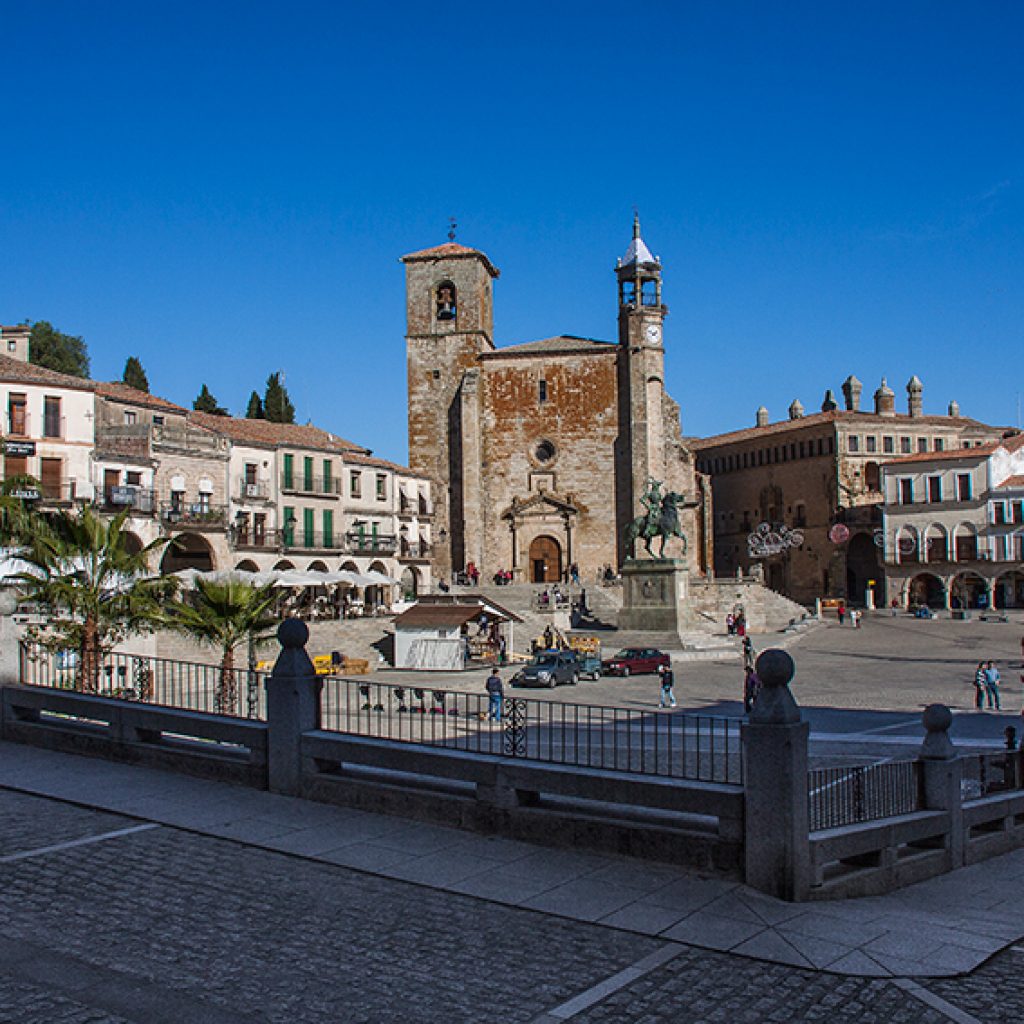
- Trujillo (also used in House of the Dragon): 45km from Caceres; free access to the historic town.
- Plaza de Toros de Osuna (Daznak’s Pit): Museum ticket approximately €3-€5.
- Bardenas Reales Natural Park, Navarre (Dothraki Sea in Season 6): Free access. A UNESCO Biosphere Reserve with a Mars-like badlands landscape.
Iceland – Beyond the Wall
Iceland’s volcanic landscapes provided the frozen wastelands beyond the Wall across multiple seasons.
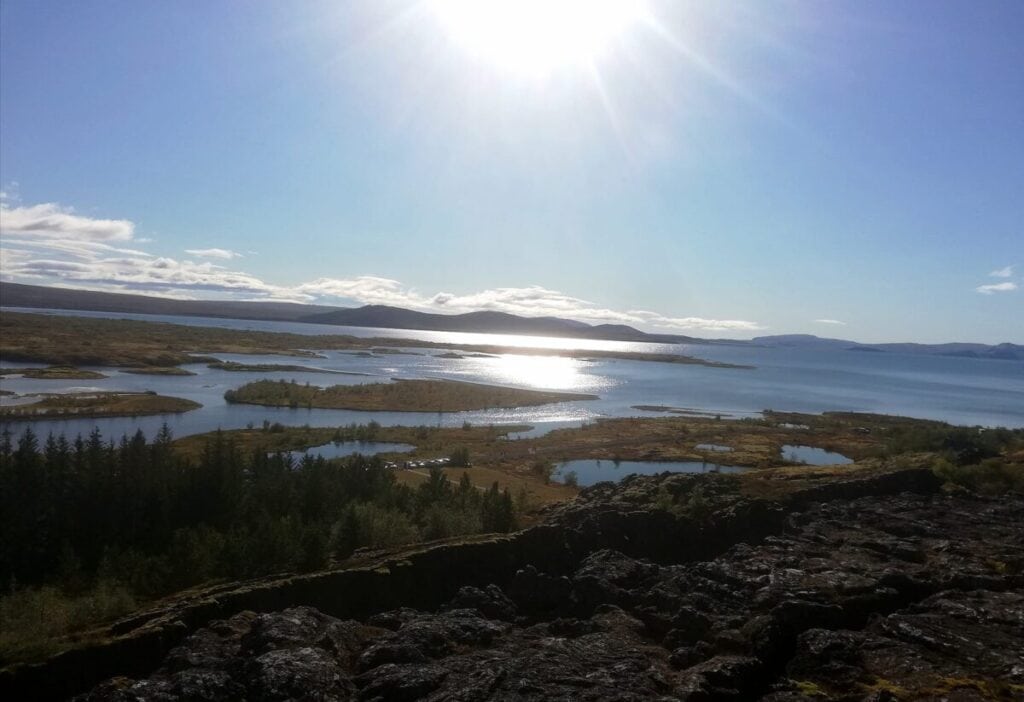
- Thingvellir National Park (Oxararfoss Waterfall, Arya and Sandor’s travels): Free entry; parking approximately 1,000 ISK.
- Lake Myvatn and Grjotajga Cave (Jon Snow and Ygritte): The cave is no longer open for bathing but can be viewed. Free entry.
- Tip: Winter tours combine Game of Thrones sites with Northern Lights experiences.

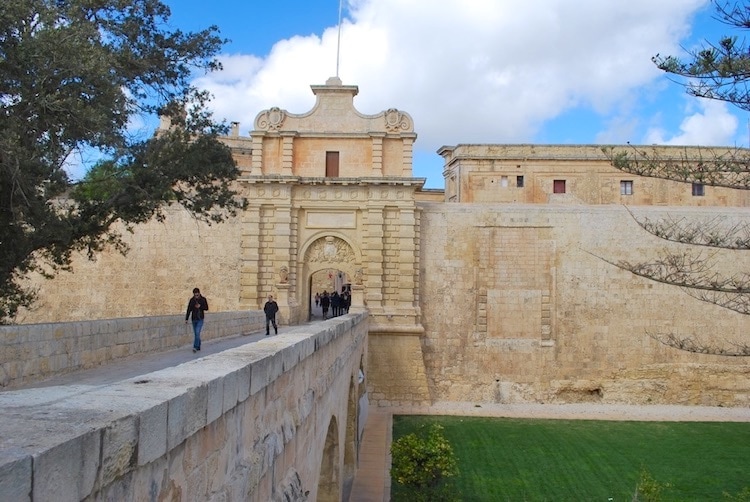
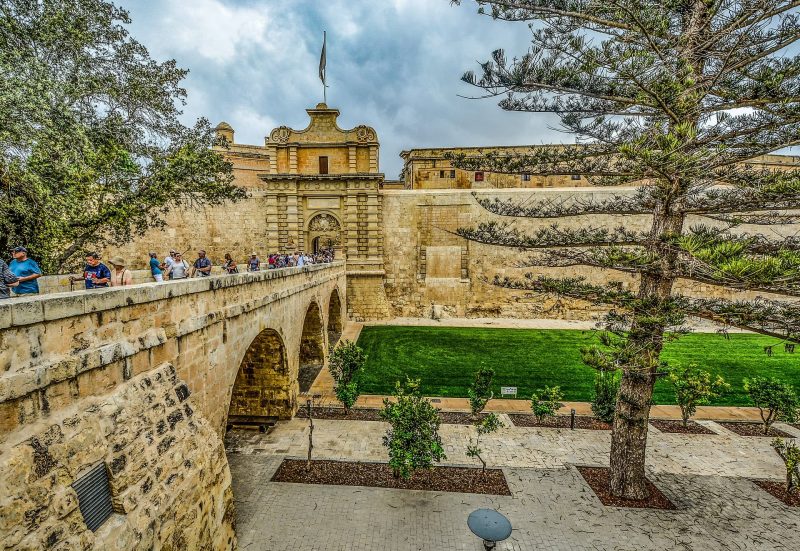
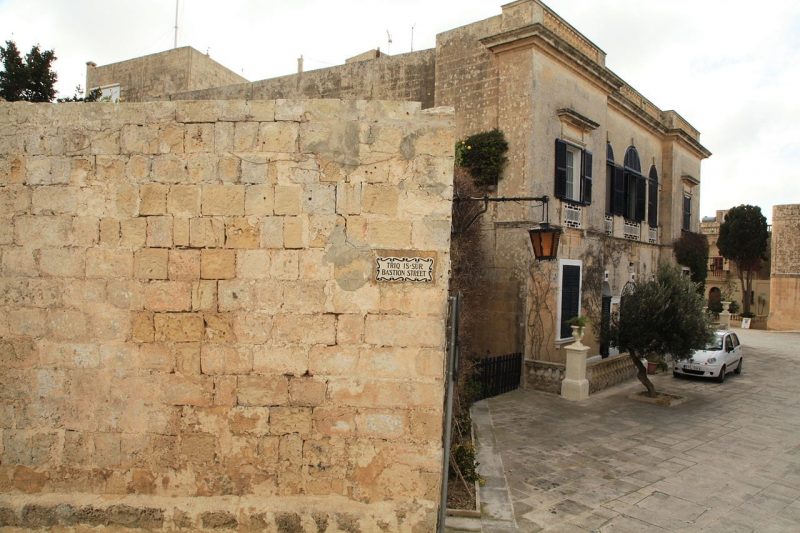
Malta – The Original King’s Landing (Season 1)
Before Dubrovnik, Malta served as King’s Landing in Season 1, with the fortified medieval city of Mdina providing the sun-drenched stone aesthetic of the show’s early episodes.
- Mdina: A living city with free public access. Fort Manoel in Gzira was used for the Great Sept of Baelor.
Morocco – Astapor, Yunkai, Essos
- Essaouira (Astapor, where Daenerys obtained the Unsullied): Free to wander; guided tours from €20-€40.
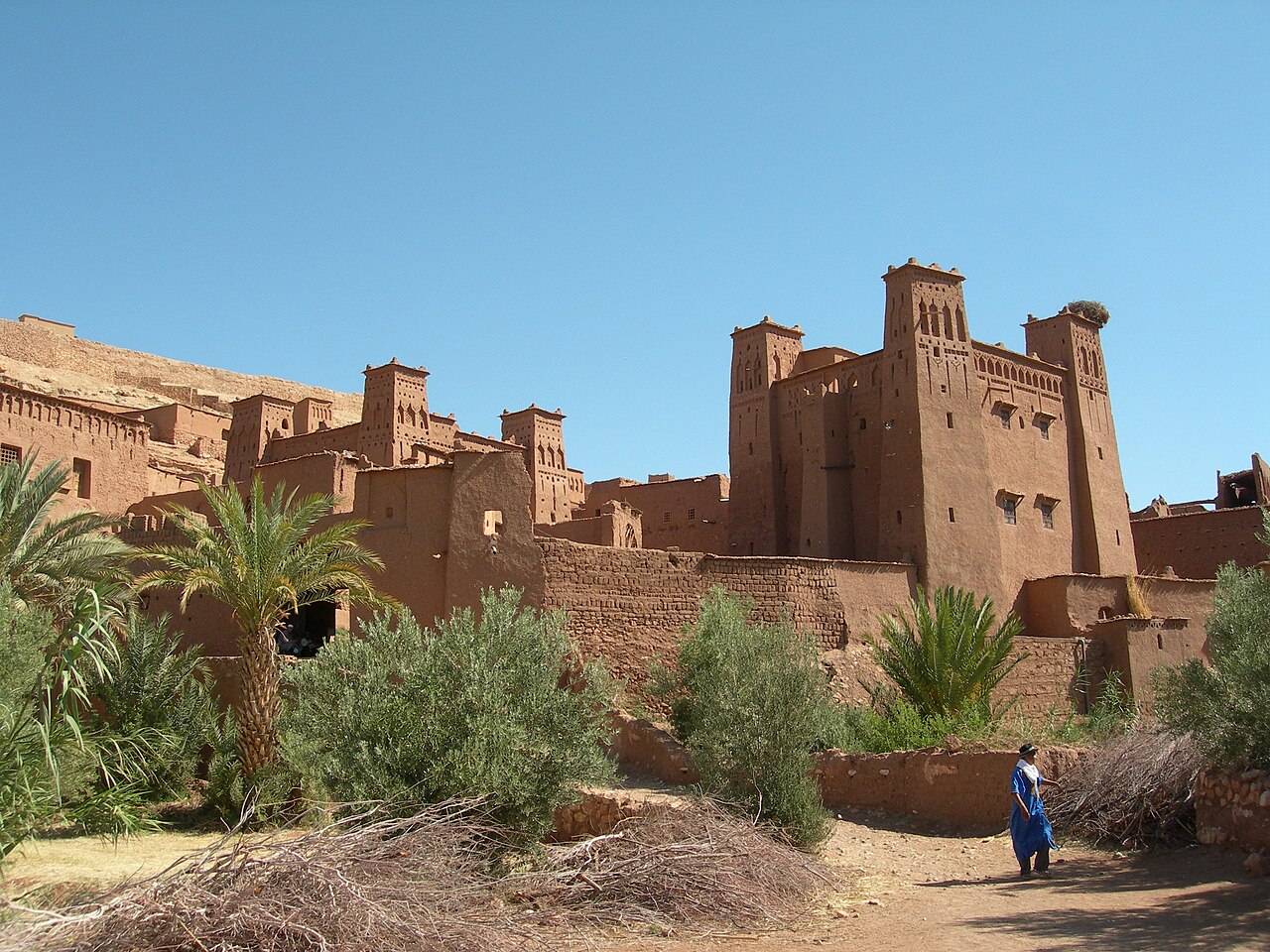
- Ait Benhaddou (Yunkai): UNESCO fortified ksar; entry approximately €2 donation.
- Tip: Combine Essaouira and Ait Benhaddou with Marrakesh for a multi-day filming itinerary.
A Personal Note on Visiting These Places
I have been to every location in this guide more than once. I have taken visitors who had never seen Game of Thrones and watched them become genuinely captivated by the landscapes. I have also watched devoted fans stand at the Dark Hedges at 7am in November rain, completely untroubled by the weather, trying to frame exactly the shot they had in their heads.
A few things I always tell people before they go: do not try to cram too many sites into one day. The Causeway Coast is more beautiful if you slow down and stop. Downhill Strand in particular deserves an hour, not the ten minutes some tour buses allow. And if you are travelling with anyone who has mobility challenges, as I sometimes do, the Studio Tour in Banbridge is by far the most accessible option on this list and it rewards that visit completely.
Northern Ireland’s hospitality is genuine and the welcome you get at even the smallest cafe on the Antrim Coast is one of the things that keeps drawing people back. Build in time to eat somewhere local rather than rushing between sites. You will not regret it.

Frequently Asked Questions About Game of Thrones Filming Locations in Ireland
Where was Game of Thrones primarily filmed in Ireland?
Game of Thrones was filmed primarily in Northern Ireland, across more than 25 locations in Counties Antrim and Down. The production ran from 2009 to 2018 across all eight seasons. Key sites include Castle Ward (Winterfell), the Dark Hedges (Kingsroad), Ballintoy Harbour (Iron Islands) and Cushendun Caves. Interior filming took place at Titanic Studios in Belfast and Linen Mill Studios in Banbridge.
Was House of the Dragon filmed in Northern Ireland?
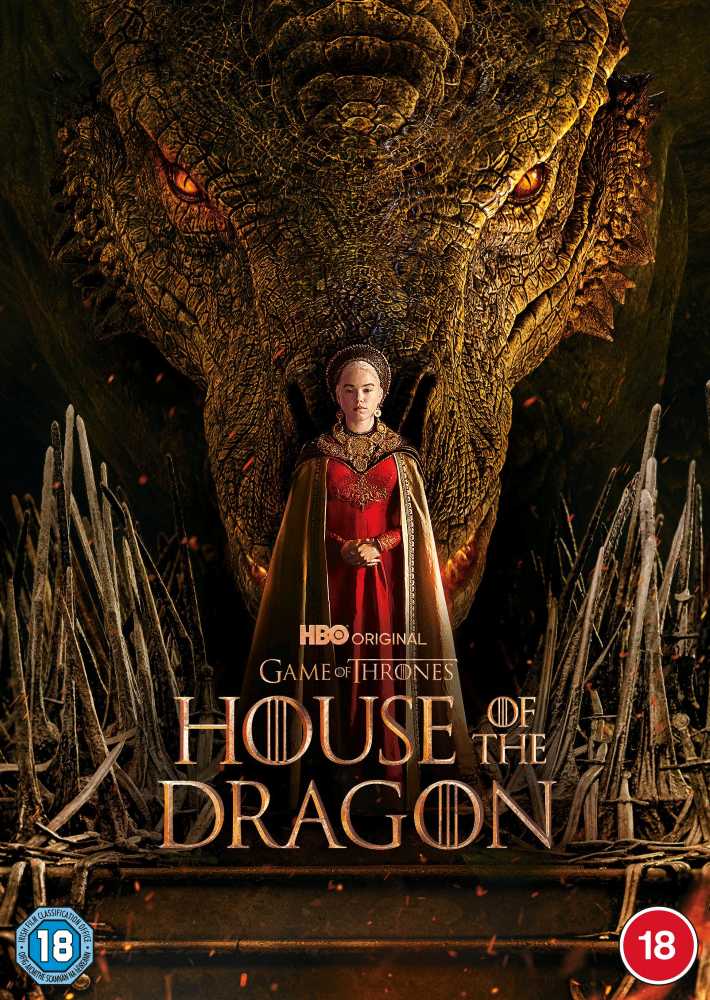
No. House of the Dragon did not film in Northern Ireland. Production was based at Warner Bros. Leavesden Studios in Watford, England, with exterior shoots in Spain (Caceres, Trujillo), Portugal (Monsanto, Penha Garcia), Cornwall (Holywell Bay, Kynance Cove, St Michael’s Mount) and Derbyshire. If you are visiting Ireland specifically for House of the Dragon filming locations, you will not find them here.
How much does the Game of Thrones Studio Tour cost?
Adult tickets for the Game of Thrones Studio Tour at Banbridge are approximately £39.50 (prices may vary; always check the official website before booking). There is no parking at the studio itself. Park free at The Boulevard shopping centre in Banbridge and take the free shuttle bus. Blue Badge holders should call +44 28 40 464 777 in advance to arrange accessible parking at the studio. One complimentary carer ticket is available with each paid disabled guest ticket.
Was A Knight of the Seven Kingdoms filmed in Ireland?
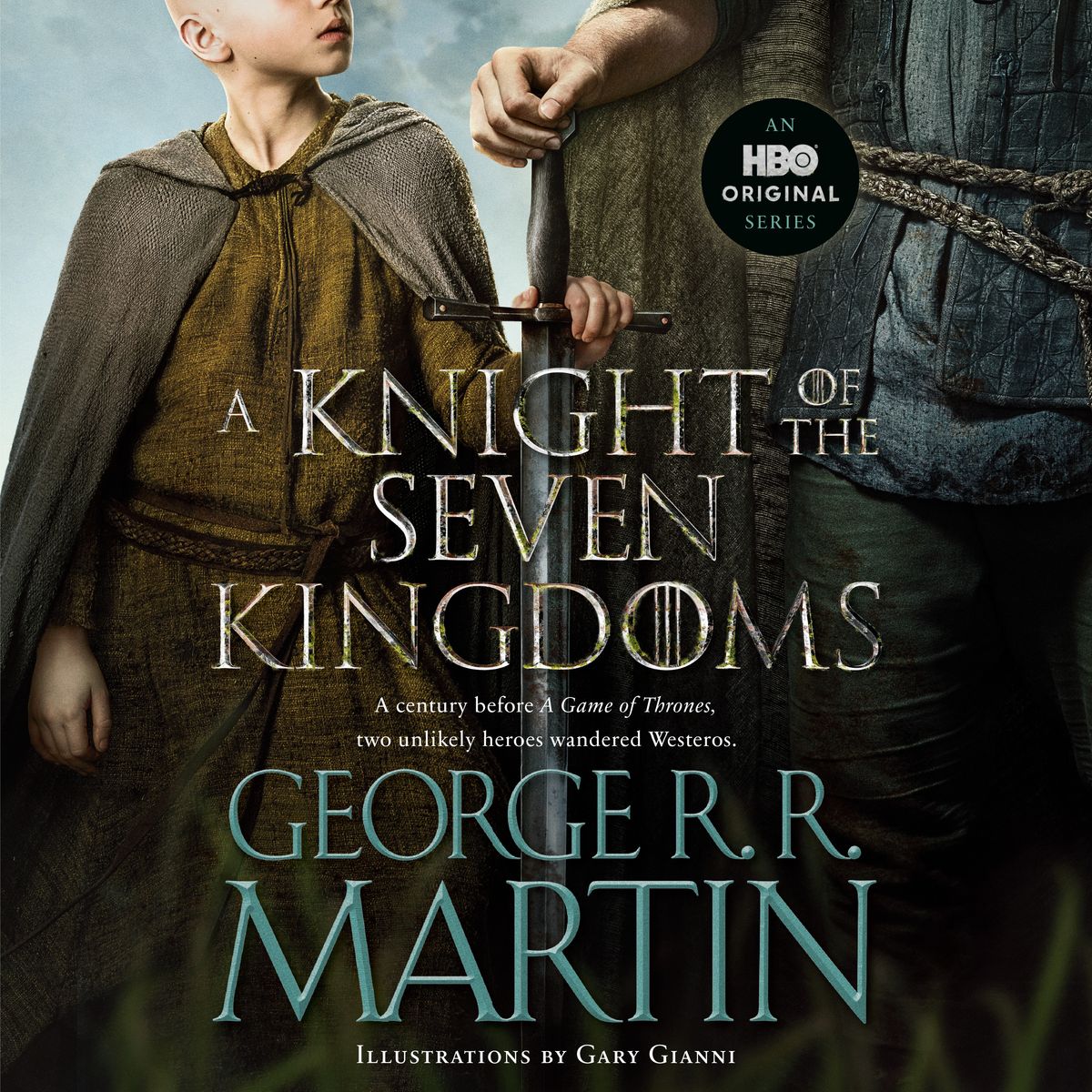
Yes. A Knight of the Seven Kingdoms, the HBO spinoff that premiered in January 2026, was filmed in Northern Ireland between June and September 2024. Filming locations include Titanic Studios in Belfast, Glenarm Castle in Co. Antrim, Tollymore Forest Park in Co. Down, the Mourne Mountains, Cave Hill above Belfast and the abandoned village of Galboly in the Glens of Antrim. A second season has been confirmed for 2027.
Do I need a car to visit the Game of Thrones filming locations in Ireland?
For most filming locations, yes. Ballintoy Harbour, Murlough Bay, Fair Head and several other sites are not accessible by public transport. Castle Ward has a bus connection from Downpatrick to Strangford that stops at the gates. The Dark Hedges are close enough to Bushmills to reach by taxi from the town. The Studio Tour has transfer options from Belfast (from Donegall Square) and Dublin (from the Molly Malone statue). A car gives you the most flexibility and allows you to combine multiple sites in a day.
Which Game of Thrones filming locations are free to visit?
The following are free to visit: the Dark Hedges, Cushendun Caves, Ballintoy Harbour, Murlough Bay, Fair Head, Inch Abbey, Magheramorne Quarry (view from road only), Audley’s Castle, Shillanavogy Valley and Binevenagh Mountain. Castle Ward charges £13.20 for adults (free for National Trust members). Dunluce Castle charges approximately £5.50 per adult. Glenariff Forest Park charges a modest car entry fee.

Are the Game of Thrones filming locations accessible for wheelchair users or those with mobility challenges?
Accessibility varies significantly by site. The Game of Thrones Studio Tour in Banbridge is the most accessible option, with fully level access throughout. Castle Ward has accessible parking, a shuttle bus on busy days, and level access to the Stableyard and some garden areas, with wheelchairs and scooters available to borrow. Many outdoor locations including Fair Head, Murlough Bay and Cushendun Caves involve uneven terrain unsuitable for wheelchairs. Downhill Beach is partially accessible at the clifftop level. Always check with the specific attraction in advance if you have particular requirements.
What is the best time of year to visit Game of Thrones filming locations in Ireland?
May through September offers the best combination of weather, light and accessibility, with longer daylight hours and more facilities open. Late spring is particularly good for avoiding peak summer crowds. Autumn brings dramatic light and mood to the landscape. Winter visits are possible and can be atmospheric, but some facilities close, and weather can make certain sites like Fair Head and Murlough Bay difficult or unsafe to access.
Walking Through Westeros
Standing at the Dark Hedges at first light, or looking down from Fair Head where Jon and Daenerys first met, or finding yourself unexpectedly moved by the ruins of Inch Abbey: visiting these game of thrones filming sites in person does something that rewatching the series on a screen cannot. It places the story in real landscape, real history, real weather.
Northern Ireland built Westeros, and it did so using places that were already remarkable before any camera crew arrived. That is ultimately the best argument for making the trip, fan or not.
Start Planning Your Trip
👉 Public Transportation in Ireland
👉 Hidden Gems in Ireland – 32 Secret places to visit
👉 Answering all your travel questions about Ireland
Wowee that is an in-depth and informative blog post, love it! I think craft and the handmade is often underrated so it’s beautiful to hear about the woodworkers creating those doors. I also started to copy and paste the names of all the beautiful places you mention to pop in this comment, but there are so many!
This is such a comprehensive post! Well done! I have actually never seen a single episode of GOT (only person in the world who hasn’t, I think), but they certainly know how to pick scenic settings for filming! Oddly enough, I’ve actually visited a couple GOT sites without trying to – the Dark Hedges in Northern Ireland and the Alcazar in Seville. Both we were visiting simply because we wanted to see them and found out afterwards they were filming sites!
lol I got caught up in it through my kids they are obsessed so living here in Ireland I decided to set out and visit all the sites I could so when they came to visit I could take them there. It is a pretty awesome fantasy tale I mean really it has dragons so cool!
When I was in N Ireland several years ago I only saw a few of these… now I must return to see them all! And the doors! So cool.
Oh my goodness, there are SO many!! Why an amazingly fantastic guide…thank you 🙂 Now I can’t wait to follow at least some of it myself!
Saved in my favorites! Love GoT and love Ireland, so… you’ll be my guide!!
I did not know there was so much Game of Thrones stuff to see in Northern Ireland!! I did a Game of Thrones walking tour in Dubrovnik but that was just of the filming locations of Kings Landing. I definitely need to head back to Ireland and visit all these places!
This is definitely the best, most comprehensive guide out there! Well done!!
Thanks for the compliment it did take me bloody ages to do lol…but I really enjoyed visiting all the sites I could.
I guess I need to watch some Game of Thrones before I go to Northern Ireland. This looks like a great tour! I know a lot of people that are obsessed with the show and would love this.
This is amazing! I’ve only been to the natural hot spring in Iceland from GOT so far – I recommend that one.
I am obsessed with getting to Iceland I can’t wait until later this year when my trip is going to be booked.
I have always wanted to visit Ireland, and my husband is a HUGE Game of Thrones fan. This would be so fun!
I love this post and the GOT doors are fab, but I’m sorry, the number of ads on the page almost killed me. Far too distracting from your fab post.
Yeah, I can appreciate that, but having said that those ads cover the increasing costs of blogging and websites so I know they can be a real pain in the butt. My recommendation is to add a Chrome extension or an Ad Blocker onto your browser it will save you all kinds of hassles with ads and they work a treat.
Heading that way this summer. This is a fabulous post with loads of information. I hope I can hit at least a few of these sites. Thanks for posting!
WOW, it’s a really epic guide for the really epic film. As I don’t watch TV, not at all, including GOT, so I have not my own opinion about it, but I must say those places are worth visiting regardless. Thanks for sharing!
I feel inspired to go on such a trip. Thank you for such a detailed description and photos. I add to my favorites and I am already planning a trip!
Enjoyed reading the article above , really explains everything in detail,the article is very interesting and effective.Thank you and good luck for the upcoming articles
Ireland is definitely on my bucket list!
Wow, what a thorough list! This is one of the most complete GOT locations list I’ve ever come across. Great job. Hoping to do this self-tour one day.
I have always wanted to visit Ireland
Your posts are extremely cool. I am glad to be here. I enjoyed reading your articles and I would like to bookmark your posts.
Your posts are really inspiring and useful for somebody like me who is planning a world travel. I think you deserve better attention on Google search rankings.
Your posts are extremely cool. I am glad to be here. I enjoyed reading your articles and I would like to bookmark your posts.
Hello
Definitely There Are Some Good Points in Your Article.
Thank You for Such a Nice Post.
Worth sharing info, especially for GOT lovers like me.
I saw the post it is amazing. Definitely I will see this type of good work in the future.
I really need to watch a few Game of Thrones before I go to Northern Ireland. This seems like a brilliant tour! I recognise a number of humans which are obsessed on the display and would really like this.
THANK YOU
Trust me it was my pleasure as a Game of Thrones fan it was an experience I will never forget touring the sites.
I am not a big fan of English movies, but after watching ” Game of Thrones ” I became a big fan of English movies.
Your posts are really inspiring and useful