
Jerpoint Abbey: Kilkenny’s Medieval Cistercian Gem
| What is Jerpoint Abbey and why should you visit it? |
| Jerpoint Abbey is a National Monument and 12th-century Cistercian abbey located 2.5km south-west of Thomastown in County Kilkenny, Ireland. Founded around 1160 by Domnall Mac Gilla Patraic, King of Ossory, it is one of the best-preserved medieval monastic ruins in Ireland, renowned for its cloister arcade, stone carvings, and medieval tombs. It is open Monday through Sunday, 9am to 5pm, with adult admission at 5 euros. |

Jerpoint Abbey is one of those places that stops you in your tracks. Standing inside its roofless nave with centuries of Irish sky overhead and medieval stone carvings catching the light, it is impossible not to feel the full weight of history pressing down. I first visited Jerpoint Abbey while housesitting in nearby Thomastown, County Kilkenny, and I have returned with friends and visitors more than once since. Each time, I notice something new.
In this guide, you will find everything you need to plan a visit to Jerpoint Abbey: its history, what to see on site, practical information on tickets and opening times, how to reach it, and what to explore nearby, including the extraordinary lost medieval town of Newtown Jerpoint. This is one of the most rewarding stops on Ireland’s Ancient East, and it deserves more than a quick look.
I do recommend renting a car outside Dublin for this region. Many of the most compelling historic sites in County Kilkenny are simply not reachable without a vehicle.
- Jerpoint Abbey: Kilkenny's Medieval Cistercian Gem
- Fast FAQs: Jerpoint Abbey at a Glance
- Where Is Jerpoint Abbey in County Kilkenny?
- Jerpoint Abbey Opening Times and Tickets
- The History of Jerpoint Abbey: From Foundation to Dissolution
- What to See at Jerpoint Abbey: A Guide to the Site
- How to Plan Your Visit to Jerpoint Abbey: Step by Step
- Newtown Jerpoint: Ireland's Lost Medieval Town
- My Experience: Why I Keep Coming Back to Jerpoint Abbey
- What Else to See Near Jerpoint Abbey in County Kilkenny
- Frequently Asked Questions About Jerpoint Abbey
Fast FAQs: Jerpoint Abbey at a Glance
Where is Jerpoint Abbey? 2.5km south-west of Thomastown, County Kilkenny, off the R448. Exit 10 on the M9.
When is it open? Monday to Sunday, 9am to 5pm. Hours may reduce from October onwards.
How much does it cost? Adults 5 euros, seniors and groups 4 euros, children and students 3 euros, family 13 euros. OPW Heritage Card holders enter free.
Who founded Jerpoint Abbey? Domnall Mac Gilla Patraic, King of Ossory, around 1160. It became a Cistercian abbey approximately 20 years later.
Is Jerpoint Abbey worth visiting? Yes. It is one of the finest and best-preserved medieval monastic ruins in Ireland, with exceptional stone carvings, a unique cloister arcade, and the nearby lost medieval town of Newtown Jerpoint.
Where Is Jerpoint Abbey in County Kilkenny?
Jerpoint Abbey is located 2.5km south-west of Thomastown on the R448, accessible from Exit 10 on the M9. Follow the signs for Thomastown and from there the brown heritage signs will direct you to the abbey.
If you are travelling from Kilkenny city, the drive takes roughly 25 minutes. From Dublin, allow approximately 90 minutes by car.
Public transport is possible but limited. Bus Eireann runs a Thursday service between Thomastown and Waterford that stops at Jerpoint, but for flexibility, a car is strongly recommended.

Jerpoint Abbey Opening Times and Tickets
Jerpoint Abbey is managed by the Office of Public Works (OPW) as a National Monument and Heritage Ireland site.
Opening Times: The abbey ruins are open Monday to Sunday, 9am to 5pm. Hours may vary slightly in winter months, particularly from October onwards, so it is worth checking the OPW Heritage Ireland website before you travel.
Admission Prices:
- Adults: 5.00 euros
- Groups and seniors: 4.00 euros
- Child and student: 3.00 euros
- Family: 13.00 euros
- OPW Heritage Card holders: free entry
Guided tours of Jerpoint Abbey are available in season and are free with your entry ticket. They last approximately 1.5 hours and are genuinely worth taking. The guides here are exceptional: knowledgeable, engaging, and full of detail that you would easily miss on your own.

The History of Jerpoint Abbey: From Foundation to Dissolution
Jerpoint Abbey was founded during the second half of the 12th century. Historians and archaeologists believe it was established around 1160, most likely by Domnall Mac Gilla Patraic (died 1176), son of Cerball Mac Gilla Patraic and King of Ossory. It began its life as a Benedictine monastery before becoming a Cistercian abbey approximately 20 years later when it was affiliated with Baltinglass Abbey, which was itself a daughter house of Mellifont, the first Cistercian foundation in Ireland.
The Cistercian order was founded in France in 1098 as a reform movement within Benedictine monasticism. Its founders emphasised austerity, manual labour, self-sufficiency, and simplicity of architecture. What makes Jerpoint Abbey so historically intriguing is the contradiction at its heart: the Cistercian order’s rule called for plain buildings and minimal decoration, yet Jerpoint is remarkable for the richness and quality of its stone carvings and its elaborately decorated cloister arcade.
The guides at the abbey offer a compelling explanation for this. The community at Jerpoint was divided into two distinct groups of monks. Choir monks, who came from noble families and brought significant financial resources with them when they entered the order, were educated, spent most of their time in prayer and study, and rarely left the abbey walls. Lay brothers came from poor backgrounds and undertook approximately 90 percent of the manual labour, including farming on outlying lands, to which they would travel during the working week and return only on Sundays.

Although the Cistercian ideal claimed equality, the reality at Jerpoint was quite different. Choir monks and lay brothers ate different food, lived in separate buildings, and occupied separate sections of the church. The wealth brought in by the choir monks financed the decorative stonework that makes this abbey so exceptional today.
The ruins visible at Jerpoint date from several periods. The church itself dates to the 12th century. The tower is a 15th-century addition. The cloister arcade, one of the finest examples of its kind in Ireland, was also largely reconstructed during the 15th century.
Following the Dissolution of the Monasteries under Henry VIII, Jerpoint Abbey was granted to the 9th Earl of Ormond. The monastic community was disbanded, and the site became primarily a place of burial. In the 1950s, significant restoration work was carried out, and the visitor centre was subsequently established to house stonework recovered during that process.

What to See at Jerpoint Abbey: A Guide to the Site
Jerpoint Abbey is large, layered, and full of detail. Taking the guided tour on your first visit is the best decision you can make. The information that follows will help you understand what you are looking at, but nothing replaces a knowledgeable guide walking you through it in person.
The Church
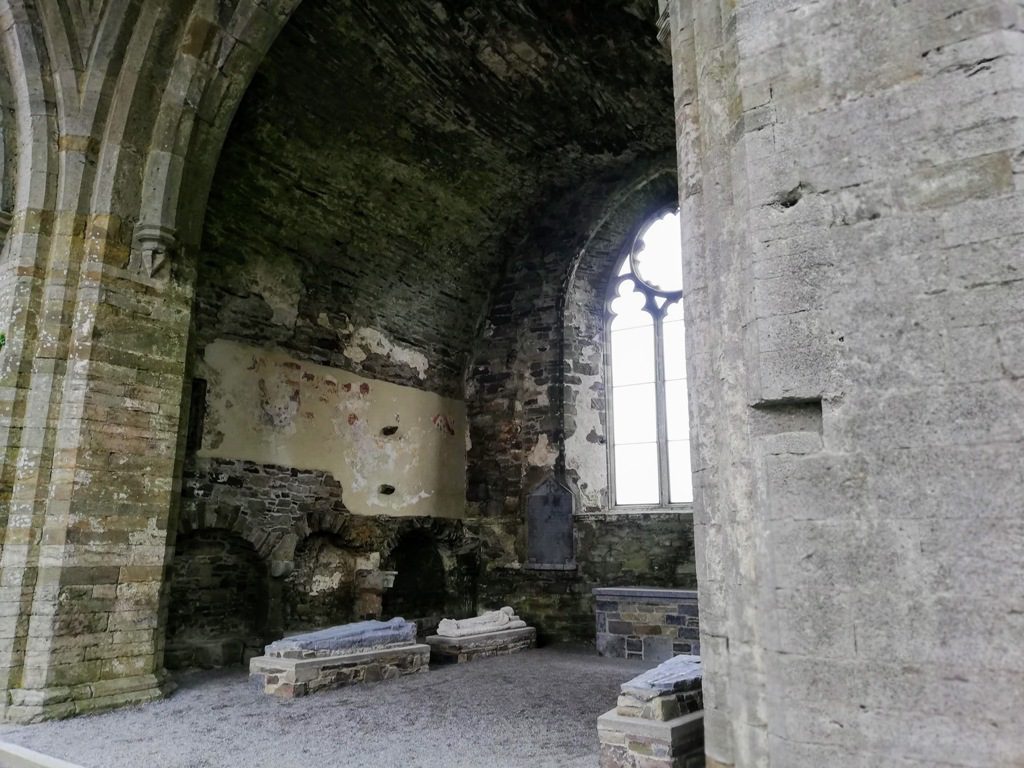
The church is the oldest part of the surviving complex, built in the Romanesque style in the 12th century. It forms a cross shape on the north side of the cloister. Within the chancel and the transepts, you will find some of the most remarkable stone tombs in Ireland, including the tomb of Felix O’Dullany, the first abbot of Jerpoint, and tombs associated with the Butler family, who also owned Kilkenny Castle.
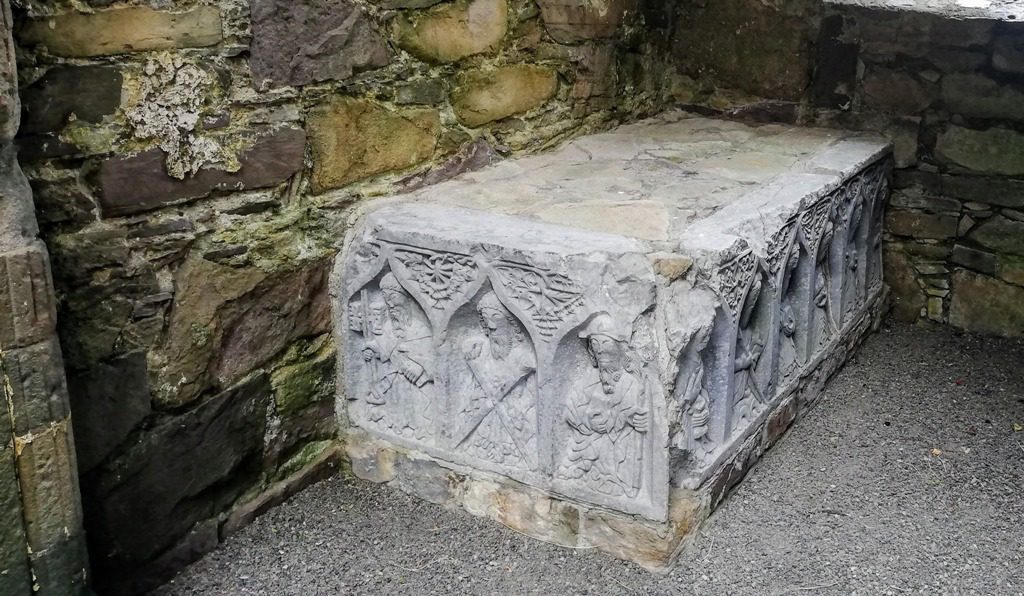
The sides of these stone tombs are carved with figures known as ‘weepers’: representations of apostles, saints, and angels, each holding an object meaningful to the person interred. Among those depicted are St. James, St. Peter, St. Michael, and the angel Gabriel. The craftsmanship is extraordinary, and looking closely at each weeper reveals a level of individual character that is genuinely moving.

The Cloister Arcade
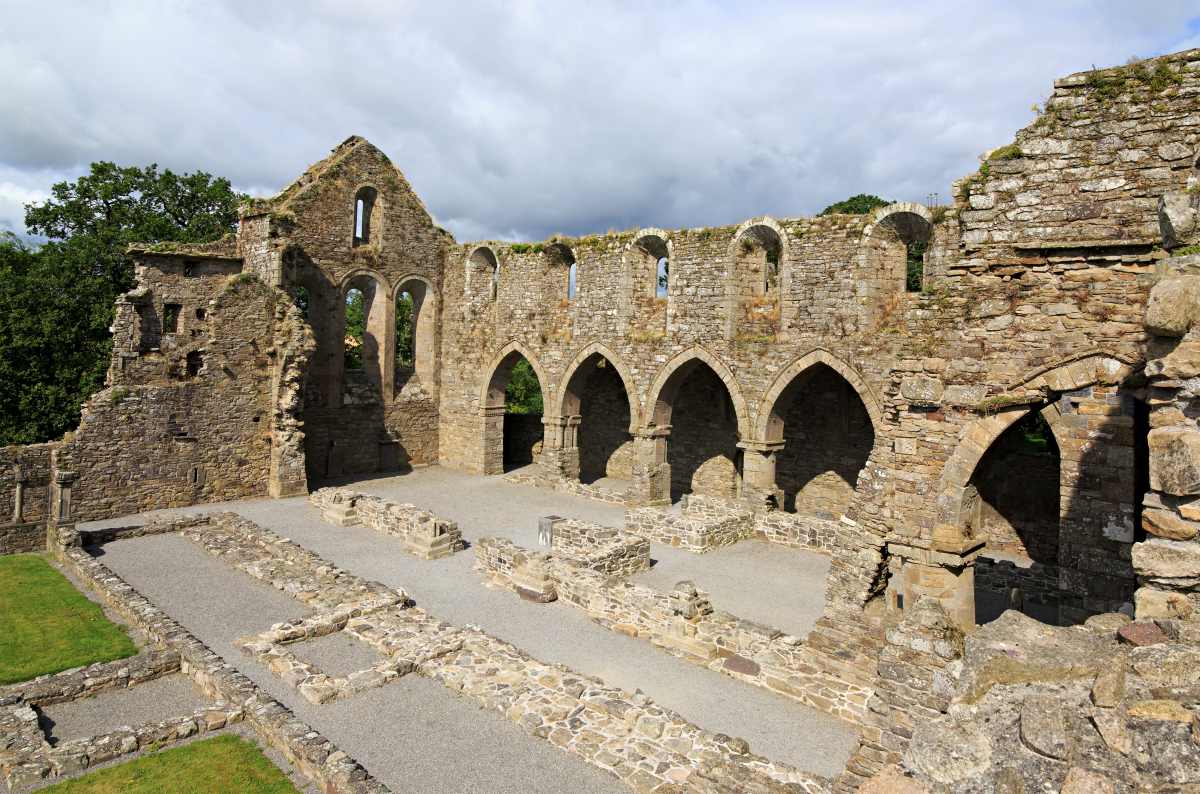
The cloister arcade at Jerpoint Abbey is one of the treasures of medieval Irish art. In a Cistercian monastery, the cloister was the heart of daily life: the covered walkway around an open courtyard where monks would study, pray, walk while chanting scripture, and move between the major buildings. All the principal structures of the abbey opened onto it.
At Jerpoint, the pillars of the cloister arcade are carved with figures in a style that is expressive and individual, ranging from knights and ladies to ecclesiastical figures, saints, and fantastical creatures. The work is believed to date from the 15th-century reconstruction of the cloister. Some of the original carved panels were removed to the visitor centre for preservation during the 1950s restoration; those remaining in situ have weathered beautifully and remain legible.
This is the part of the site I keep returning to. The cloister at Jerpoint is unlike any other in Ireland, and it rewards slow, close attention.
The Chapter House
The chapter house was where the monks gathered daily for a reading from the Rule of St. Benedict, the announcement of the day’s chapter, and the public confession of faults. It was a space of strict silence and communal accountability.
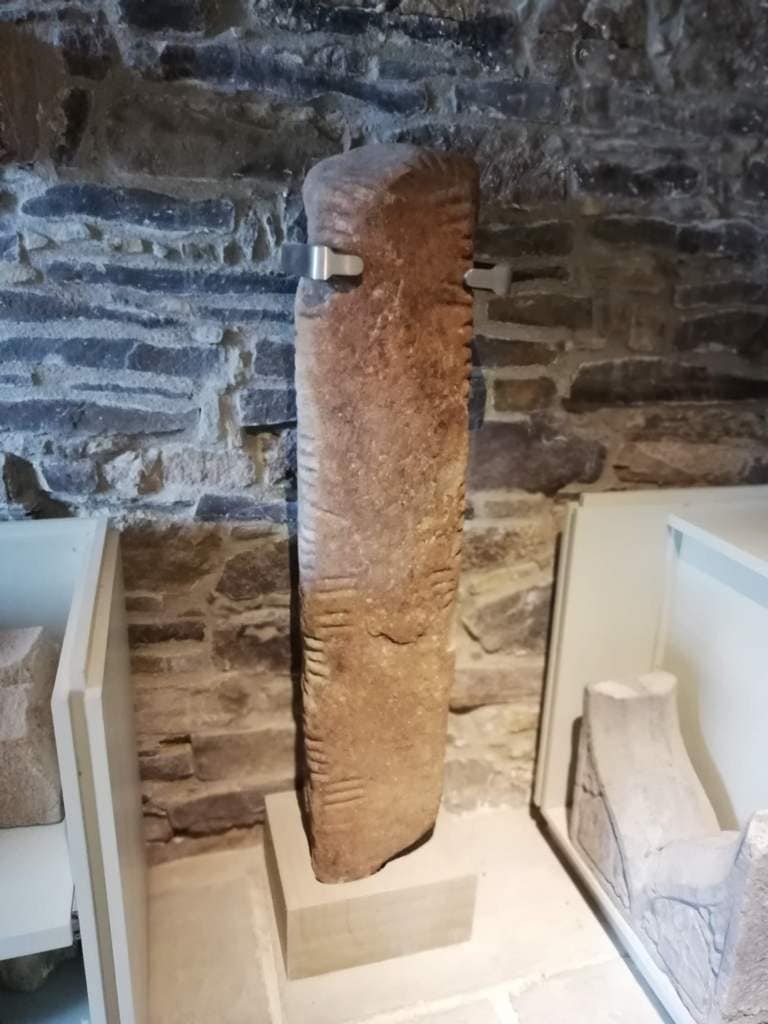
Today, the chapter house at Jerpoint serves as a small exhibition space, housing stonework recovered during restoration, along with an Ogham stone found in a field north of Thomastown, on a tributary of the River Nore, in an area historically referred to as the ‘monks’ field.’


The Ogham Stone
The Ogham stone displayed at Jerpoint is a direct link to pre-Christian Ireland and the early medieval period. Ogham was an early Irish writing system, used primarily between the 4th and 7th centuries, in which letters were represented by notches and lines cut along the edge of a stone. These inscriptions were typically memorial markers recording a person’s name and parentage.
The stone found near Thomastown is a tangible connection to the Gaelic Irish culture that preceded and coexisted with the Norman settlers who shaped so much of this region. Finding it here, within a Cistercian abbey complex, adds an extra layer to the already rich human story of this site.
The Frescos
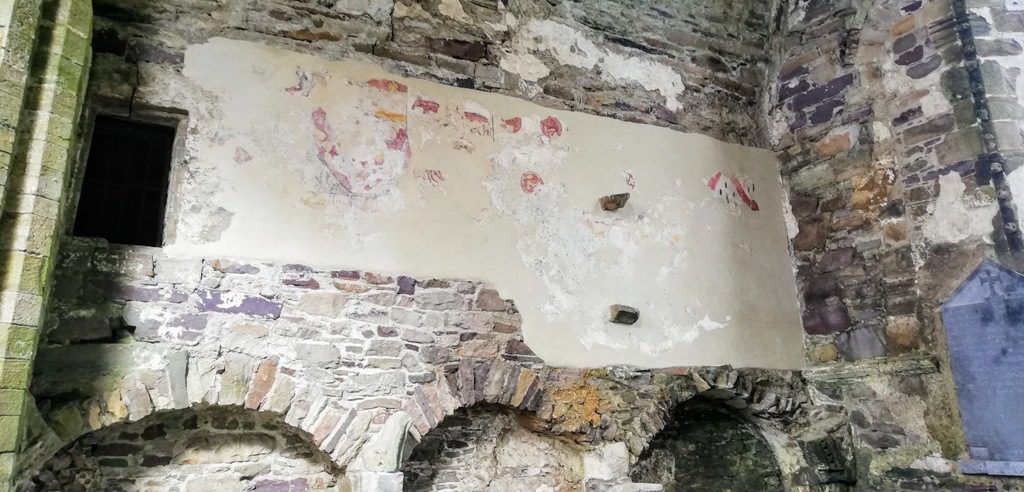
On the north wall of the church, faint traces of painted wall decoration survive from the 15th or 16th century. These frescos, barely visible now but haunting in their suggestion, were likely images of benefactors of the abbey, painted as a permanent record of patronage and a form of spiritual commemoration.
Research into the Jerpoint Abbey frescos is ongoing. The fact that any pigment survives at all after centuries of exposure speaks to the sheltered position of this section of wall. When I visited, I found myself straining to make out the shapes and thinking about how vivid these paintings must once have been against freshly whitewashed stone.
How to Plan Your Visit to Jerpoint Abbey: Step by Step
Whether you are coming for an hour or an afternoon, a little planning will make your visit much more rewarding.
Book your journey in advance. Drive from Kilkenny city (25 minutes) or from Dublin (90 minutes) via the M9, exiting at Junction 10 for Thomastown.
Check opening times before you travel, particularly in October and outside the main summer season, as hours can change.
Arrive early. The site is popular in August and September, and the guided tours fill up. Morning visits are quieter and the light on the stone carvings is excellent.
Take the guided tour. It is free with your entry ticket and lasts around 1.5 hours. The guides are among the best at any heritage site in Ireland.
Wear comfortable footwear. The ground within the ruins is uneven, and some areas involve steps and rough stone floors.
Allow extra time for the visitor centre, where the restored stonework and the Ogham stone are displayed.
Combine your visit with Jerpoint Park (just a few minutes away by car) to see the ruins of the lost medieval town of Newtown Jerpoint. Tours there last approximately 30 minutes and cost 8 euros per adult.

Newtown Jerpoint: Ireland’s Lost Medieval Town
A short distance from the abbey, and closely connected to its history, lies one of the most unusual sites in Ireland: the remains of Newtown Jerpoint, a medieval town that flourished for centuries and was then effectively abandoned.
Founded in the 12th century at a principal crossing of the River Nore, Newtown Jerpoint was a functioning town with approximately 27 houses, a woollen mill, a tannery, a brewery, a courthouse, two water wheels, and a tower house near the marketplace. Its proximity to Jerpoint Abbey made it one of the most economically significant settlements in this part of Kilkenny. Historians and archaeologists regard it as one of the most important sites for the study of medieval settlements in Ireland.
The remains of Newtown Jerpoint are now part of Jerpoint Park, where self-guided tours run for 8 euros per adult and take around 30 minutes. Tea is available at the Belmore House Tea Room within the park, which is a pleasant way to finish the afternoon.

St. Nicholas and the Grave at Newtown Jerpoint
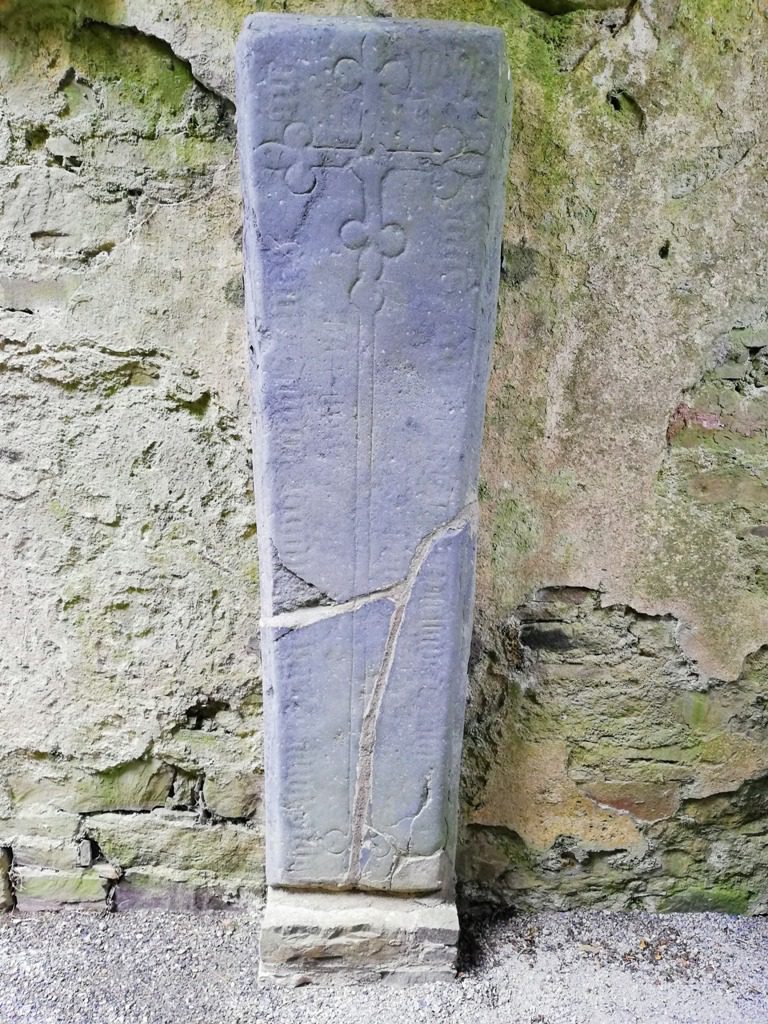
One of the most striking features of Newtown Jerpoint is a ruined church dedicated to St. Nicholas, and within its churchyard, a grave slab that is the subject of one of Ireland’s most remarkable local legends.

According to local tradition, the remains of St. Nicholas of Myra, the historical bishop whose generosity inspired the legend of Santa Claus, were brought to this very spot in the 12th century. The most detailed version of the story centres on a Norman family called de Frainet. These crusaders owned land in the Thomastown area and, following the Norman loss of power in various parts of Europe, ultimately settled in Ireland, bringing the relics of Nicholas with them from Myra via Bari and Nice.
Whether or not one takes the legend literally, the grave slab itself is genuinely unusual. Carved into the stone is the image of a bishop, identified locally as St. Nicholas, flanked by two figures believed to be the crusaders who transported the remains. It is a quietly extraordinary thing to stand before.
This legend also touches on Irish folklore traditions in a distinctly Kilkenny context: the blending of Christian iconography, Norman heritage, and local storytelling that characterises so much of the ancient sites of Ireland.

My Experience: Why I Keep Coming Back to Jerpoint Abbey
I have brought several friends and visitors to Jerpoint Abbey over the years, and it is one of those places that consistently delivers, regardless of the weather or the season. Even on an overcast day in October, when the grey sky sits low over the tower and the grass in the cloister is dark with rain, the place has an atmosphere that is almost impossible to describe.
What I find most affecting is the detail in the stonework. It is easy to walk through a medieval ruin and think of it as uniform, monolithic, a relic of some collective historical moment. But every carved face in the cloister arcade at Jerpoint is individual. Someone sat down with a chisel in the 15th century and gave each figure its own expression, its own posture, its own presence. That human particularity, surviving across six centuries, is something I find genuinely moving.
If you are visiting Kilkenny and you have a car, Jerpoint Abbey is not optional. It is one of the finest medieval sites in Ireland, and the combination of the abbey, the visitor centre, and Jerpoint Park makes for a full, rewarding half-day.


What Else to See Near Jerpoint Abbey in County Kilkenny
Thomastown, the nearest town, is pleasant and has cafes and a small number of shops. From there, the range of historic sites within a short drive is genuinely impressive.
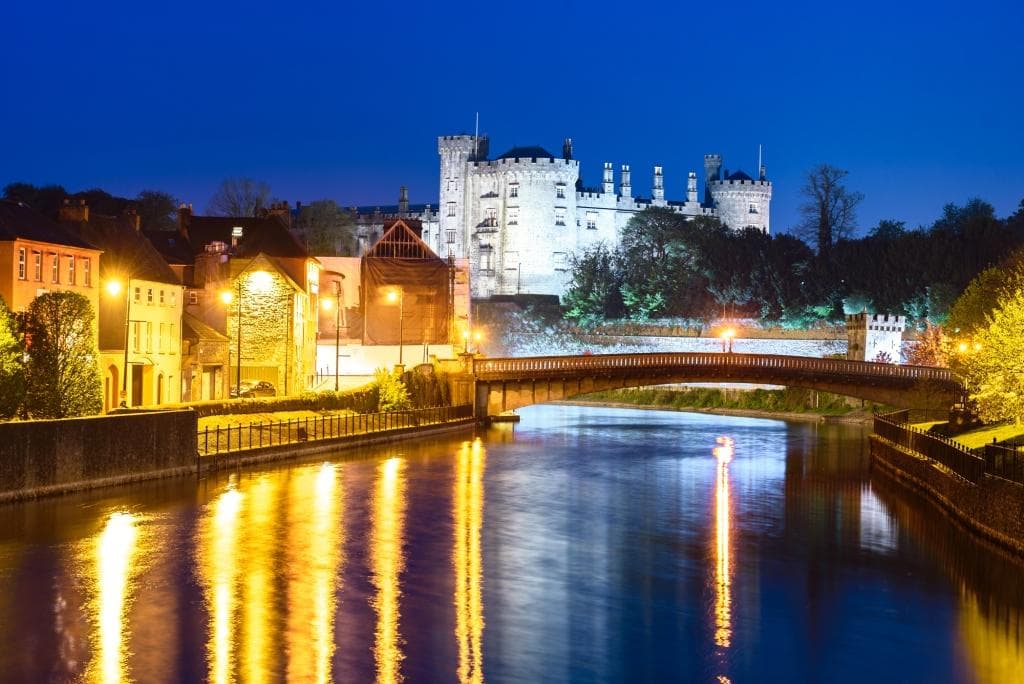
Kilkenny city itself, roughly 25 minutes away, is home to Kilkenny Castle, the medieval mile, the National Design and Craft Gallery, and some of the best food and drink in the south-east. For a full guide to the best things to do in County Kilkenny, see the linked article.
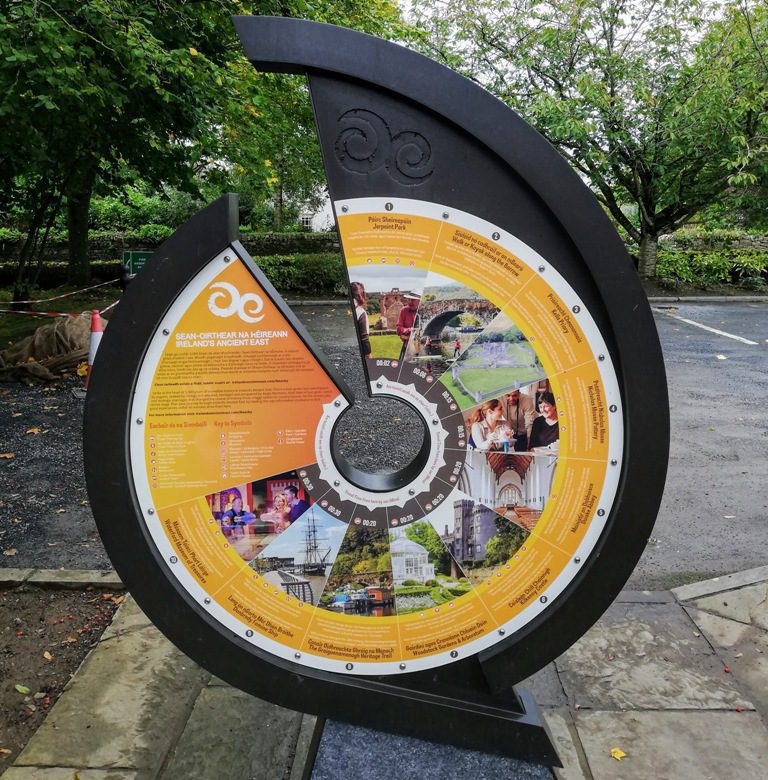
If you are exploring beyond Kilkenny, consider the wider region of Ireland’s Ancient East, which encompasses Newgrange, the Rock of Cashel, and dozens of other sites of comparable historical significance.
Frequently Asked Questions About Jerpoint Abbey
What is Jerpoint Abbey and why is it significant?
Jerpoint Abbey is a 12th-century Cistercian abbey in County Kilkenny, Ireland, founded around 1160 by Domnall Mac Gilla Patraic, King of Ossory. It is one of the most important and best-preserved medieval monastic ruins in Ireland. It is designated a National Monument and is notable for its elaborately carved cloister arcade, its medieval tombs with carved weeper figures, surviving fresco fragments, and the Ogham stone displayed in its chapter house.
When is Jerpoint Abbey open and how much does it cost?
Jerpoint Abbey is open Monday to Sunday from 9am to 5pm. Adult admission is 5 euros. Group and senior rates are 4 euros, children and students pay 3 euros, and a family ticket costs 13 euros. Holders of the OPW Heritage Card enter free. Guided tours are included in the price and last approximately 1.5 hours. Opening hours may be reduced in October and through winter, so checking the OPW Heritage Ireland website before visiting is advisable.
How do I get to Jerpoint Abbey from Kilkenny city?
Jerpoint Abbey is approximately 25 minutes by car from medieval Kilkenny city. Take the M9 south, exit at Junction 10 for Thomastown, and follow signs from Thomastown. The abbey is 2.5km south-west of the town on the R448. Bus Eireann runs a limited service between Thomastown and Waterford on Thursdays that stops at Jerpoint, but a car is strongly recommended for flexibility.
Who founded Jerpoint Abbey and what order was it part of?
Jerpoint Abbey was most likely founded by Domnall Mac Gilla Patraic, King of Ossory, who died in 1176. It was initially established as a Benedictine monastery before becoming a house of the Cistercian order approximately 20 years after its founding. It was affiliated with Baltinglass Abbey and, through that connection, with Mellifont, the first Cistercian abbey in Ireland.
What is the significance of the cloister arcade at Jerpoint Abbey?
The cloister arcade at Jerpoint Abbey is considered one of the finest examples of medieval carved stonework in Ireland. Dating from the 15th-century reconstruction of the cloister, its pillars are carved with a remarkable variety of figures including knights, saints, ecclesiastical figures, and fantastical creatures. The cloister was the central space of monastic life, where monks prayed, studied, and moved between the major buildings of the abbey.
Is there a connection between Jerpoint Abbey and Santa Claus?
There is a local legend associated with the nearby ruined church at Newtown Jerpoint, part of Jerpoint Park, that claims the remains of St. Nicholas of Myra, the historical figure behind the Santa Claus legend, were brought to this location in the 12th century by a Norman family called de Frainet. A carved grave slab in the churchyard, depicting a bishop flanked by two figures, is identified locally as the tomb of St. Nicholas. The story is a legend rather than an established historical fact, but the grave slab itself is genuine and unusual.
Is Jerpoint Abbey accessible for visitors with mobility challenges?
Parts of Jerpoint Abbey are accessible, including the visitor centre. The interior of the ruins involves uneven ground, some steps, and rough stone surfaces, which can be challenging for visitors using wheelchairs or mobility aids. The site is outdoors, and some areas are more manageable than others. Contacting the OPW in advance to discuss specific access requirements is recommended.
Related Reading:
Visiting Kilkenny: A Complete Guide | Kilkenny Castle | Best Things to Do in County Kilkenny | Ogham Stones in Ireland | Ancient Ireland | Renting a Car in Ireland | Moving to Ireland: The Ultimate Guide
Join 7,500 Ireland travellers in my Ireland Uncovered Facebook Group and 1,897 on my XYUandBEYOND PAGE
If you are interested in the folklore, culture and women’s roles in Ireland you may enjoy these articles