
The Shambles, York: History, Myths and Ghosts
The Shambles is a medieval street in York city centre, first documented in the Domesday Book of 1086, with most of its surviving timber-framed buildings dating from 1350–1475. It was originally a street of butchers’ shops (the name comes from ‘Shammel’, an Anglo-Saxon word for the shelves used as shop counters). It’s popularly linked to Diagon Alley from Harry Potter, though no scenes were actually filmed there, and it has a genuine dark history, including the martyrdom of Margaret Clitherow, a resident of the street.
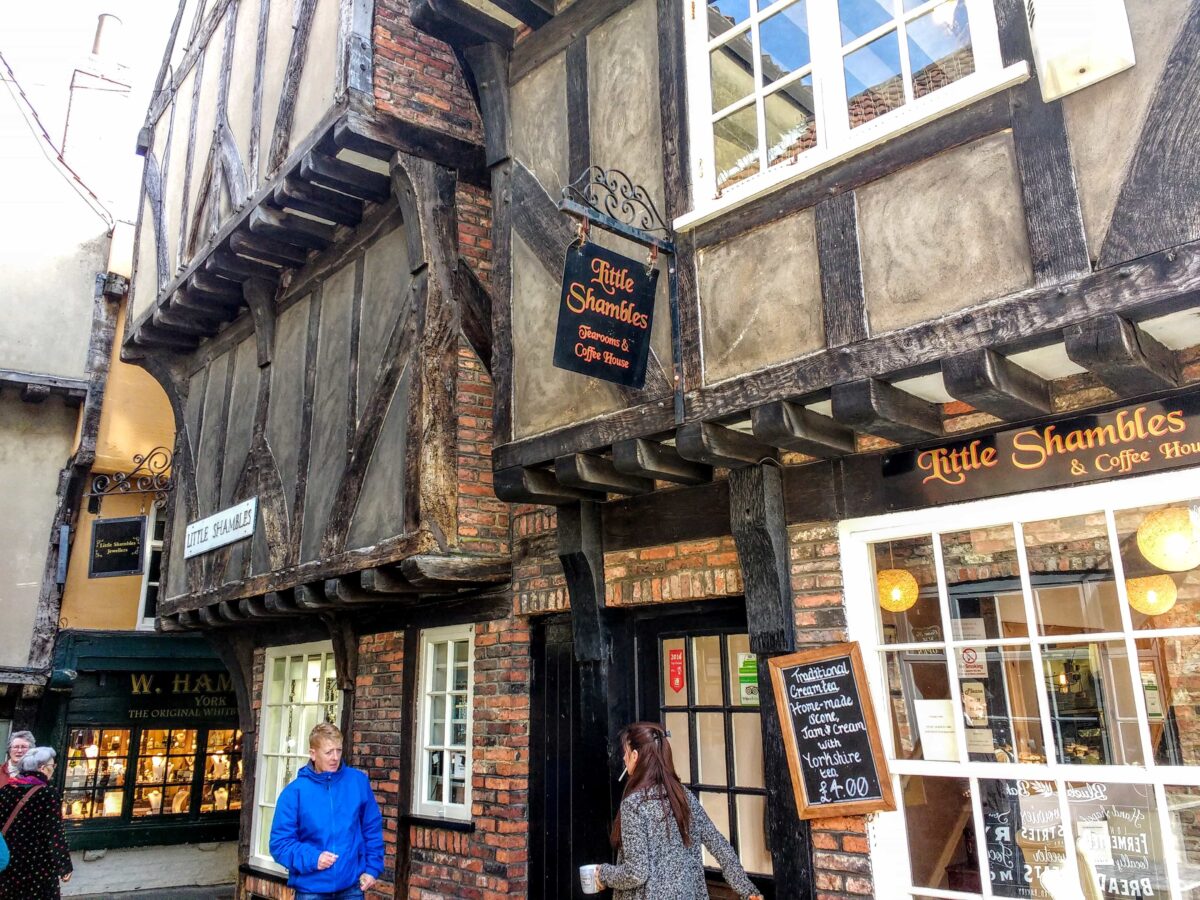
I’ve been to the Shambles many times now, and it’s never once lost its pull on me. Visiting York’s most famous street was a dream of mine since I read about it in high school history class, long before Harry Potter ever came along. The appeal of an ancient medieval street dating back to the Domesday Book caught my imagination like nothing else, and every time I go back, I still find myself slowing down to look up at just how far those upper floors lean toward each other.
From that moment I was determined to visit, and then came Harry Potter, and I learned that the Shambles was the inspiration for Diagon Alley. Since then, several shops with a Harry Potter focus have opened to much acclaim in the area more on what’s actually true about that connection below.
York is an amazing city to wander, and I highly recommend spending at least 2 days in York and simply soaking up everything there is to do. You are also spoiled for choice on where to stay in York and which neighbourhood puts you close to the sights on your bucket list.
It was probably the Romans who established York as Eboracum, and sometime around 410 AD they abandoned the area; the city, like much of Roman Britain, fell into a period of decay and decline. New settlers followed the Anglo-Saxons, and later the Vikings, who renamed the city Jorvik and made it their northern capital in 866.
The Shambles, York: History, Myths and Ghosts
| What it is | A medieval street of leaning, timber-framed buildings in York city centre one of the best-preserved medieval streets in Europe |
| Built | Documented in the Domesday Book of 1086; most surviving buildings date from 1350–1475 |
| Harry Potter myth | No scenes were filmed here it’s a visual inspiration for Diagon Alley, not a filming location (Diagon Alley was shot at Leadenhall Market and Leavesden Studios) |
| Real ghost story | Margaret Clitherow, who lived at 10–11 The Shambles, was executed nearby in 1586 for harbouring Catholic priests; her house is now a shrine on the street |
| Best time to visit | Midweek, to avoid weekend crowds; shops generally open 10am–6pm daily |
| Getting there | 15-minute walk from York train station; London King’s Cross is around 1hr 50m by direct train |
- The Shambles, York: History, Myths and Ghosts
- The Shambles, York: History, Myths and Ghosts
- How to get to the Shambles, York
- When's the best time to visit the Shambles?
- When was the Shambles in York built?
- Margaret Clitherow's house: the Shambles' real dark history
- Ghosts and legends of the Shambles
- Myth-busting: was Harry Potter actually filmed on the Shambles?
- What is the Shambles in York known for?
- Things to do in the Shambles, York
- Harry Potter gift shops on the Shambles
- Harry Potter filming sites in York, outside the Shambles
- Where to eat in the Shambles, York
- Pubs in the Shambles, York
- Where to stay in York
- Frequently Asked Questions
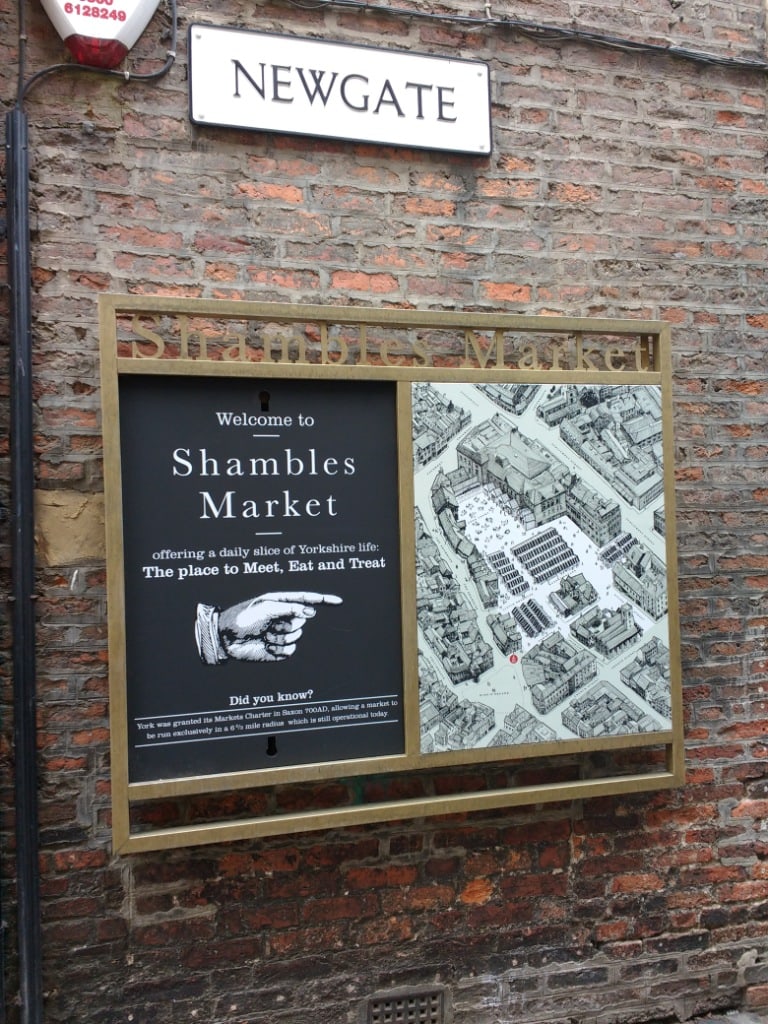
How to get to the Shambles, York
An easy trip if you’re housesitting or staying in Yorkshire, as I was drive in and leave the car at a Park and Ride, then take the bus into the city. It’s not a large city, and you can ask the bus driver where to get off for the Shambles. It’s very accessible from most areas of the city, since it sits right in the historic heart of the place.
If you’re coming from London, you can catch a direct train from King’s Cross that takes around 1 hour 50 minutes. From Manchester Piccadilly it’s about 1 hour 20 minutes, and from Manchester Airport around 1 hour 40 minutes.
You can easily walk to the Shambles from York train station it’s about 15 minutes on foot. With beautiful B&Bs, historic hotels and excellent youth hostels close by, you won’t run out of places to stay or things to see and do.
When’s the best time to visit the Shambles?
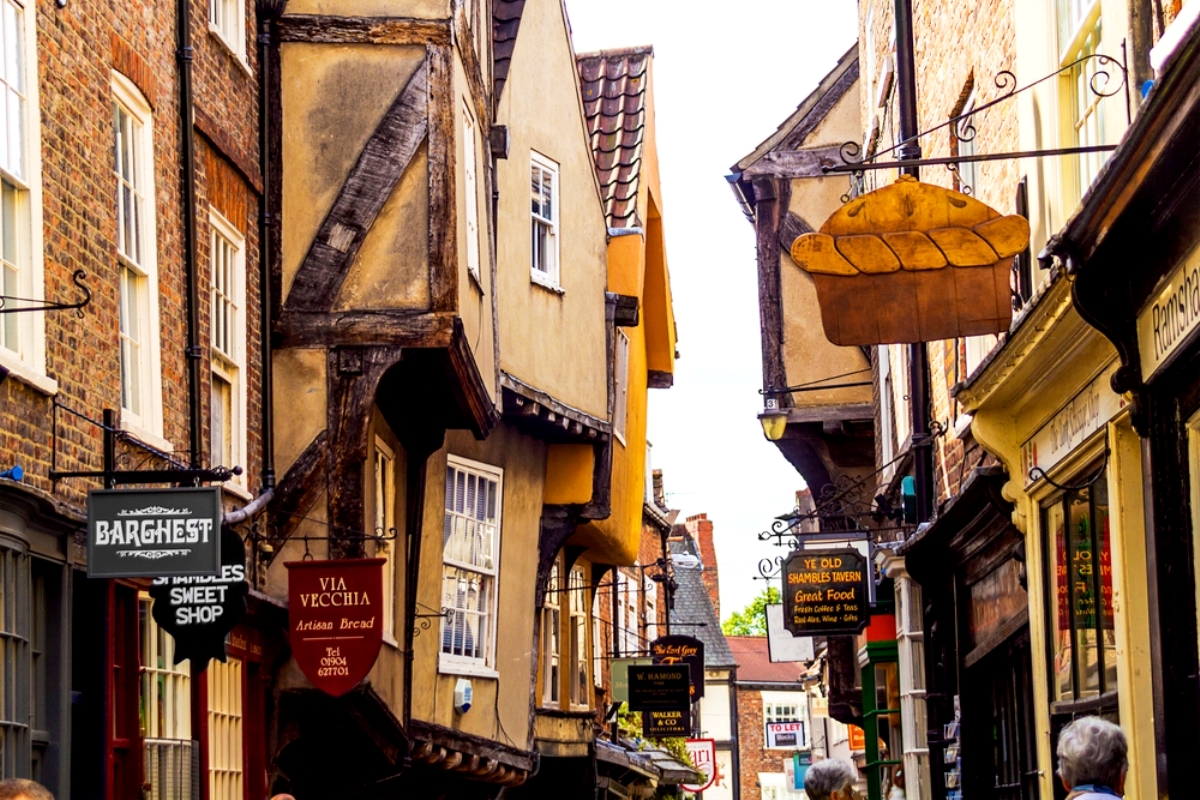
The Shambles gets particularly busy at weekends, so for the best shopping and strolling experience, plan your visit midweek. Shops are generally open 7 days a week from 10am to 6pm.
It’s well worth staying in York for a few days, since there’s so much to explore in the city see my guide to 15 things to see and do in North Yorkshire for the wider area.
When was the Shambles in York built?
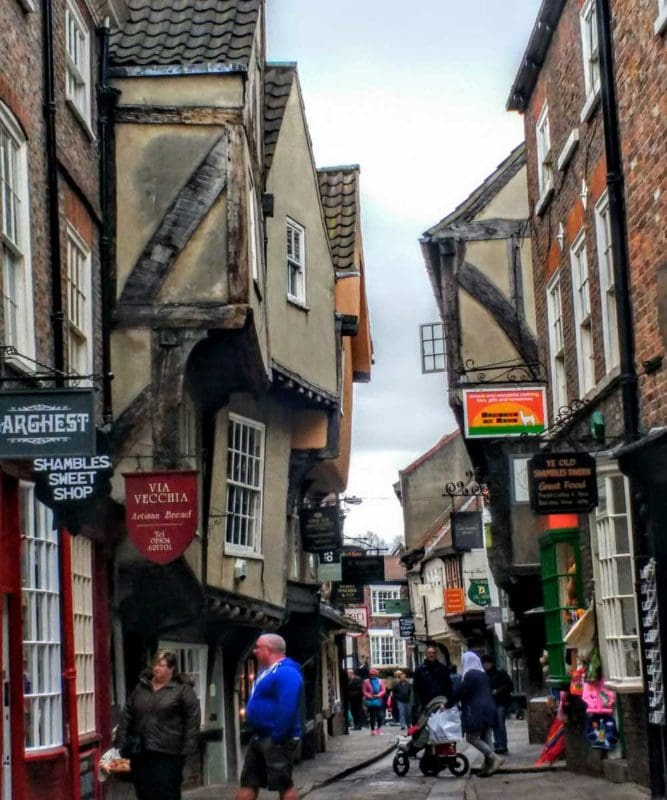
“The Shambles” is used to describe a maze of narrow, twisting lanes in the centre of York. At the heart of it is the actual lane called The Shambles, widely considered one of the best-preserved medieval streets in Europe. The Domesday Book of William the Conqueror mentions the Shambles in 1086, and many of the existing buildings date from 1350–1475 each one chock full of stories and interesting history.
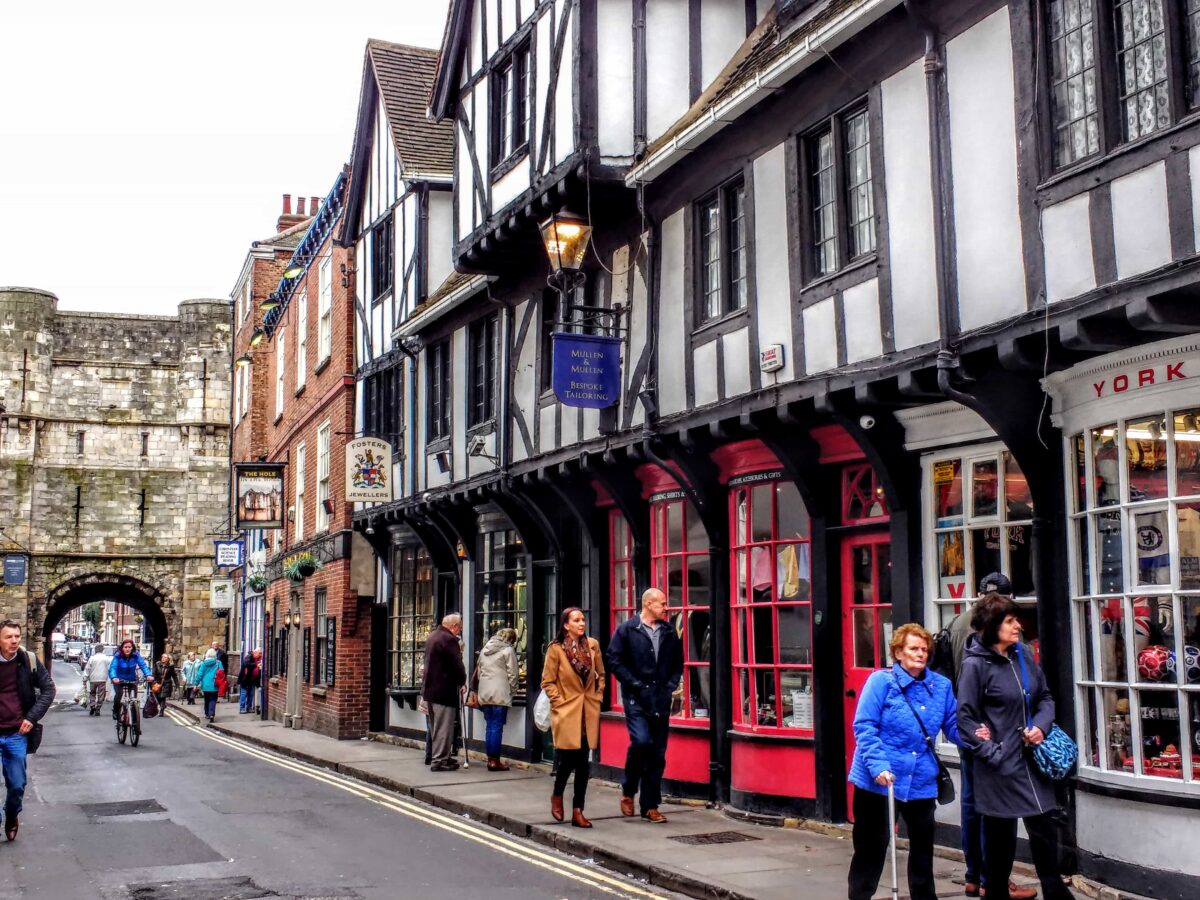
The Shambles was a street of butchers’ shops and houses, many complete with a slaughterhouse at the back of the premises, where they prepared their own “home-grown” meats. The meat was hung outside the shops and laid out for sale on what are now the shop window bottoms. With several former butcher shops along the street, you can still spot some of the original meat hooks attached to the fronts.
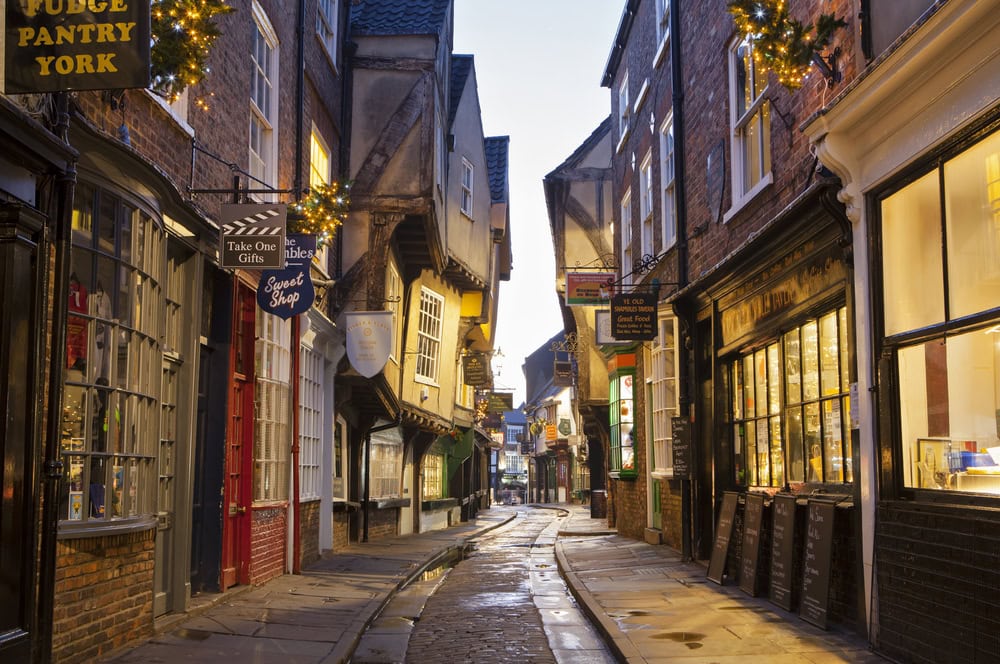
Given the times, there was a constant problem of how to dispose of the waste produced by slaughtering animals in the city. One solution still visible today: the pavements are raised on either side of the street, forming a channel down the middle that could be washed with buckets of water a few times a week.
In parts of the Shambles, you can stretch out your arms and touch both sides of the street. This had a practical purpose beyond the obvious cramped charm it protected the wattle-and-daub material covering the buildings, and kept the meat out of direct sunlight, helping it last longer without refrigeration.
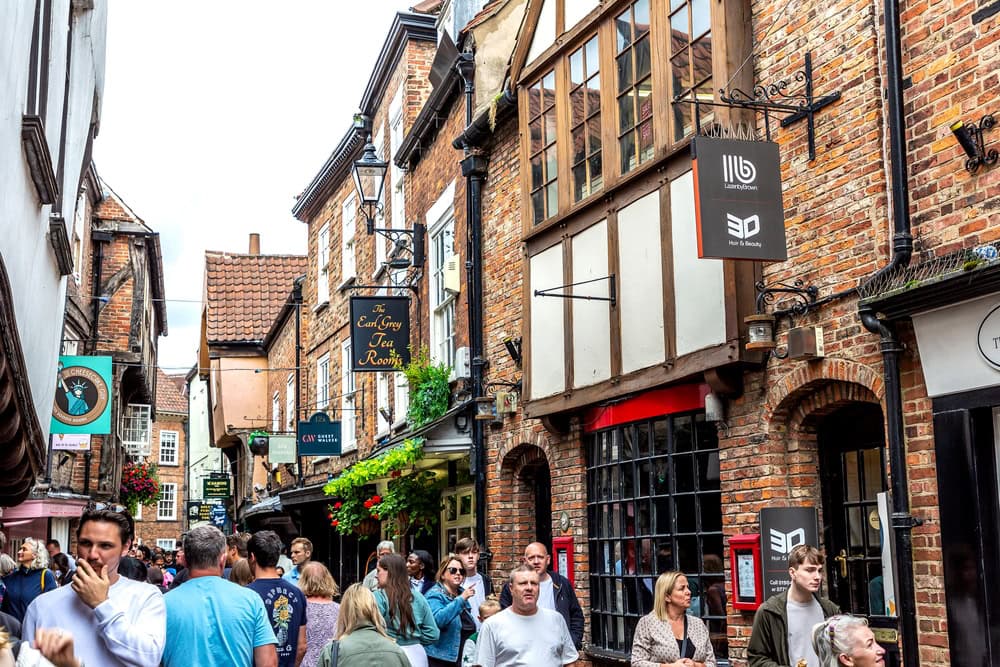
The name Shambles is believed to come from the Anglo-Saxon word for shelves, a major feature of the shops thought to derive from ‘Shammel’, an Anglo-Saxon word for the shelves or booth-style shop fronts. Another theory traces it to the word ‘flesshammel’, meaning flesh, so the original name is thought to have been “the Great Flesh Shambles.”
Margaret Clitherow’s house: the Shambles’ real dark history
One of the most striking historic sites on the Shambles is the shrine to Margaret Clitherow, who lived with her butcher husband at 10–11 The Shambles. Born around 1556, Margaret converted to Catholicism in 1574, at a time when sheltering Catholic priests was a capital offence in Elizabethan England. For over a decade she hid priests in secret chambers in her home and arranged for Mass to be said there, and was imprisoned more than once for it, sometimes for two years at a stretch.
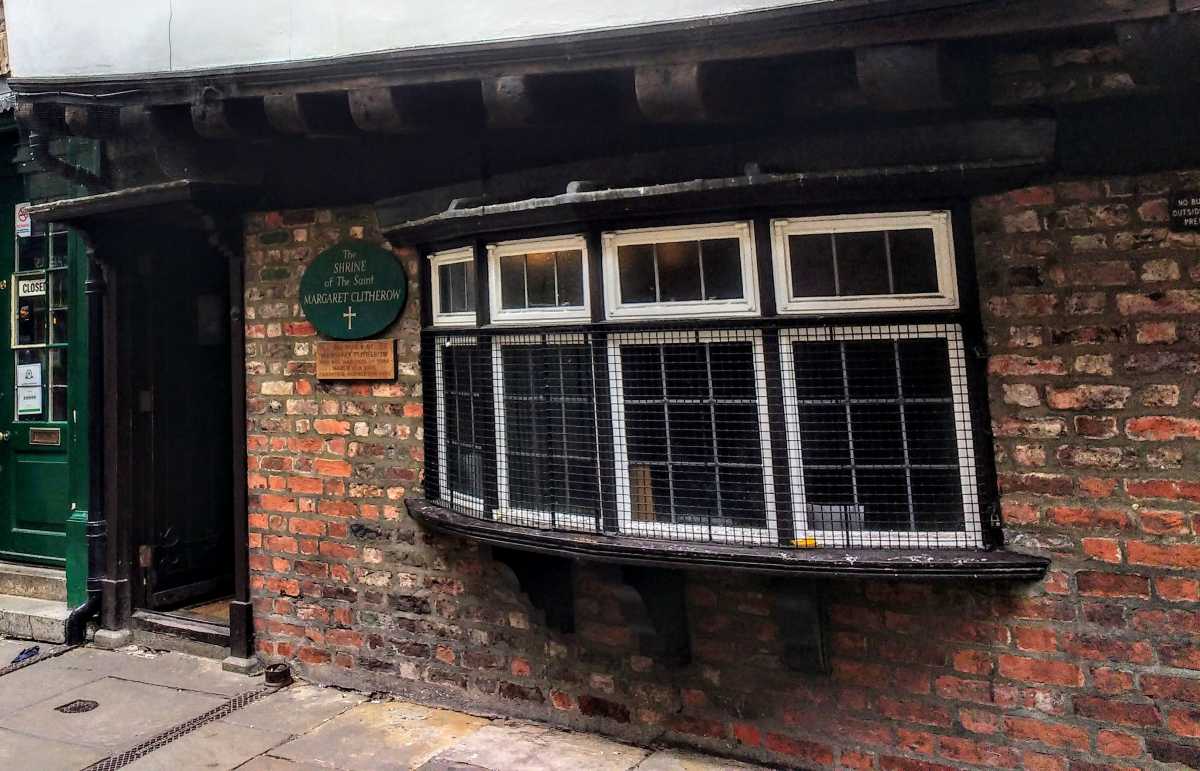
She was arrested for the final time in March 1586. Because she refused to enter a plea partly to spare her own children from being forced to testify against her she was sentenced to peine forte et dure: death by crushing. On 25 March 1586, Good Friday, she was taken to the Toll Booth on Ouse Bridge, laid on the ground with a sharp stone under her back, and had a door placed over her, weighted with somewhere between 700 and 800 lbs of stone, until she died. It’s said her ordeal lasted around fifteen minutes. She was beatified in 1929 and canonised in 1970 by Pope Paul VI, one of the Forty Martyrs of England and Wales, and is now known as St Margaret Clitherow, the Pearl of York.
Her house on the Shambles is preserved as a shrine and is open to visitors, and her story features on several of York’s ghost and history walking tours a genuinely sobering stop on a street that can otherwise feel like pure storybook charm.
Ghosts and legends of the Shambles
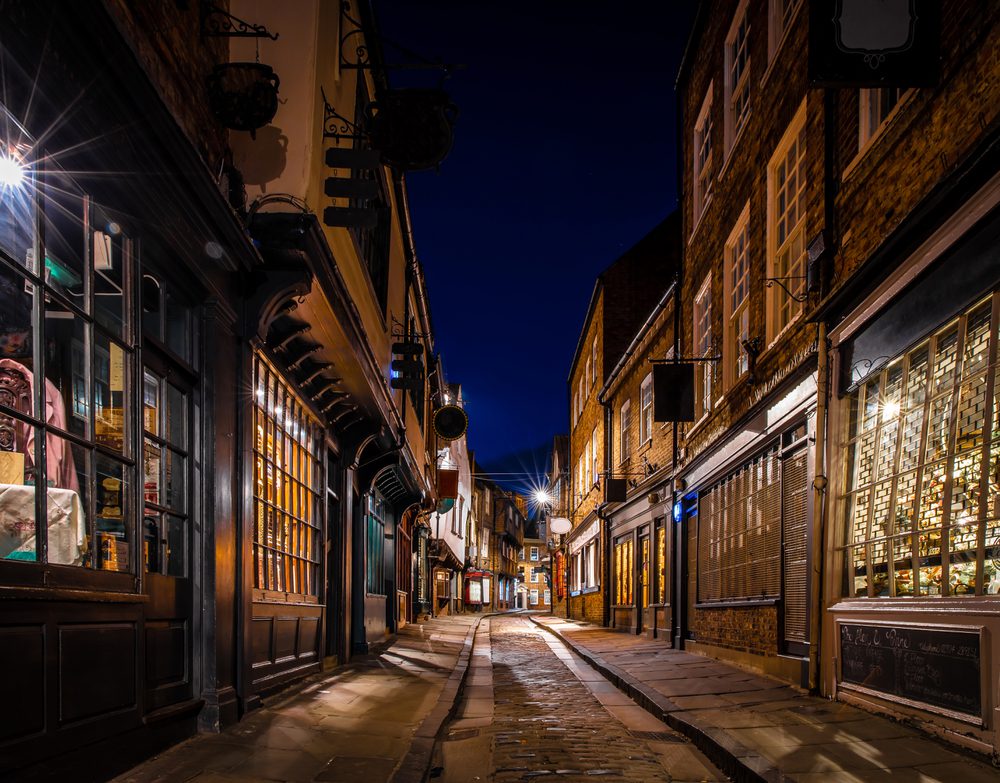
York has a strong claim to being one of the most haunted cities in Europe, and the Shambles is regularly named on the city’s ghost walks as one of its most atmospheric stops a crooked medieval lane where guides and locals alike talk of shadowy figures glimpsed after dusk, once the shops close and the crowds thin out.
Just off the Shambles, connecting Swinegate and Low Petergate, is Mad Alice Lane (officially renamed Lund’s Court, though almost everyone still calls it Mad Alice Lane). It’s named for Alice Smith, a resident of the lane who was hanged at York Castle in 1825, officially for insanity, though local accounts say she had killed her abusive husband after years of beatings. Some visitors and guides claim to have seen her face looking down from one of the lane’s windows.

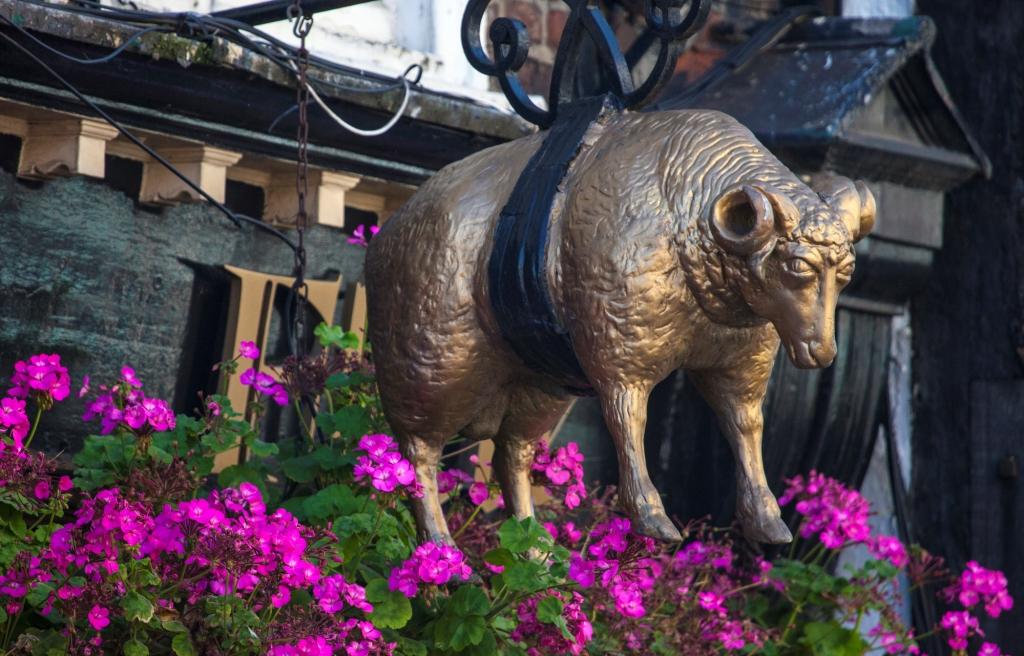
A short walk from the Shambles, the Golden Fleece dating to 1503 and reputedly York’s most haunted pub is said to be home to at least five ghosts, including Lady Alice Peckett, a former landlord’s wife seen moving furniture, and a Canadian airman who died falling from a top-floor window. Several York ghost walks route through the Shambles itself before finishing there.
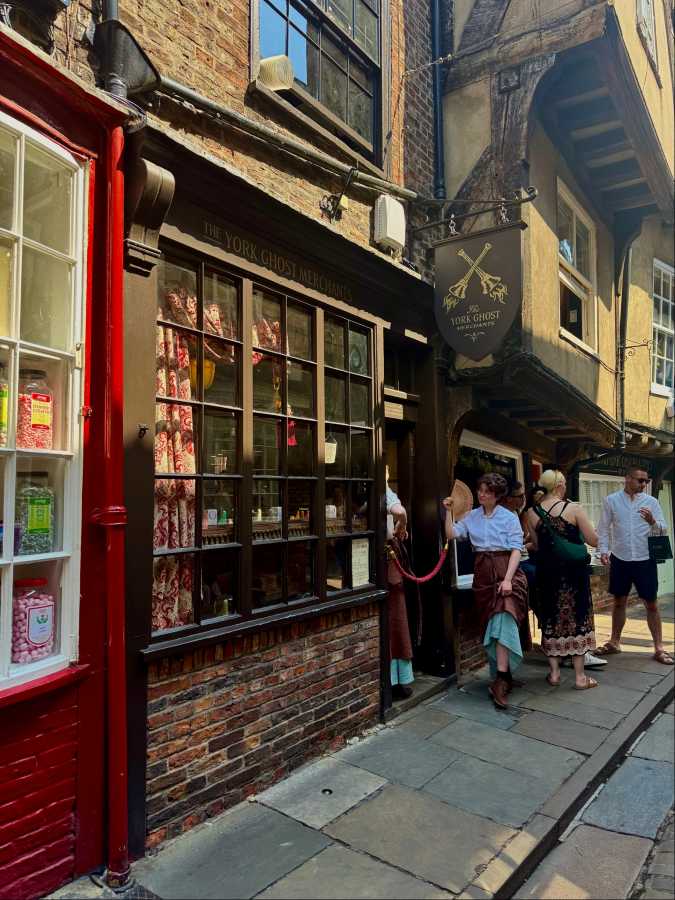
If you’d like to go looking for ghosts on purpose rather than just hoping to bump into one, Mad Alice’s Bloody Tour of York and Shadows of York both run evening walks that take in the Shambles, and York Ghost Merchants a shop on the Shambles itself selling handcrafted ghost figurines has become a genuine phenomenon, with queues regularly running two hours long.
Myth-busting: was Harry Potter actually filmed on the Shambles?
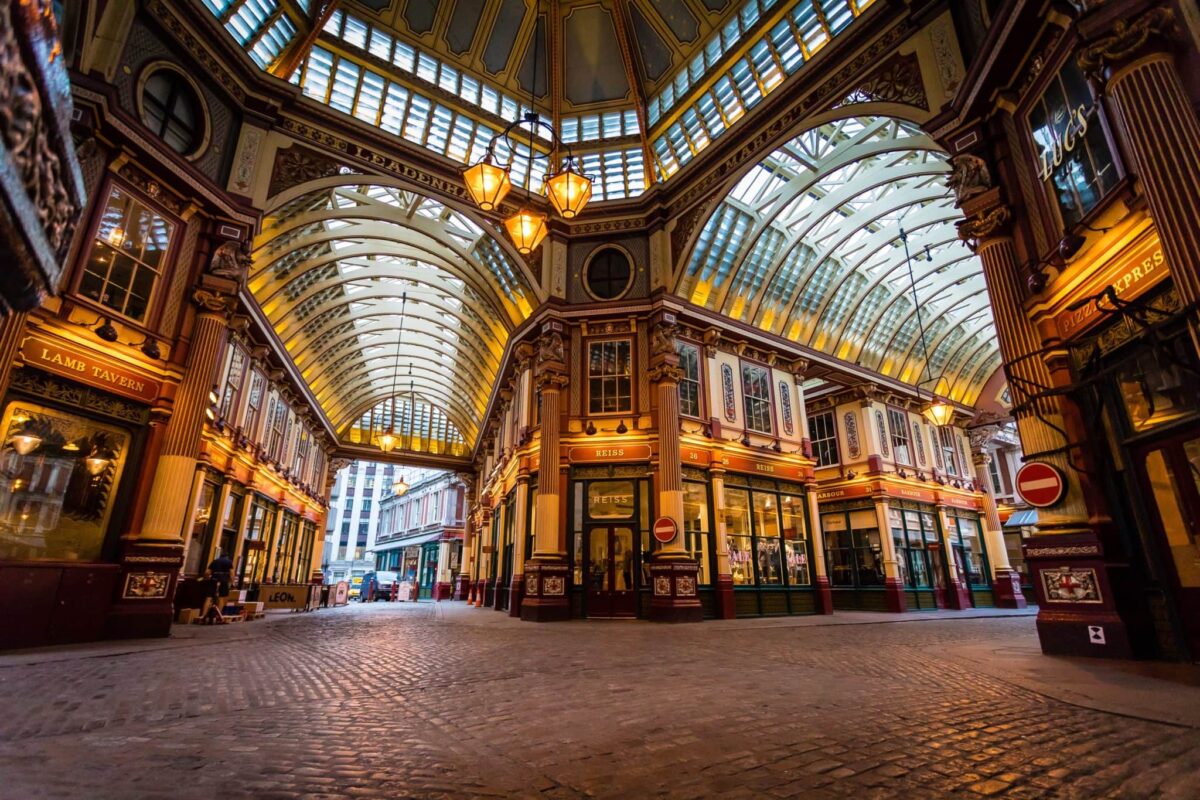
No and this is worth clearing up properly, because it’s one of the most repeated myths about the street, including, in an earlier version of this page, by me. No scenes from any Harry Potter film were shot on the Shambles. Diagon Alley was filmed at Leadenhall Market in London for some exterior shots, and built as a full set at Leavesden Studios in Hertfordshire for the rest.
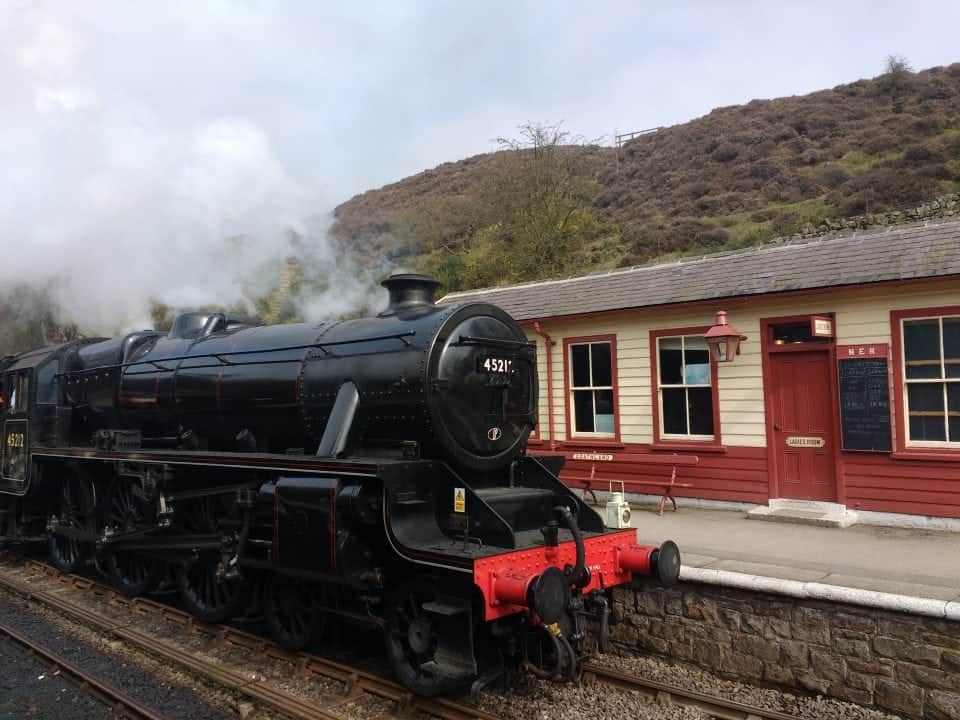
What is true is that the Shambles’ narrow, crooked, overhanging buildings bear a striking visual resemblance to Diagon Alley, and it’s widely believed to have been at least a loose inspiration for the look of the set though even that link has never been officially confirmed by J.K. Rowling or the filmmakers, and the Shambles isn’t the only street to make that claim; similar claims have been made for streets in Edinburgh, Exeter, London and Chepstow. What is confirmed is that York itself does appear in the films: the pedestrian bridge across the platforms at York railway station appears in Harry Potter and the Philosopher’s Stone, and Goathland Station, on the North Yorkshire Moors Railway, played Hogsmeade Station.
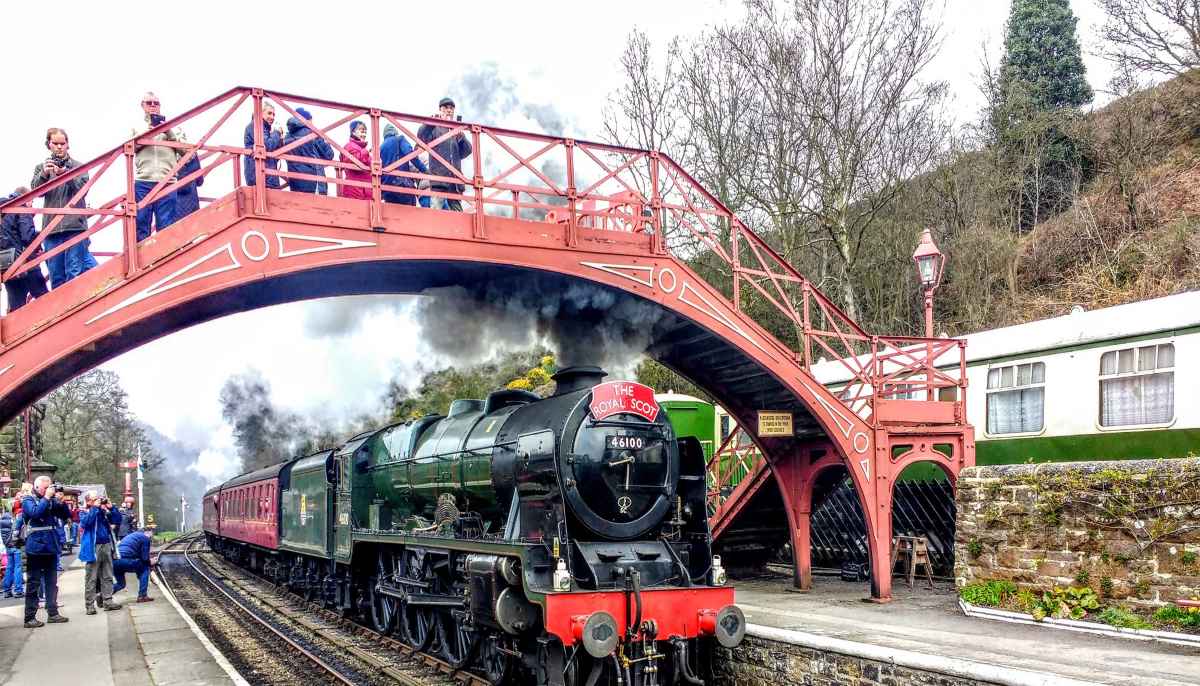
None of which has slowed the Shambles down one bit the resemblance is close enough, and the atmosphere magical enough after dark, that the myth has taken on a life of its own, and the street has embraced it wholeheartedly.
In 2010, the Google Street View team voted the Shambles the most picturesque street in Britain, based on public nominations of the country’s favourite historic streets a genuine, verifiable accolade, unlike the filming claim.
What is the Shambles in York known for?
Today the Shambles is known for its Harry Potter connection (real or not), and for its history as one of the best-preserved medieval streets in Europe. Cobbled streets lead you back in time, and the wonky, overhanging buildings create an atmosphere that brings history to life. Whatever you make of the Diagon Alley story, the buildings themselves are the real draw.
Things to do in the Shambles, York
Harry Potter gift shops on the Shambles
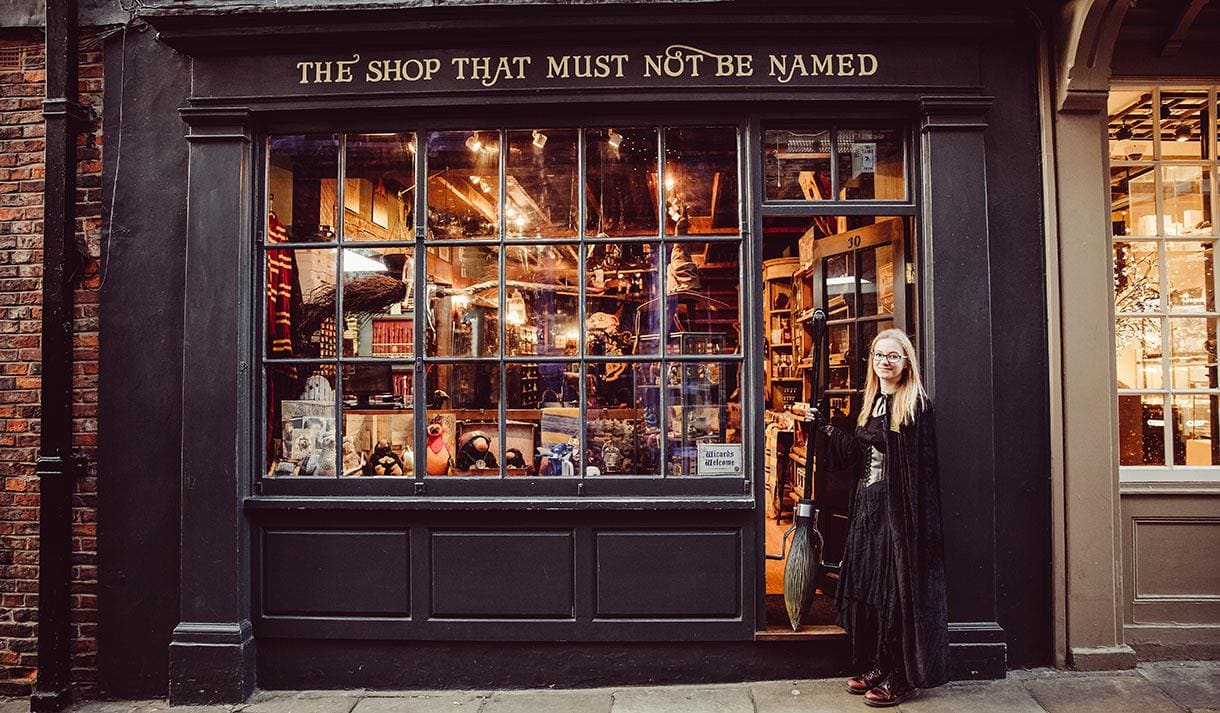
The Shop That Must Not Be Named
Located at 30 The Shambles, this shop is fabulous from free broom parking to Potter-branded ice cube trays, it’s a wonderland of merchandise. Opened in May 2017, they stock official Harry Potter merchandise including cloaks, wands, spell books and wizard hats for fans young and old. I do recommend getting there early, since crowds of muggles gather early to check it out.
The World of Wizardry
A few shopfronts down, The World of Wizardry is more Potter heaven, similarly overflowing with merchandise and staffed by Hogwarts-costumed students. Tucked at the back of the shop is a small selection for other fantasy series fans, including Game of Thrones.
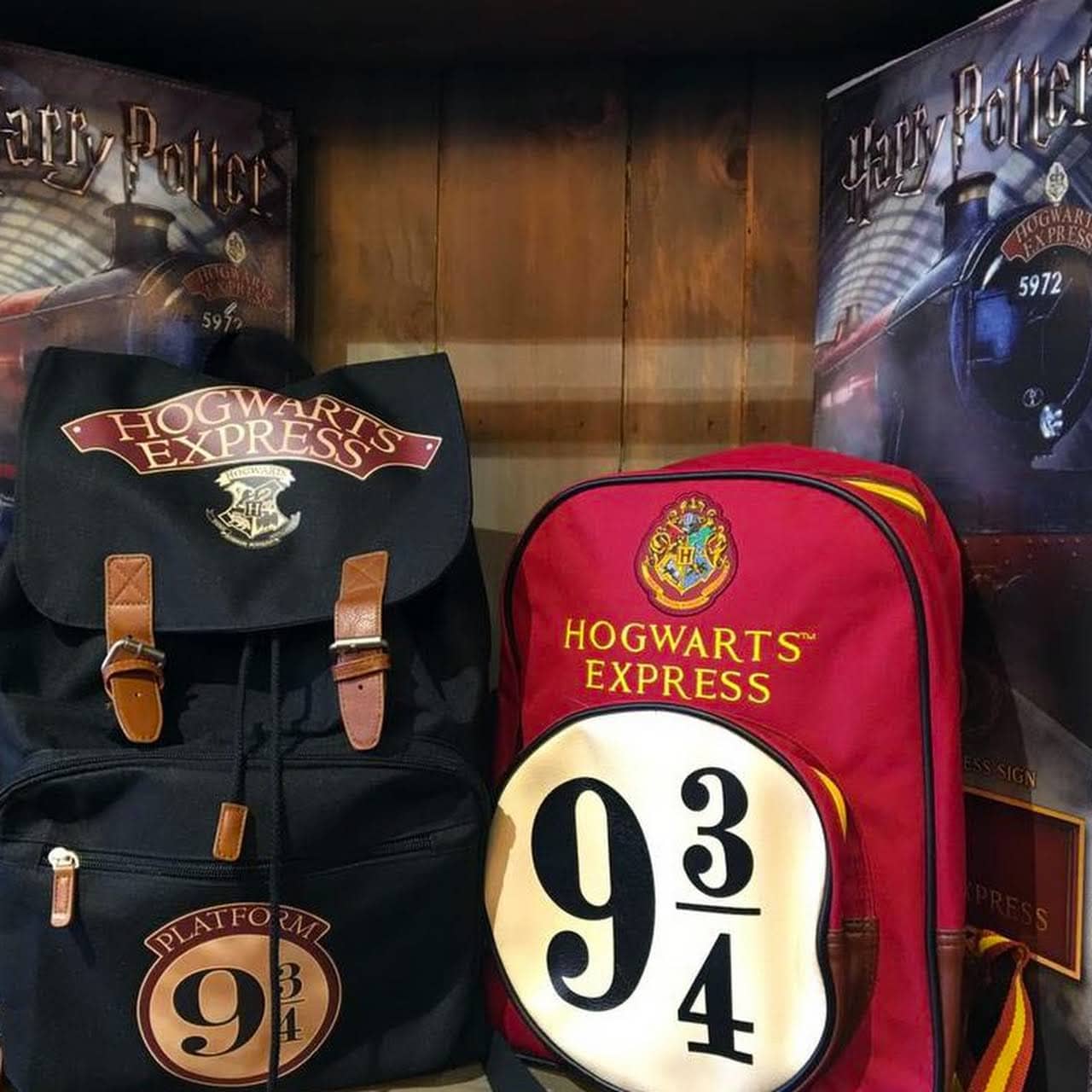
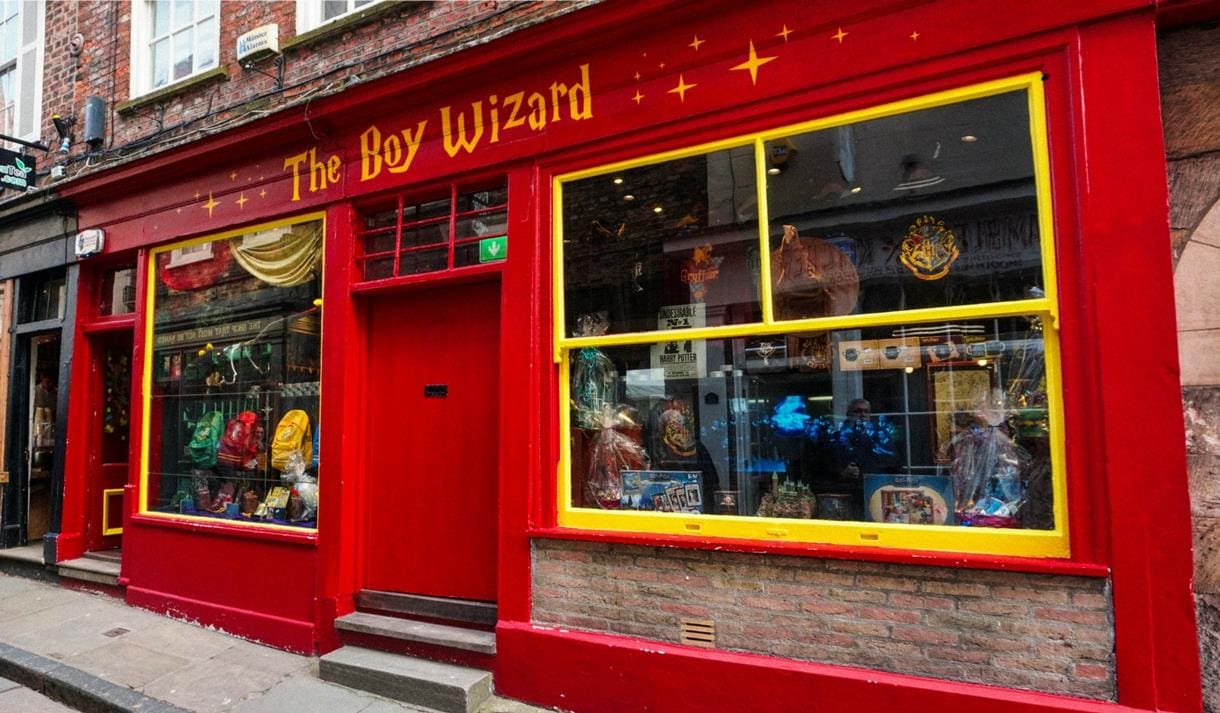
The Boy Wizard
With locations in Edinburgh, York and London, the York branch of The Boy Wizard has a bright red shopfront and a good range of merchandise, often at better prices than its neighbours if you’re looking for a bargain.
The Potions Cauldron
The Potions Cauldron is where you go to mix your own magical potions and become a trainee wizard for the afternoon. This drinks emporium serves “ancient recipes” supposedly handed down from a 14th-century French witch, including Serpent’s Venom, Lion’s Roar Elixir and Dragon’s Breath. Hidden in the witch’s hole at the back is a 6,000-piece Hogwarts Lego set worth seeking out even if you don’t fancy a potion.

Harry Potter filming sites in York, outside the Shambles
York Railway Station
The pedestrian bridge across the platforms at York Station was used as a filming location in Harry Potter and the Philosopher’s Stone. It looks a little different today, since the barriers are now plastic rather than the original thick metal beams.
Goathland Railway Station the Hogwarts Express
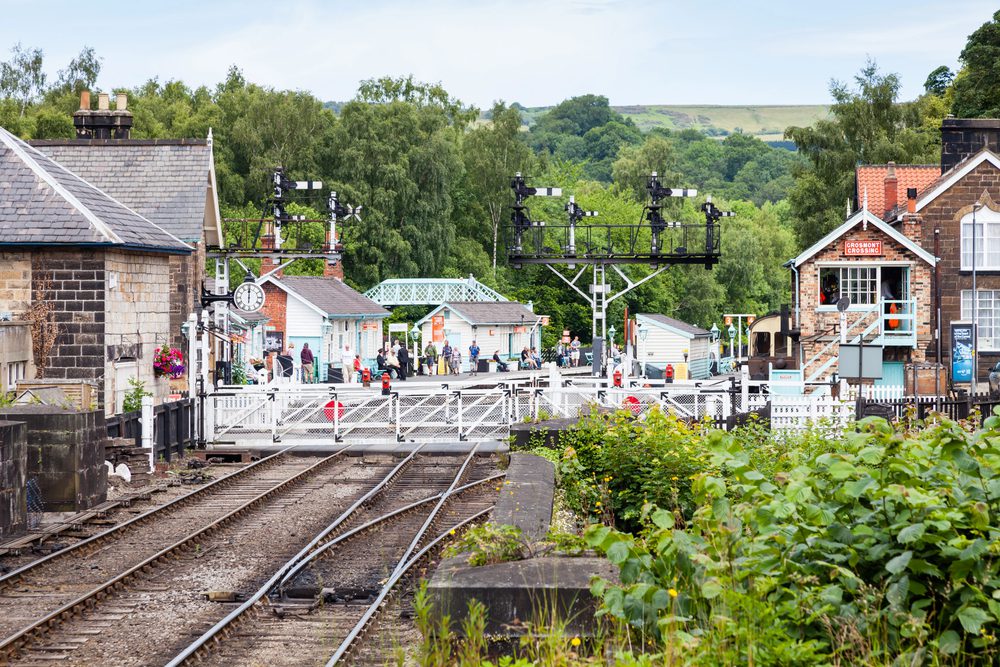
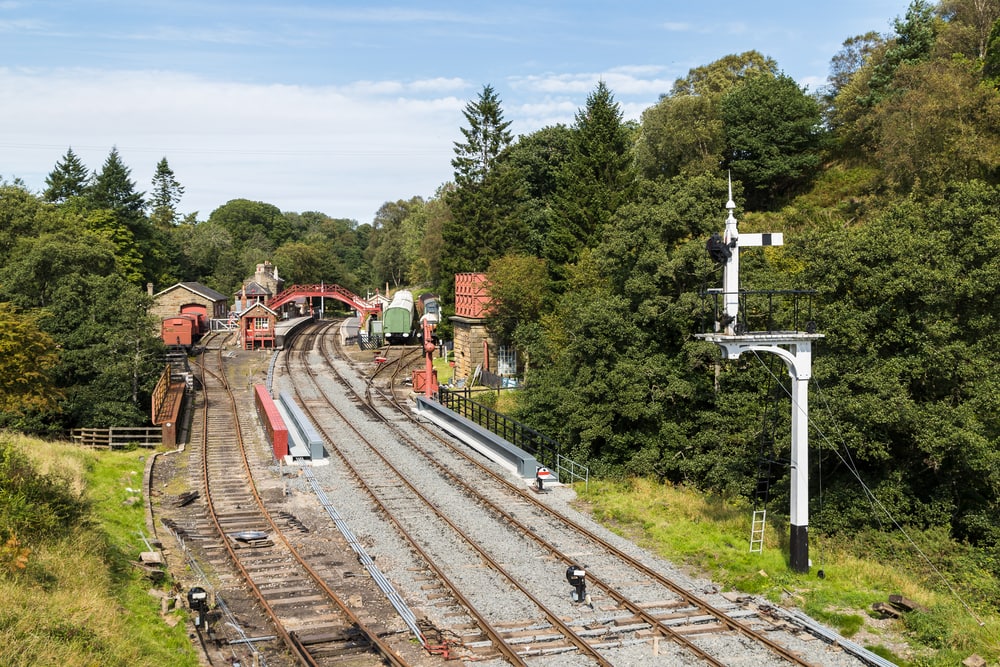
A ride on a steam train has always been a dream of mine, and the chance to ride the “Hogwarts Express” to “Hogsmeade” wasn’t one to miss. The famous scenes were filmed on the old steam lines managed by the North Yorkshire Moors Railway.
The North Yorkshire Moors Railway (NYMR) runs heritage steam trains from Grosmont to Pickering, including a stop at Goathland station, all maintained and operated by volunteers. A Whitby/Goathland return ticket costs £23 per adult and £10.50 per child check current times and prices on the NYMR website before you go.
Where to eat in the Shambles, York
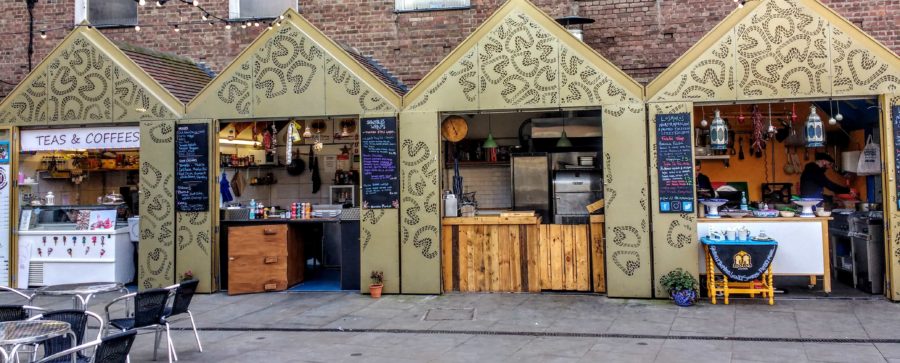
The Shambles Food Court
Inside the Shambles Market, alongside the Shambles Farmer’s Market, this food court gathers a small international lineup in individual “sheds”:
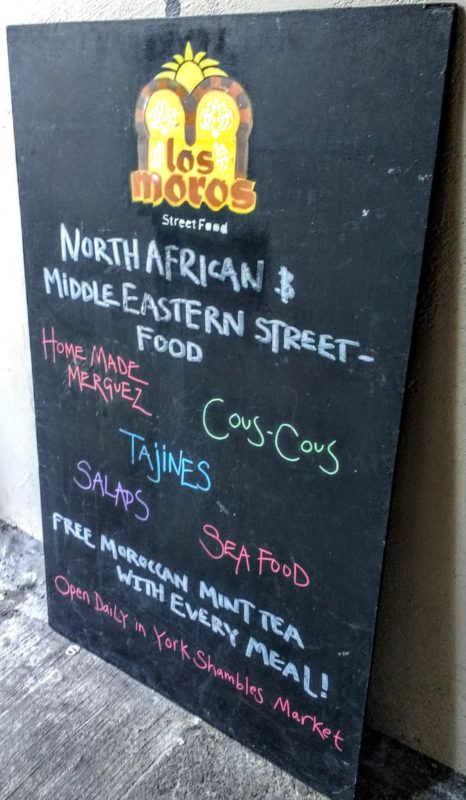
- Los Moros North African and Levantine street food, including chermoula lamb’s liver with spicy Lebanese potatoes (batata harra), hummus, vegan falafels and salads
- Krep authentic French crêpes and galettes (savoury crêpes), served from a vintage Citroën, alongside good coffee from a local Yorkshire roaster
- Pizzoli’ Sicilian street food: pizza, lasagne and focaccia, known for their pizzolo (filled flatbread pizza) and arancino (risotto croquette)
- Shambles Wraps Turkish sautéed meat wraps and grilled kufta kebabs, from grilled lamb to vegan and vegetarian options, each with a free soft drink
- Shambles Kitchen gently smoked meats cooked for hours over oak chips: hot sausage, spicy chicken thighs, turkey breast and pork ribs, with sides like homemade slaw, potato salad or twice-fried chips
- Winner Winner marinated and brined (12 hours) rotisserie chicken and their well-known chicken wings
- Café M coffees (Americano, latte, cappuccino, mocha, Turkish) and teas, including Yorkshire tea, green tea, earl grey, vanilla chai and caffeine-free options

Pubs in the Shambles, York
The Shambles Tavern
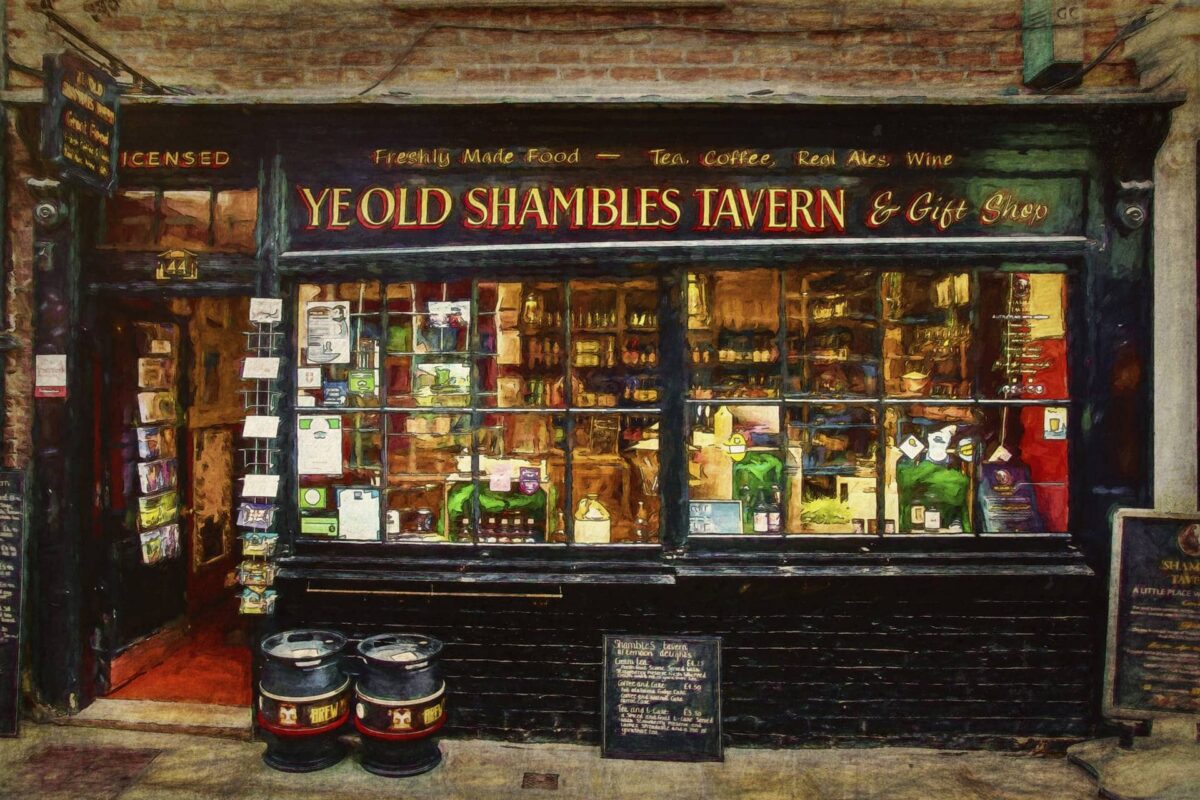
A great gastropub known for its Wall of Ales, offering a vast selection of Yorkshire cask, keg and bottled ales. The food is all sourced locally, and the Tavern has won numerous awards.
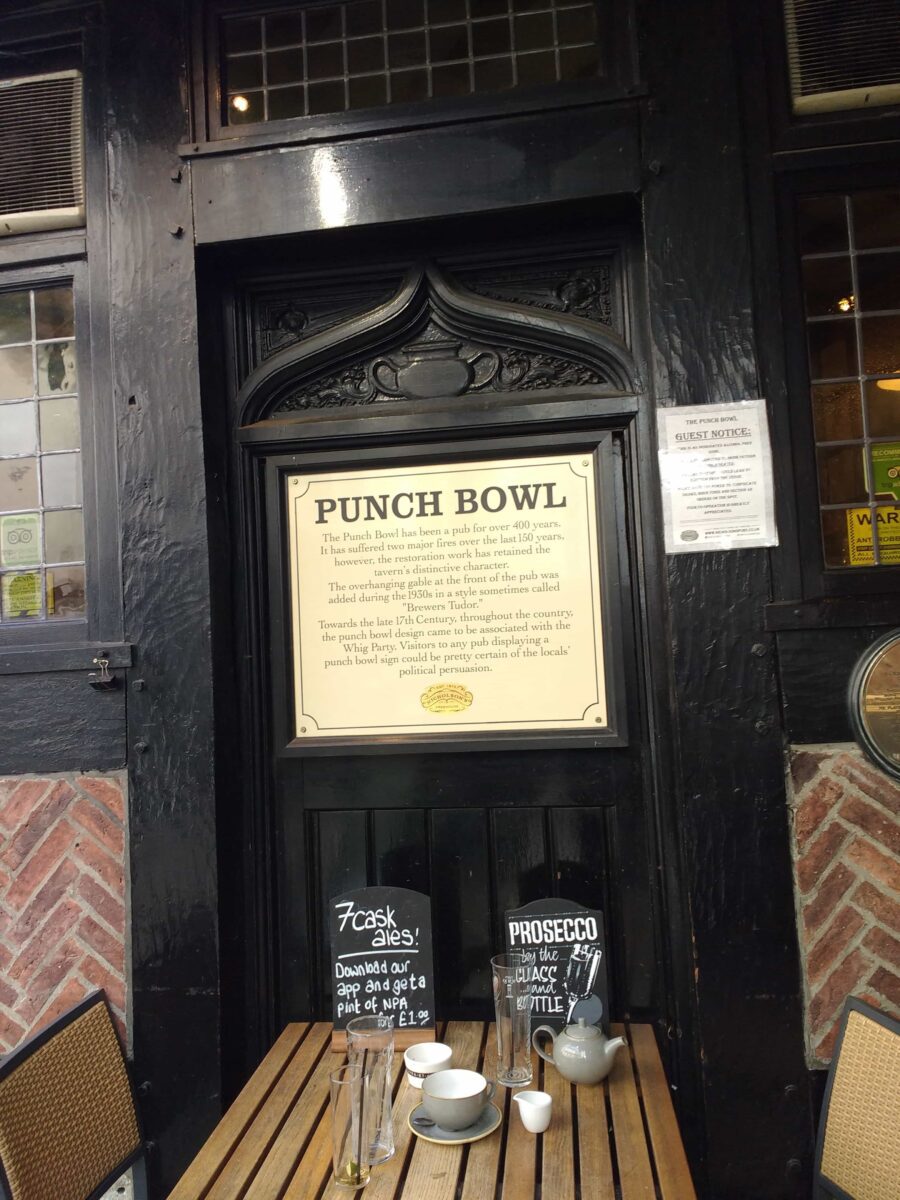
The Punch Bowl
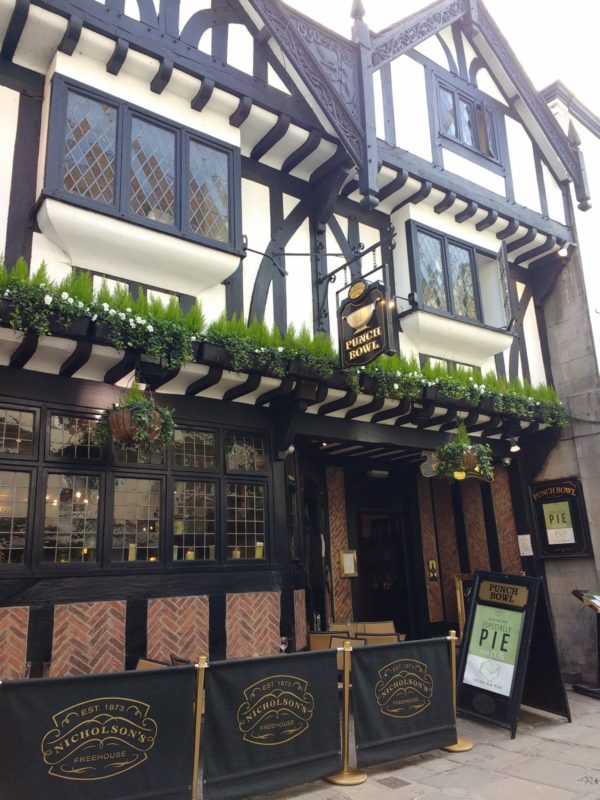
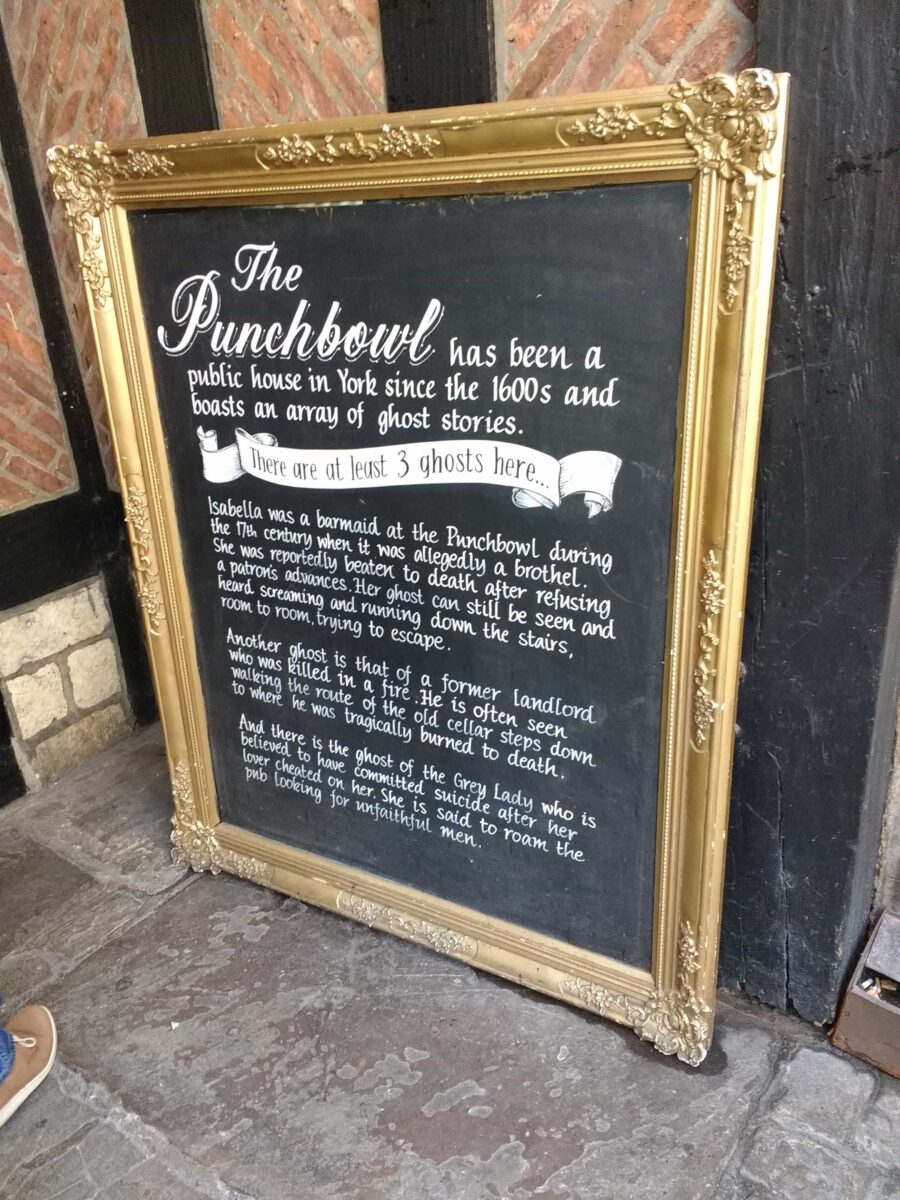
Said to be haunted, the Punch Bowl is a traditional pub with a vast range of real ales and great food. It’s been a pub for over four centuries, though it has suffered two major fires and been restored each time. Its political connection comes from the Whigs, who preferred punch over the claret favoured by the Tories.
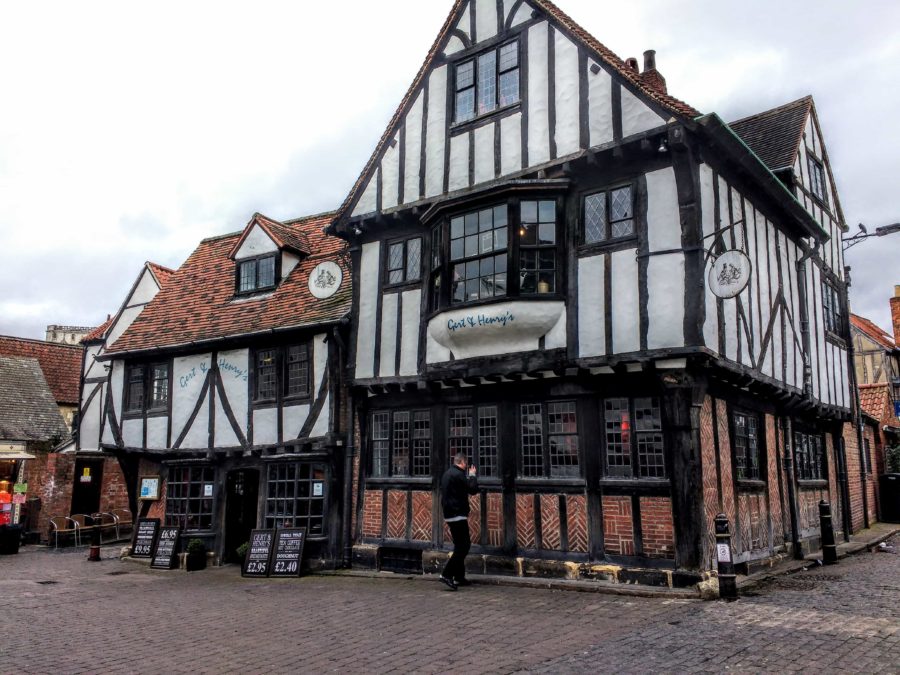
Gert and Henry’s
A beautiful old building, timber-framed and dating from the 1600s, Gert and Henry’s has been a restaurant since 1929, serving classic English food. I had traditional fish and chips and a steak pie here, alongside some great local ales.
With so many classic pubs, alehouses, restaurants and cafés to choose from, and a wealth of heritage and truly unique buildings, it’s worth a wander and perhaps a stop in every interesting place you find.
Where to stay in York
York has everything from ultimate luxury to some pretty quirky places to stay. It’s best to stay within the city walls, which makes York and the Shambles that much more walkable.
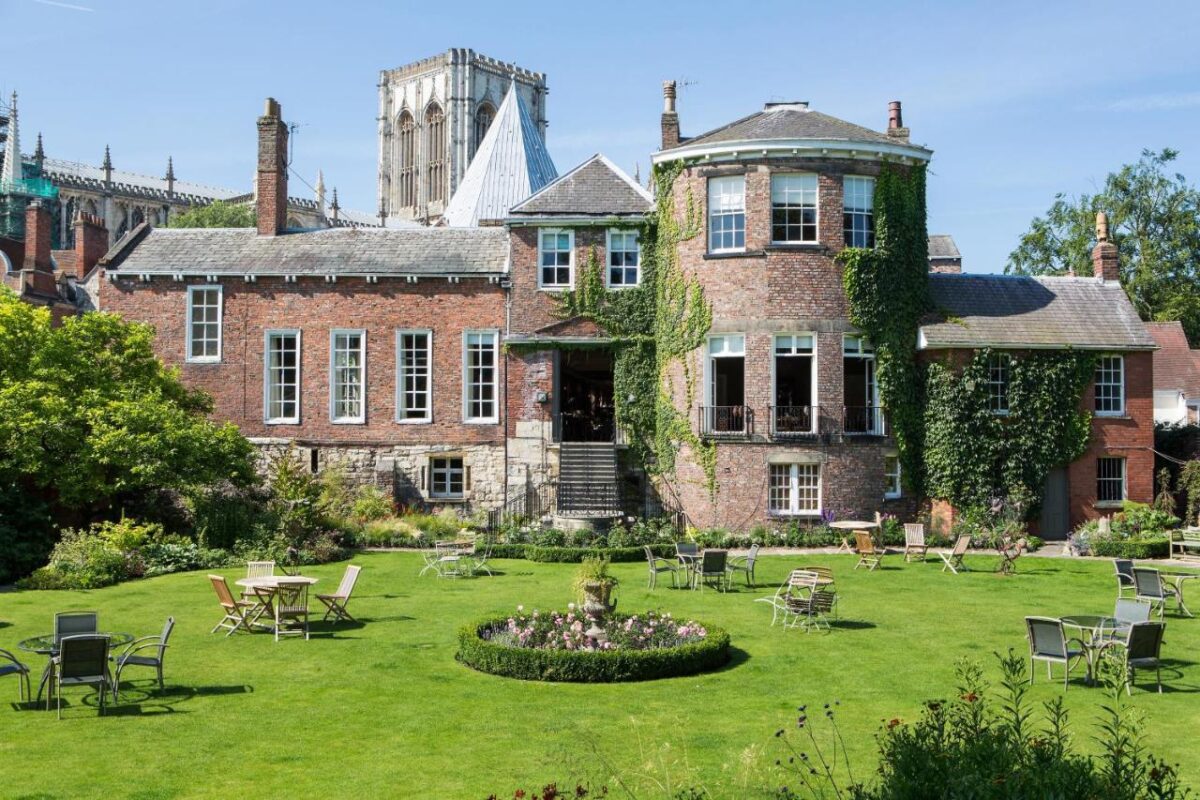
Grays Court
Between York Minster and the walls, with a history dating back to the 11th century. With views across York’s medieval walls, Grays Court is a beautiful historic house with leafy gardens, an intimate restaurant and free Wi-Fi. The grand house sits beside York Minster and was once home to King James I.
The Bar Convent
Part of a still-working convent in a historic building, this is one of Britain’s more unusual guest houses. The bedrooms are modest yet roomy and well-equipped, there’s a charming café and a peaceful garden, and the city is entirely walkable from here. Rooms with a shared bathroom offer particularly good value.
The Grand York
York’s only five-star hotel, with a luxury vaulted spa and a swimming pool. Located in a Grade II listed Edwardian building, it maintains a splendid aura of luxury throughout.
Trembling Madness Apartments
Located in a quiet medieval courtyard behind the pub The House of Trembling Madness, the Old Gallery and the Chamber apartments offer a quirky, delightful stay, with incredible interiors and their own ghost stories. It’s a brilliant, convenient base a 10-minute walk from the Shambles, and the apartments overlook York Minster.
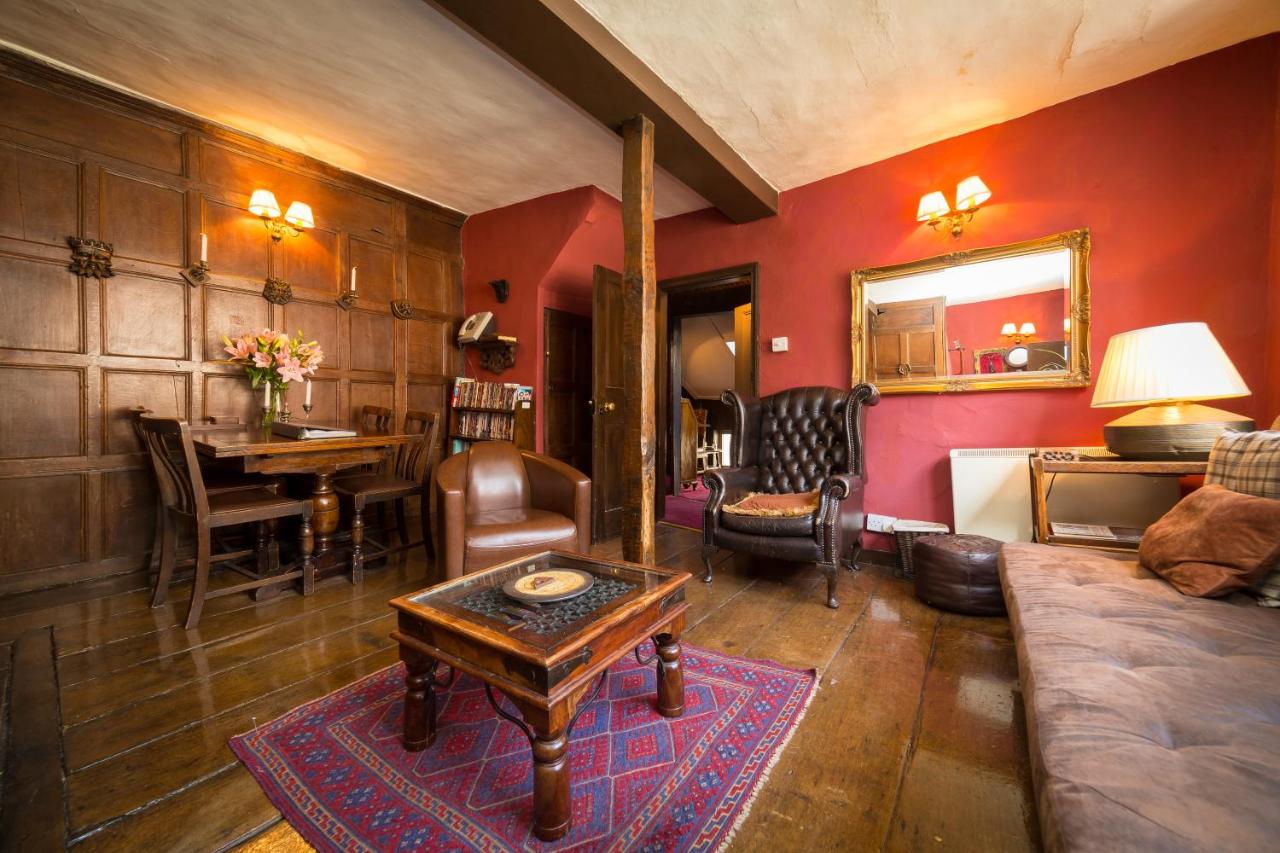
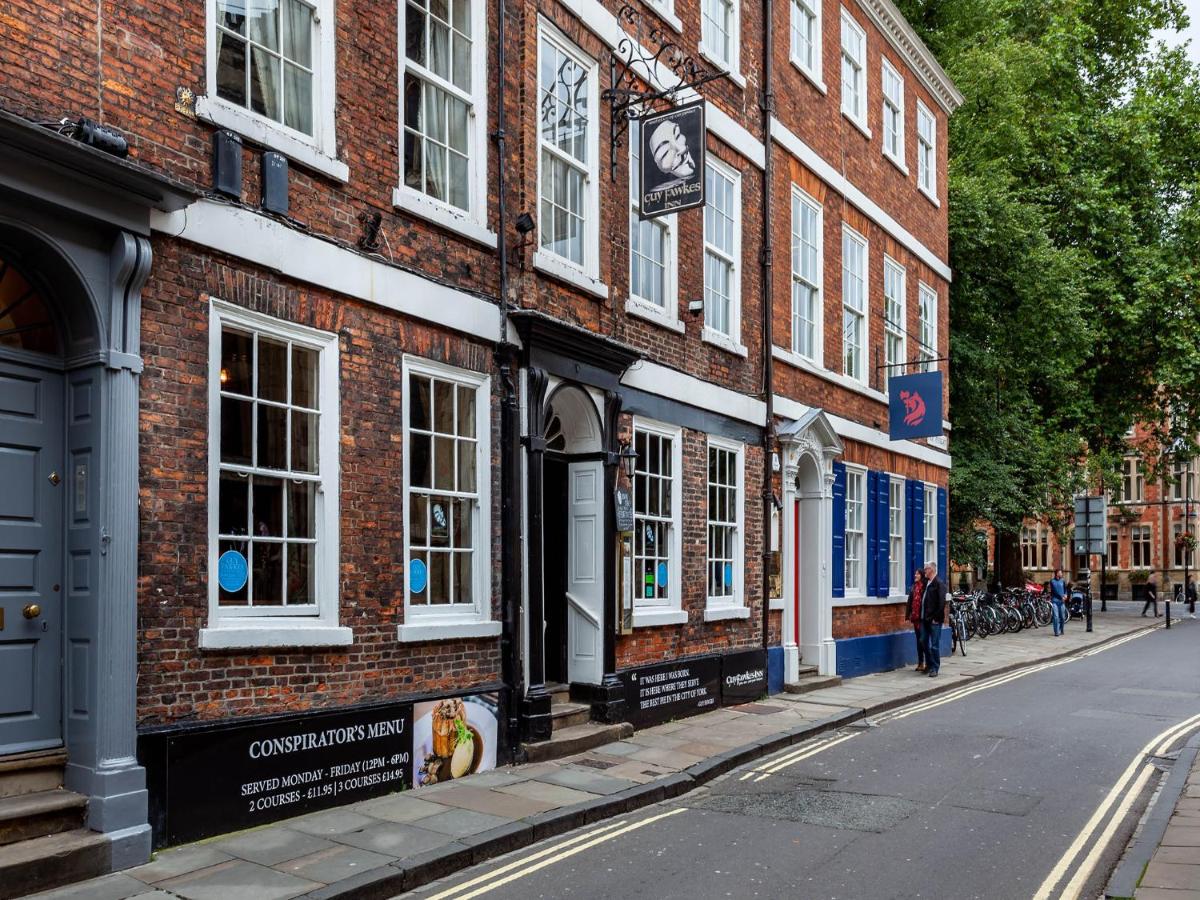
Guy Fawkes Inn
The birthplace of the notorious British traitor himself. The Guy Fawkes Inn, by Best Western, keeps many original features including gas lighting, real log fires and the original timber staircase. You can dine by candlelight in the restaurant, which serves classic pub food from locally sourced ingredients, and the bar stocks a good range of real ales.

Frequently Asked Questions
Was Harry Potter actually filmed on the Shambles?
No. Diagon Alley was filmed at Leadenhall Market in London and on a purpose-built set at Leavesden Studios. The Shambles is widely believed to have visually inspired the look of Diagon Alley, but no scenes were shot there, and the connection has never been officially confirmed by J.K. Rowling or the filmmakers.
Is the Shambles the oldest medieval street in the world?
That specific claim isn’t really defensible older medieval streets survive elsewhere in Europe. What’s well documented is that the Shambles appears in the 1086 Domesday Book, that most of its surviving buildings date from 1350–1475, and that it’s widely regarded, including by Visit York, as one of the best-preserved medieval streets in Europe.
What does the name ‘Shambles’ mean?
It’s thought to come from ‘Shammel’, an Anglo-Saxon word for the wooden shelves or booth-style shop fronts butchers used to display meat. An alternative theory traces it to ‘flesshammel’, meaning flesh, giving the street’s original name as “the Great Flesh Shambles.”
Is the Shambles haunted?
It has a strong reputation for it, and features on several of York’s ghost walking tours. Just off the street, Mad Alice Lane is said to be haunted by Alice Smith, hanged in 1825; the Shambles itself is described by tour guides as having a lingering, watched feeling after dark, and Margaret Clitherow, executed in 1586, lived and is now commemorated at a shrine on the street.
Who was Margaret Clitherow?
A butcher’s wife who lived at 10–11 The Shambles, executed by crushing on 25 March 1586 for harbouring Catholic priests during Elizabethan religious persecution. She was canonised in 1970 as St Margaret Clitherow, one of the Forty Martyrs of England and Wales, and her house is preserved as a shrine open to visitors today.
How long do you need to visit the Shambles?
An hour is enough to walk its length and pop into a few shops, but the surrounding streets, market and food stalls easily fill half a day, especially if you’re also visiting York Minster or the National Railway Museum nearby.
Is the Shambles free to visit?
Yes it’s a public street, free to walk at any time. You’ll only spend money in the shops, cafés and pubs along it if you choose to.
Have you been to Shambles York? What did you like best?
If Yorkshire’s on your route, start with the Yorkshire Travel Guide for the wider picture before diving into individual stops. This is just one part of a much bigger country see the full England Travel Guide for everywhere else worth building into your trip, and my United Kingdom Travel Guide for a broader picture of the whole country. Explore more of the region with guides to Scotland, Wales, Northern Ireland. If you are a foodie, take a look at my Global Food Guide.
I only recently went to York but loved it. I’m definitely going again and going to look more closely at the things you mention. Plus I want to try some of that great food! When we were there we took the grandkids to Dig. I could have spent hours in there.
That’s the one place I wanted to go but never made it I love the whole idea of Dig.
Loved the article. So many great photos to enjoy the ‘visit’. Great fun and a chance to experience real medieval world.
It would be lovely if you could make the visit someday and come spend some time in Ireland
I went to York on a day trip once, many years ago. I wish I had known about this street! I love your photos – it looks absolutely charming. If I ever make it back there, it’s going on my list.
If you get a chance to go back go there is just so much to explore in Yorkshire it has become one of my favourite areas in the UK.
A lovely reminder of our trip there in December with friends. What a sad tale about Margaret though. I didn’t know that story. Beautiful.
I went there 23 years ago and this post bought back those memories. Thanks. It was in the time before Harry Potter and now I want to go back and experience this side of the Shambles.
I can’t wait to go back again myself love Yorkshire and York – well actually the whole area is just so beautiful and they have some amazing farm stores and restaurants everywhere.