
23 Best Things to do in Stratford-upon-Avon
Stratford-upon-Avon is one of England’s most historic market towns and one of the best places in the UK to explore Shakespeare’s world. From Shakespeare’s Birthplace and Anne Hathaway’s Cottage to performances at the Royal Shakespeare Company and peaceful river cruises along the Avon, there are far more things to do here than many visitors expect.

We spent three full days exploring Stratford-upon-Avon in Warwickshire, visiting every major Shakespeare site, taking a behind-the-scenes tour at the RSC, and attending a live performance. If you’re planning a visit whether you’re a lifelong Shakespeare fan or recently inspired by Hamnet this guide covers the 23 best things to do, along with practical tips to help you make the most of your time.
- 23 Best Things to do in Stratford-upon-Avon
- Is Stratford-upon-Avon Worth Visiting?
- How Many Days Do You Need?
- Quick Highlights: Best Things to Do in Stratford-upon-Avon
- Was Hamnet Filmed in Stratford-upon-Avon?
- Attractions in Stratford-upon-Avon
- Shakespeare’s Birthplace Trust
- Shakespeare’s Birthplace
- Royal Shakespeare Company
- Hall’s Croft
- Shakespeare’s Schoolroom & Guildhall
- Nash’s House
- Shakespeare’s New Place
- Mary Arden’s Farm
- Anne Hathaway’s Cottage
- Shakespeare’s Grave at Holy Trinity Church
- MAD Museum
- Canal Basin
- The Big Wheel
- River Cruise on the Avon
- Tudor World
- Stratford-upon-Avon Butterfly Farm
- Almshouses
- Harvard House
- Getting to Stratford-upon-Avon in England
- Getting Around Stratford-upon-Avon
- Where to Eat and Drink in Stratford-upon-Avon
- Where to stay in Stratford-upon-Avon
Is Stratford-upon-Avon Worth Visiting?
Yes particularly if you enjoy history, theatre, architecture, or literary travel.
Stratford-upon-Avon is compact and walkable, with beautifully preserved Tudor buildings, riverside paths, and some of England’s most significant Shakespeare landmarks. Even beyond its literary heritage, the town has a relaxed atmosphere that makes it an enjoyable stop in Warwickshire.
How Many Days Do You Need?
You can see the main highlights in one full day. However, 2–3 days allows time to properly explore the Shakespeare houses, take a theatre tour or attend a performance, enjoy a river cruise, and wander beyond the busiest streets.
Quick Highlights: Best Things to Do in Stratford-upon-Avon
If you’re short on time, start here:
- Best for Shakespeare lovers: Shakespeare’s Birthplace
- Best theatre experience: Royal Shakespeare Company
- Best historic home: Anne Hathaway’s Cottage
- Best riverside activity: Avon river cruise
- Best traditional pub: The Garrick Inn
- Best family attraction: Stratford Butterfly Farm
Below you’ll find a detailed guide to the best attractions and experiences in Stratford-upon-Avon.

Was Hamnet Filmed in Stratford-upon-Avon?
If you loved Maggie O’Farrell’s novel Hamnet or plan to see the film adaptation, it’s worth noting that filming did not take place in Stratford-upon-Avon itself.
Although the story is set in Shakespeare’s hometown, production recreated Tudor Stratford in parts of Herefordshire, Gloucestershire, and London. According to publicly available production notes and regional tourism boards, key filming locations included:
Weobley, Herefordshire – Used to recreate Stratford’s Tudor streets
Cwmmau Farmhouse (Whitney-on-Wye) – Featured as Agnes Hathaway’s childhood home
Lydney Park Estate, Gloucestershire – Woodland and countryside scenes
Charterhouse, London – Used for Shakespeare’s London sequences
While you won’t find filming sets in Stratford, you can visit the real-life places connected to Shakespeare and his family including Shakespeare’s Birthplace, Anne Hathaway’s Cottage, and Holy Trinity Church. For many literary travellers, that historical connection is even more meaningful than a filming location.

Attractions in Stratford-upon-Avon
Shakespeare’s Birthplace Trust
The Shakespeare Birthplace Trust manages five historic properties in and around Stratford-upon-Avon connected to Shakespeare and his family.
A combined ticket includes entry to:
- Shakespeare’s Birthplace
- Anne Hathaway’s Cottage
- Shakespeare’s New Place
- Hall’s Croft
- Mary Arden’s Farm
(Check current pricing and opening times on the official Shakespeare Birthplace Trust website.)
Shakespeare’s Birthplace
Located on Henley Street in the heart of town, Shakespeare’s Birthplace is where William Shakespeare was born in 1564 and spent his early years.
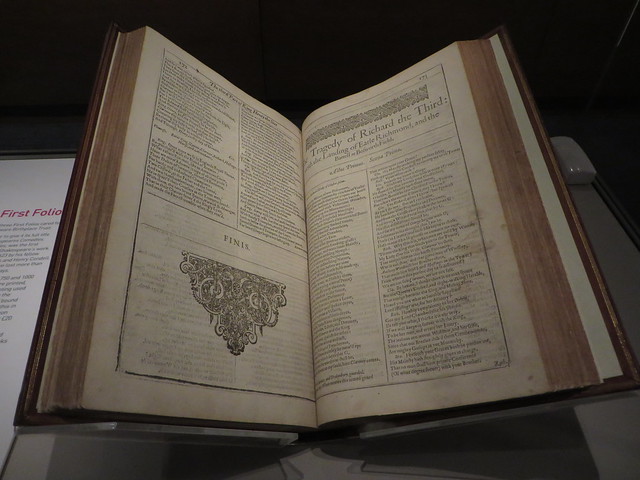
The adjoining Shakespeare Centre displays manuscripts, artefacts, and rare editions of his works including a copy of the First Folio, published in 1623.

The timber-framed Tudor house was owned by Shakespeare’s father, John Shakespeare, a glove maker and prominent local figure who later served as Mayor of Stratford. Walking through the creaking rooms and original floors gives a strong sense of the domestic life Shakespeare would have known.


One detail to look for is the carved “witching mark” a protective symbol cut into a timber beam to ward off evil spirits. Outside, actors often perform scenes and sonnets in the garden, adding a lively theatrical element to the visit.


Royal Shakespeare Company
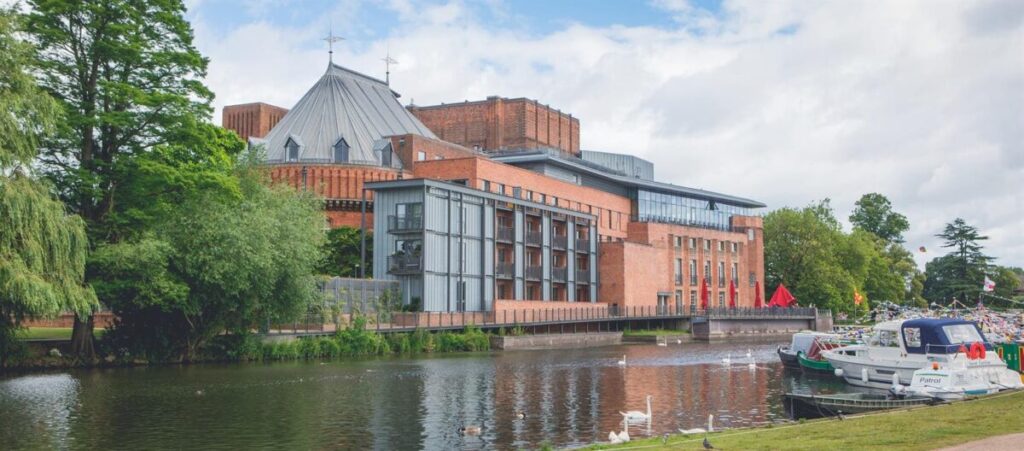
A short walk from Shakespeare’s Birthplace, along the River Avon, is the Royal Shakespeare Company (RSC).
Founded in the 19th century, the RSC remains one of the world’s leading theatre companies. We took the Behind the Scenes Tour, which offers insight into costume design, stage management, props, and production techniques. Seeing the technical side of theatre from quick-change costume magnets to stage blood preparation added a fascinating layer to the experience.
Tours are reasonably priced, and availability varies by season, so it’s worth checking the official RSC website before your visit.


If possible, attend a live performance. Watching Shakespeare in his hometown adds a special dimension to the experience.
If you’re interested in seeing how Shakespeare’s works are staged beyond Stratford-upon-Avon, you may also consider visiting Shakespeare’s Globe in London. While the modern Globe is a reconstruction, it offers a powerful sense of how plays were originally performed in the open air.
Hall’s Croft
Hall’s Croft was the home of Shakespeare’s daughter Susanna and her husband, Dr John Hall. The Jacobean house is beautifully preserved and contains period furnishings and medical artefacts reflecting Dr Hall’s practice.
The gardens are particularly pleasant in warmer months, and the on-site café is a lovely place to pause for tea.


Shakespeare’s Schoolroom & Guildhall
Shakespeare’s Schoolroom & Guildhall is where William Shakespeare was educated. In the 16th century, paper was expensive, so lessons were written on reusable slates. Latin formed the core of the curriculum, and school days ran from sunrise to sunset — six days a week.
Today, visitors can step inside the very classroom where Shakespeare studied. Knowledgeable guides explain what Tudor education involved and how it shaped his later writing. This site is not included in the Shakespeare Birthplace Trust ticket, so check the official website for current admission prices and opening times before visiting.

Nash’s House
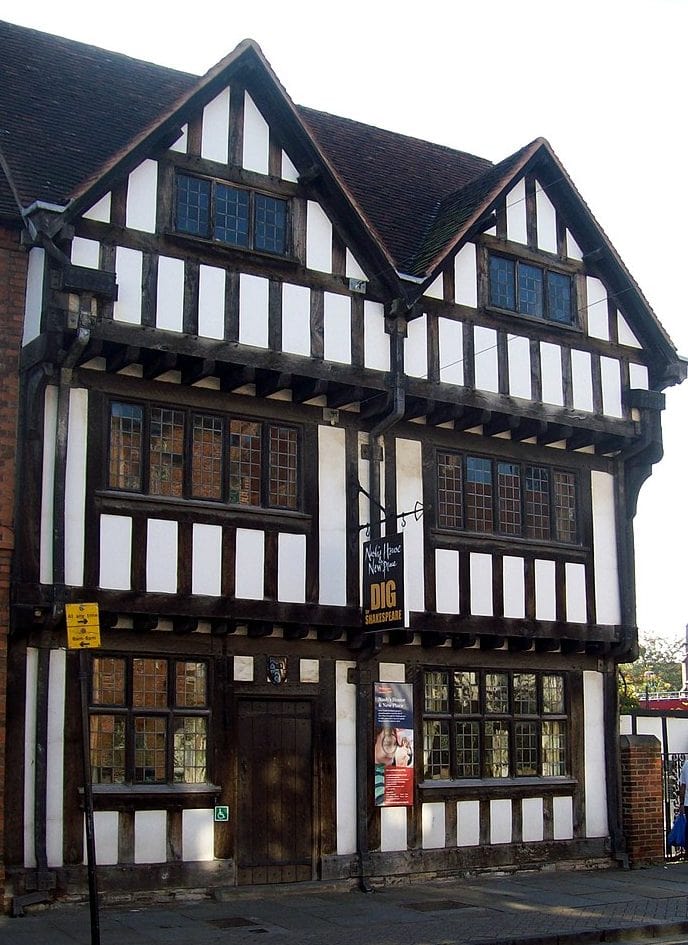
Nash’s House is a timber-framed Tudor building that once belonged to Shakespeare’s granddaughter, Elizabeth. It stands beside the site of Shakespeare’s former home, New Place.
The house now hosts exhibitions exploring Shakespeare’s life, family, and local history. A viewing platform overlooks the reconstructed Tudor knot garden at New Place, where archaeological discoveries from the original property are displayed. Entry tickets for New Place are purchased here.
Shakespeare’s New Place
New Place was Shakespeare’s family home from 1597 until his death in 1616. When plague outbreaks affected London, he returned here to Stratford-upon-Avon.
Although the original house was demolished in the 18th century, the site remains historically significant. The gardens mark the footprint of the former property, and sculptures reference the large mulberry tree once associated with the house. Today, the landscaped grounds provide insight into Shakespeare’s later life in Stratford.

Mary Arden’s Farm
Mary Arden’s Farm was the childhood home of Shakespeare’s mother. Located about three miles from Stratford’s centre, it is best reached by car, taxi, or hop-on-hop-off bus.
The working Tudor farm recreates 16th-century rural life, with heritage livestock, falconry demonstrations, and costumed interpreters explaining daily farming practices. Seasonal programming varies, so consult the Shakespeare Birthplace Trust website for current information.

Anne Hathaway’s Cottage
Anne Hathaway’s Cottage, located just outside the town centre, was the childhood home of Shakespeare’s wife. The thatched farmhouse dates to the 15th century and is surrounded by extensive gardens.
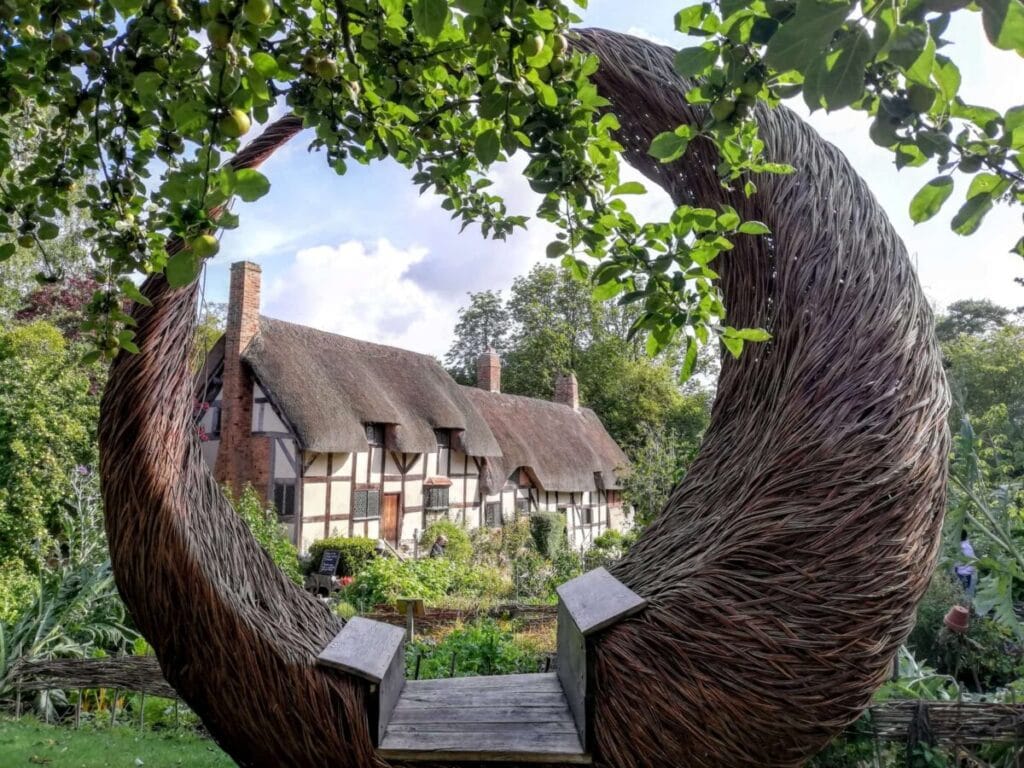


Inside, period furnishings and original features help illustrate domestic life in Tudor England. The cottage can become busy during peak season, so arriving early is advisable. Parking is available nearby, and hop-on-hop-off buses also stop here.
Shakespeare’s Grave at Holy Trinity Church
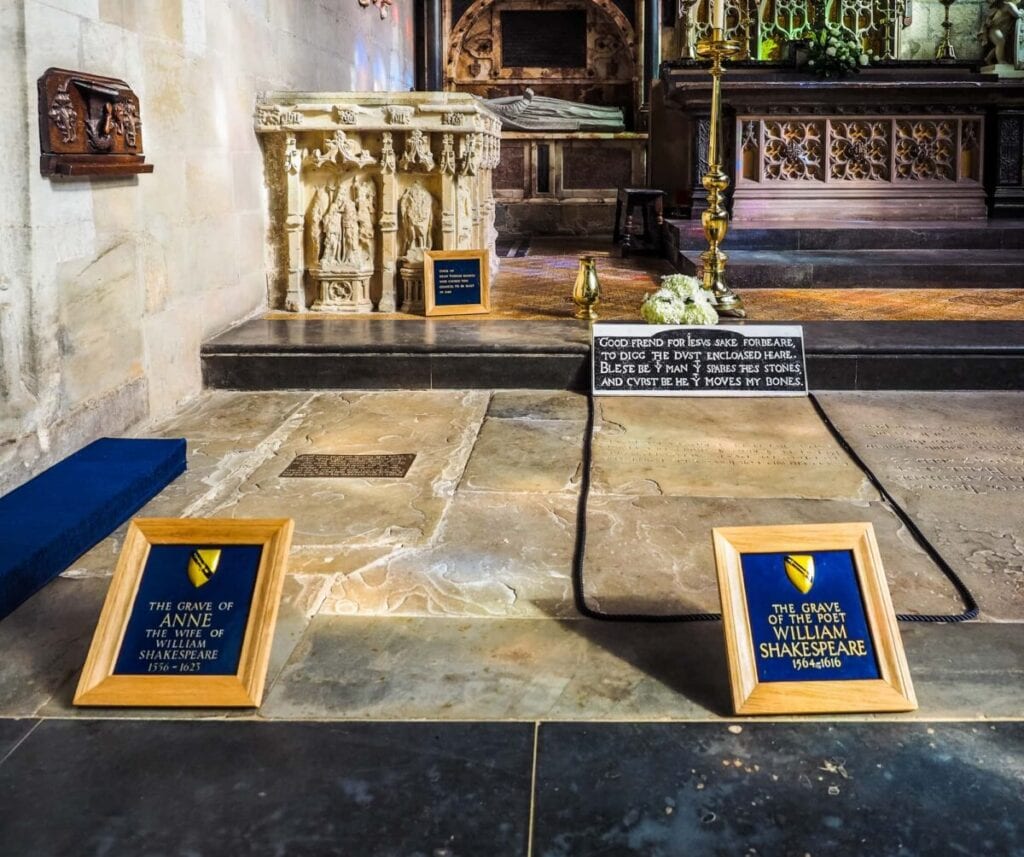
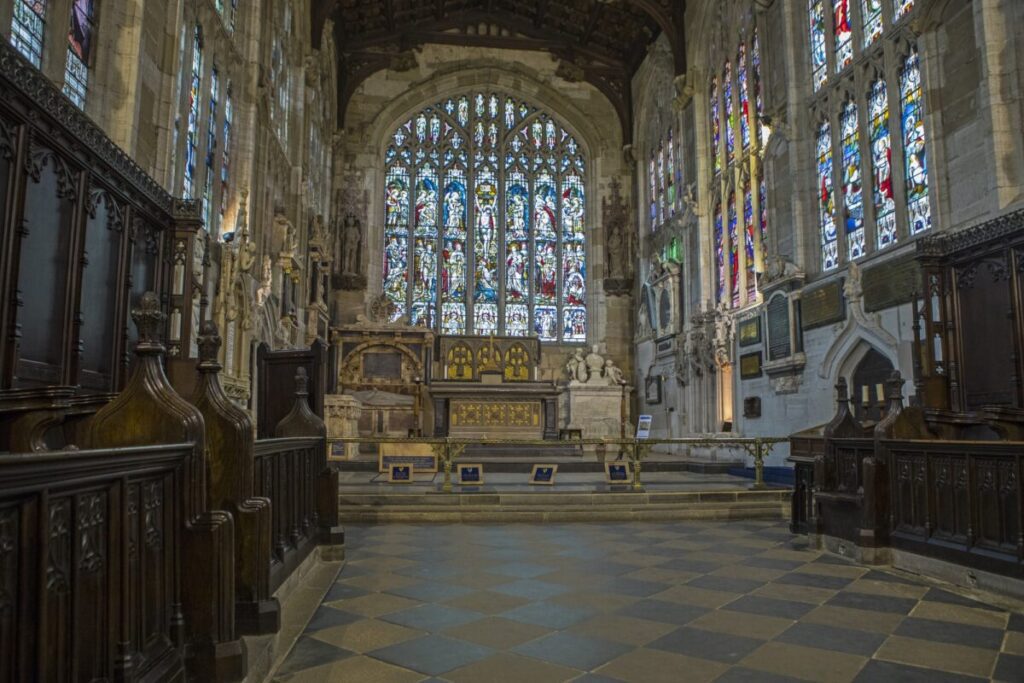
Holy Trinity Church was central to Stratford life during Shakespeare’s lifetime. He was baptised here, worshipped here, and was ultimately buried in the chancel.
Entry to the church is free, though a small donation is requested to view Shakespeare’s grave. His tomb bears the well-known inscription warning against disturbing his remains. The peaceful riverside setting adds to the atmosphere of the visit.

MAD Museum
The MAD (Mechanical Art & Design) Museum offers a modern contrast to Stratford’s Tudor history. This interactive museum features kinetic sculptures and mechanical art that combine science, engineering, and creativity. It is particularly popular with families. Check the official website for current ticket prices and opening times.

Canal Basin
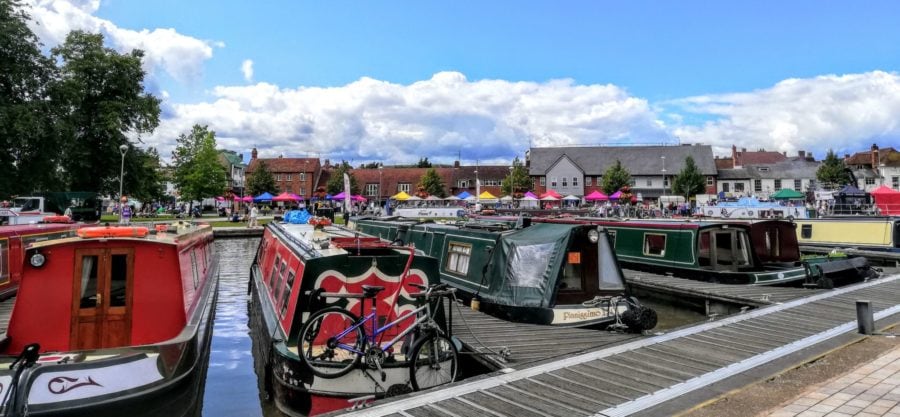
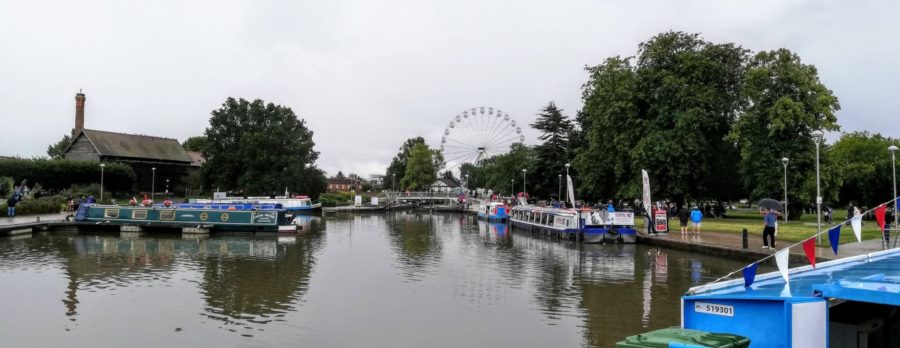
The canal basin, located between the Royal Shakespeare Theatre and the town centre, is a pleasant riverside area ideal for a walk or picnic. Markets, food stalls, and local craft displays often take place here.
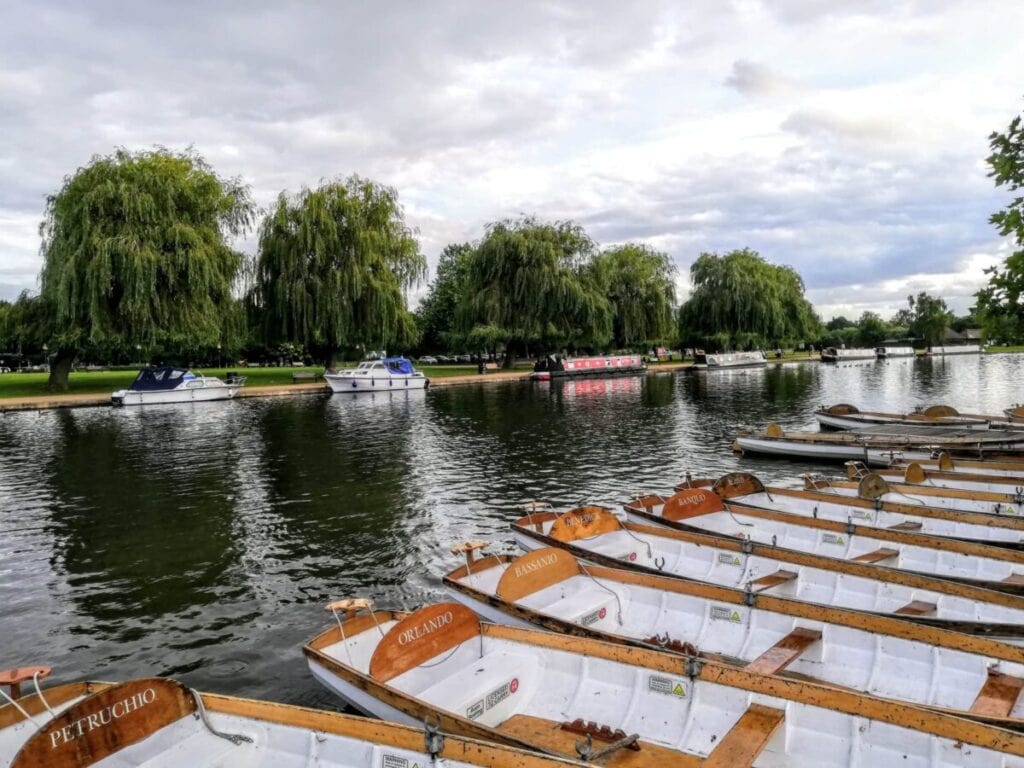
From the basin, visitors can hire rowing boats or join a river cruise along the Avon.
The Big Wheel
Seasonal attractions such as the Big Wheel offer elevated views across the River Avon, the Royal Shakespeare Theatre, and the surrounding countryside. Operating times vary, so check locally during your visit.
River Cruise on the Avon
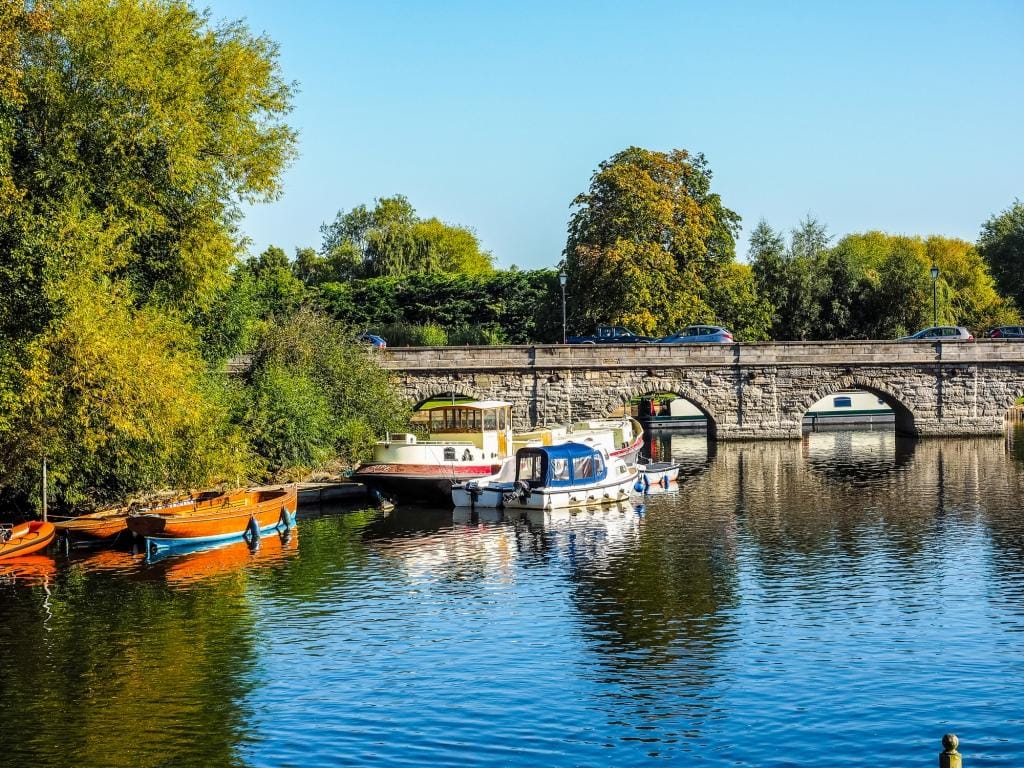
A river cruise provides a relaxing way to see Stratford from the water. Boats pass Holy Trinity Church, the Royal Shakespeare Theatre, and the landscaped riverbanks. Cruises vary in length and availability depending on the season.

Tudor World
Tudor World is housed in a 16th-century timber-framed building near the canal. The museum recreates aspects of daily life in Shakespeare’s era through immersive displays and interactive exhibits. Due to the historic nature of the building, expect uneven floors and low beams.

Stratford-upon-Avon Butterfly Farm
Located near the river, the Butterfly Farm features tropical plants, waterfalls, and free-flying butterflies within a large greenhouse environment. Educational displays explain butterfly life cycles, and additional insect exhibits make this a popular family attraction.

Almshouses
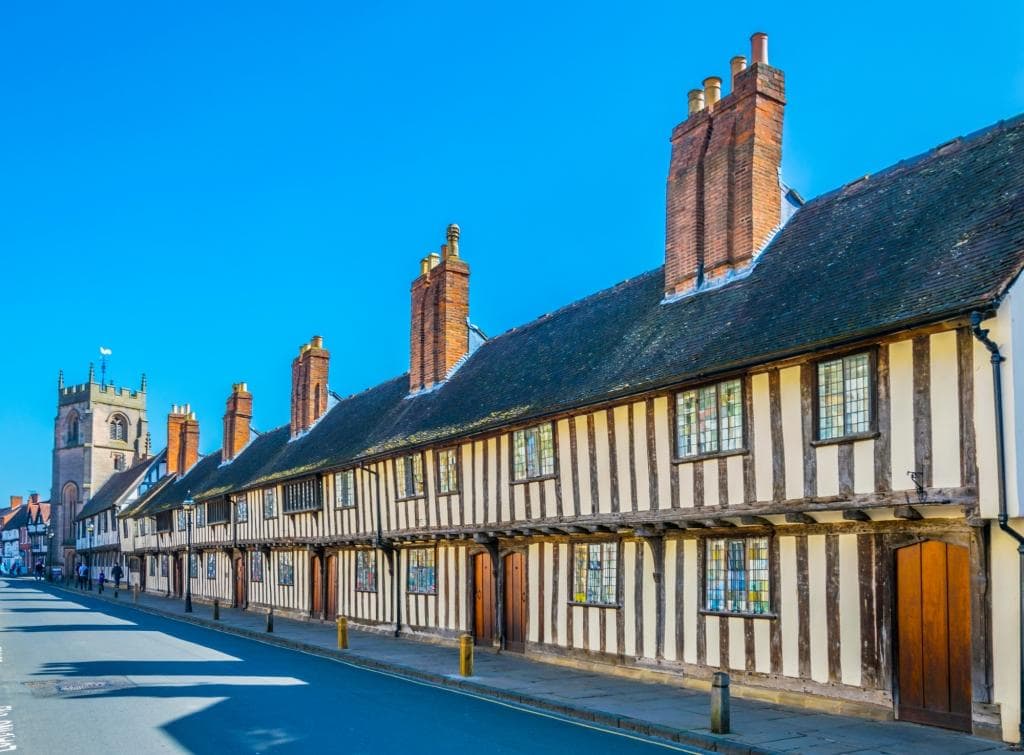
The Almshouses, founded in the early 15th century by the Guild of the Holy Cross, were originally built to support elderly townspeople. Although now converted into private residences, they remain an important architectural feature beside the Guild Chapel.

Harvard House
Harvard House is an ornate Elizabethan townhouse rebuilt after Stratford’s Great Fire of 1594. It was once owned by the ancestors of John Harvard, founder of Harvard University. The property is occasionally open to visitors; check the Shakespeare Birthplace Trust website for current access details.
Getting to Stratford-upon-Avon in England
Stratford-upon-Avon is a historic market town in Warwickshire which is very close to London and the drive is around 2.5 hours. It’s very easily accessible by public transport and by car. Although parking in Stratford-upon-Avon can be limited during peak season. Official visitor info: Visit Stratford’s site and the Tourist Information Centre by the Avon are helpful starting points.
Stratford -upon-Avon by car: Coming from London it’s a pretty straight run on the M40 into Warwickshire and then it is very well signed from there. For a break check out some of Warwickshire’s fantastic river-side pubs.
Stratford -upon-Avon by train: The Stratford -upon-Avon – train station (National Rail)] has direct links to trains from London including Marylebone and Birmingham New Street.
Stratford -upon-Avon by bus : Unfortunately the buses, although somewhat cheaper than trains take around 3 hours to get to Stratford, so unless you plan to stay over it could be a very long day. There are National Express coaches that run from London Victoria to Stratford upon Avon.
Getting Around Stratford-upon-Avon
Stratford-upon-Avon is compact and easy to explore on foot. Most major attractions including Shakespeare’s Birthplace, the Royal Shakespeare Company, Holy Trinity Church, and the canal basin are within walking distance of each other.
For visitors who prefer guided insight, the Stratford Town Walk and ghost tours offer an excellent introduction to the town’s history. Cycling and river cruises are also popular ways to see the area from a different perspective. My advice is to take the Hop on Hop Off bus which can get you to the places like Anne Hathaway’s Cottage which is just outside of Stratford.
Where to Eat and Drink in Stratford-upon-Avon
The Garrick Inn
Dating back to the 15th century, The Garrick Inn is one of Stratford-upon-Avon’s oldest pubs. Its timber-framed interior and traditional English menu make it a popular stop for visitors exploring the Shakespeare sites nearby. It can be busy in peak season, so reservations are recommended.

Barnaby’s Fish & Chips
Located near the canal basin, Barnaby’s serves classic British fish and chips in generous portions. It’s a convenient and informal option for a quick lunch or takeaway by the river.

The Countess of Evesham
For a more unusual dining experience, the Countess of Evesham offers lunch and dinner cruises along the River Avon. Meals are served onboard as the boat glides past Stratford’s riverside landmarks. Menus and pricing vary seasonally, so check the official website for current details.

Anne Hathaway’s Tea Rooms
Set in a historic building in the town centre, Anne Hathaway’s Tea Rooms specialises in traditional afternoon tea. It’s a relaxed spot for breakfast, light lunches, or a mid-afternoon break between attractions.

The Old Thatch Tavern
The Old Thatch Tavern claims to be Stratford’s oldest pub, dating from the 15th century. It serves traditional British dishes in a characterful historic setting just a short walk from the main Shakespeare attractions.

Where to stay in Stratford-upon-Avon
Most visitors base themselves in the town centre, within walking distance of the Shakespeare sites and the RSC and it’s worth it, since Stratford is compact enough that you won’t need a car once you’re settled. For a splurge with real theatre pedigree, The Arden Hotel sits directly opposite the Royal Shakespeare Theatre and is the RSC’s official accommodation partner. The White Swan Hotel, a Grade II listed coaching inn dating to 1450, is one of the oldest buildings in town and recently reopened after a full refurbishment.
Hotel Indigo Stratford is a good boutique option built around the town’s Tudor heritage, and Macdonald Alveston Manor offers a proper country-house stay complete with spa and pool just a short walk from the centre. Budget travellers should look at the YHA Stratford-upon-Avon hostel or one of the town’s many family-run B&Bs, several of which are a five-minute walk from Hall’s Croft and the river.

Stratford-upon-Avon is far more than a single Shakespeare attraction it is a town where history, theatre, and everyday life intersect. Whether you visit for literary inspiration, riverside walks, or traditional pubs, you can easily spend several days discovering its layers.
If you are in the area of Warwickshire County why not explore the riverside pubs or historic sites like Warwick Castle or Kenilworth Village and Castle.
You can read more about places to visit in my United Kingdom Travel Guide or check out Visiting Historic British Sites.
Accessibility note: Central Stratford is compact but can be crowded in peak season; most major sites provide accessibility information on their official pages check ahead for step‑free access and facilities.
Accessible UK Broader guide to accessible rail travel, National Trust accessibility schemes, and city-by-city notes.
Accessible London Compared to many older European capitals, London is genuinely one of the more accessible large cities you can visit.
Accessible Bath Discover how to explore an accessible Bath including the Roman Baths, and other attractions.
Accessible Cotswolds many of the lovely Cotswolds villages and towns are accessible.
Accessible Edinburgh Accessible Edinburgh travel is entirely possible, but it rewards realistic planning far more than an aggressive checklist.
Accessible Historic sites in England Discover accessible historical sites in England including castles, Roman ruins, cathedrals, museums, and heritage attractions with realistic tips for limited mobility and hidden disabilities.
Accessible York Explore the great city of York with tops for what sites are accessible and how to visit.